

Motion graphics ads are animated video assets that combine graphic design, typography, and visual effects to communicate a brand message without requiring a live-action shoot. For agency leads, the single most important commissioning decision is format first: lock the platform and aspect ratio before anything else, because that choice drives every downstream production spec.
- Primary business benefits: Motion graphics scale across campaigns without reshoots, and they simplify complex messages that static creative can't carry. A product explainer that would take three paragraphs of copy lands in eight seconds of animation.
- The format decision that determines specs: 9:16 for Instagram Reels, TikTok, and YouTube Shorts; 1:1 for LinkedIn and Facebook feed; 16:9 for YouTube long-form. Get this wrong and you're paying for recropping after delivery.
MINIM builds motion graphics campaigns from concept through final delivery, integrated directly with agency creative teams on a project basis.
Table of Contents
- Why do motion graphics ads outperform static creative in paid campaigns?
- What formats and specs should you order for each platform?
- Which creative style fits your campaign objective?
- What does a reliable production timeline look like?
- What should you budget for motion graphics production?
- How do you write a brief that actually works?
- When should you choose motion graphics over live action?
- What does a clean delivery checklist look like?
- How does MINIM help agencies execute motion graphics campaigns?
- Key Takeaways
- The case for treating motion graphics as infrastructure, not a one-off
- MINIM delivers motion graphics campaigns built for agency workflows
- Useful sources
Why do motion graphics ads outperform static creative in paid campaigns?
Motion graphics consistently outperform static posts in social engagement, and the operational reason is straightforward: animation stops the scroll in a way a still image rarely does. The movement triggers attention before the viewer has consciously decided to watch.
Beyond the scroll-stop effect, motion graphics do something static creative simply can't: they simplify complex value propositions by replacing dense text with animated visuals, and they require no physical crew, location, or cast. That removes the single biggest variable in live-action production timelines.
- Stop-the-scroll animation: Motion in a feed draws the eye before any copy is read.
- Simplified messaging: Abstract concepts, multi-step processes, and data-heavy claims become clear in seconds with animation.
- Rapid A/B testing: Because there's no location or cast to rebook, agencies can iterate hooks and CTAs at a fraction of live-action cost.
- Use cases: Paid social, product launch hero videos, product overlay demos, explainer content, and internal communications.
Pro Tip: Brief your vendor to deliver a "master concept" plus platform crops simultaneously. One animation concept, exported as 9:16, 1:1, and 16:9 variants, gives your media team three placements from a single production budget.
What formats and specs should you order for each platform?
Format and duration are the production rules that determine cost and turnaround time. Brief a vendor without these locked and you'll get a revision request before a single frame is animated.
Animated social clips perform best under 15 seconds for Reels and TikTok, and up to 30 seconds for LinkedIn. YouTube pre-roll has more flexibility, but anything over 30 seconds needs a strong hook in the first five.
| Platform | Aspect Ratio | Ideal Duration | Deliver As |
|---|---|---|---|
| Instagram Reels / TikTok | 9:16 | 7–15 sec | MP4 |
| YouTube Shorts | 9:16 | 15–30 sec | MP4 |
| LinkedIn Feed | 1:1 | 15–30 sec | MP4 |
| Facebook Feed | 1:1 or 16:9 | 15–30 sec | MP4 |
| YouTube Long-Form / Pre-Roll | 16:9 | 15–30 sec pre-roll | MP4 |
| Presentations / OOH Screens | 16:9 | Variable | ProRes or MP4 |
Required delivery variants for every campaign:
- Master edit at highest resolution (ProRes or uncompressed)
- Platform-specific crops (9:16, 1:1, 16:9)
- H.264 web exports for each variant
- SRT caption files and/or burned-in caption versions
- Portrait thumbnail and poster frame assets
Which creative style fits your campaign objective?
Match the creative format to the communication job. Trying to explain a SaaS product with a cinematic 3D render, or using a flat 2D loop for a premium brand launch, both miss the mark.
Common motion-graphics formats each serve a distinct campaign function:
- 2D motion graphics: The workhorse. Clean, fast to produce, and ideal for explainers, social ads, and data visualization. Works across every budget tier.
- 3D motion graphics: High-impact for product reveals, brand films, and premium launches. Longer production time and higher cost, but the visual authority is hard to replicate.
- Kinetic typography: Text animated to music or voiceover. Exceptionally effective for manifesto-style brand spots and awareness campaigns. The BT Black Friday kinetic typography project is a strong reference: tight synchronization between typographic velocity and a custom music edit drove unusually high message retention.
- Logo animations: Short, versatile, and reusable across every deliverable. Brief these as a standalone asset, not an afterthought.
- UI/UX demos: Screen recordings with motion-graphics overlays. The go-to format for SaaS, app launches, and product walkthroughs.
Style briefing anchor: Before your first vendor call, pull three reference examples that represent the visual register you want — one for pacing, one for typography, one for color treatment. Vendors who ask for references before quoting are the ones worth working with.
What does a reliable production timeline look like?
A well-run motion-graphics production pipeline minimizes review loops by front-loading decisions. The most expensive revision is the one that happens after animation has started.
- Brief and scope (1–2 days): Objective, platform specs, brand assets, and legal/IP notes confirmed in writing.
- Creative concept (2–4 days): Styleframes, color direction, and typography treatment. Approve before any animation begins.
- Animatic / storyboard (2–3 days): Rough motion test showing timing and flow. This is the cheapest point to change direction.
- Animation (3–7 days): Full production. Duration and complexity drive this range.
- Sound design and music (1–2 days): Music licensing should be confirmed at brief stage, not here.
- QA and delivery (1–2 days): Codec checks, caption sync, platform crop review.
Typical specialist roles on a vendor team:
- Producer (scope, timeline, client comms)
- Art director (visual concept and styleframes)
- Motion designer (animation execution)
- Compositor (VFX, 3D integration, finishing)
- Sound designer (music edit, SFX, mix)
- QA/encoder (file delivery and technical review)
Build two structured revision rounds into your SOW: one after the animatic, one after the first animation cut. Late-stage changes to animation, after the animatic is approved, should trigger a change-order conversation.
What should you budget for motion graphics production?
Price is driven by three variables: animation complexity, duration, and the number of deliverable variants. A 10-second 2D social ad and a 30-second 3D brand film are not the same product.
- Entry-level (simple 2D, templated motion, single format): pricing varies depending on asset complexity.
- Mid-tier (custom 2D, kinetic typography, multi-platform crops): costs depend on campaign scope and complexity.
- Premium (3D, custom illustration, VFX, full sound design): typically higher-cost projects reflecting increased production complexity.
Primary cost drivers: 3D rendering time, custom illustration, licensed music or voice talent, number of revision rounds, and the volume of platform variants. Billing models vary: fixed-fee per deliverable is standard for defined scopes; day rates apply for senior talent on open-ended projects; retainer arrangements suit agencies running ongoing content programs across multiple clients.
How do you write a brief that actually works?
A clear brief cuts vendor back-and-forth by half. The one-line format: "We need a [duration] [format] for [platform], communicating [primary message] to [audience], with [CTA], delivered by [date]."
Brief template fields:
- Campaign objective and KPI
- Target audience and platform placement
- Primary message (one sentence)
- Desired CTA
- Visual references (3 minimum)
- Brand assets (logos, fonts, color codes, existing footage)
- Legal/IP notes (licensed music, talent releases, trademark restrictions)
- Technical deliverables (formats, aspect ratios, caption requirements)
12 questions to ask every motion-graphics vendor:
- What's your standard revision policy, and what triggers a change order?
- Do you deliver source project files (After Effects, Premiere) at handoff?
- How do you handle music licensing — sync licenses or royalty-free libraries?
- What's your animatic approval process before full animation begins?
- Can you deliver platform crops within the original quote?
- What codec and container do you deliver masters in?
- Do you provide SRT caption files or burned-in captions, or both?
- What's your typical turnaround for a [specific format] at this complexity level?
- Who is the primary point of contact during production?
- How do you handle brand asset management across multiple campaigns?
- What's your process if a deliverable fails QA after handoff?
- Have you worked within an agency workflow before, and how do you handle multi-stakeholder approvals?
When should you choose motion graphics over live action?
Choose motion graphics when scale, speed, or abstract explanation matter. Choose live action when authenticity, real people, or physical product texture are the campaign's core argument.
- Motion graphics: Product demos, SaaS explainers, data-driven campaigns, rapid A/B testing, multi-market localization, tight timelines.
- Live action: Testimonials, lifestyle brand films, food and beverage, anything where a real human face drives trust.
- Hybrid: Live-action footage with motion-graphics overlays. Effective for product UI demos layered over real-world usage footage, or for adding kinetic typography and data callouts to interview-style content.
When live action is involved, lighting and set planning become a separate budget line. Fixture selection, beam angles, and crew add both cost and schedule that motion-graphics workflows simply don't carry.
What does a clean delivery checklist look like?
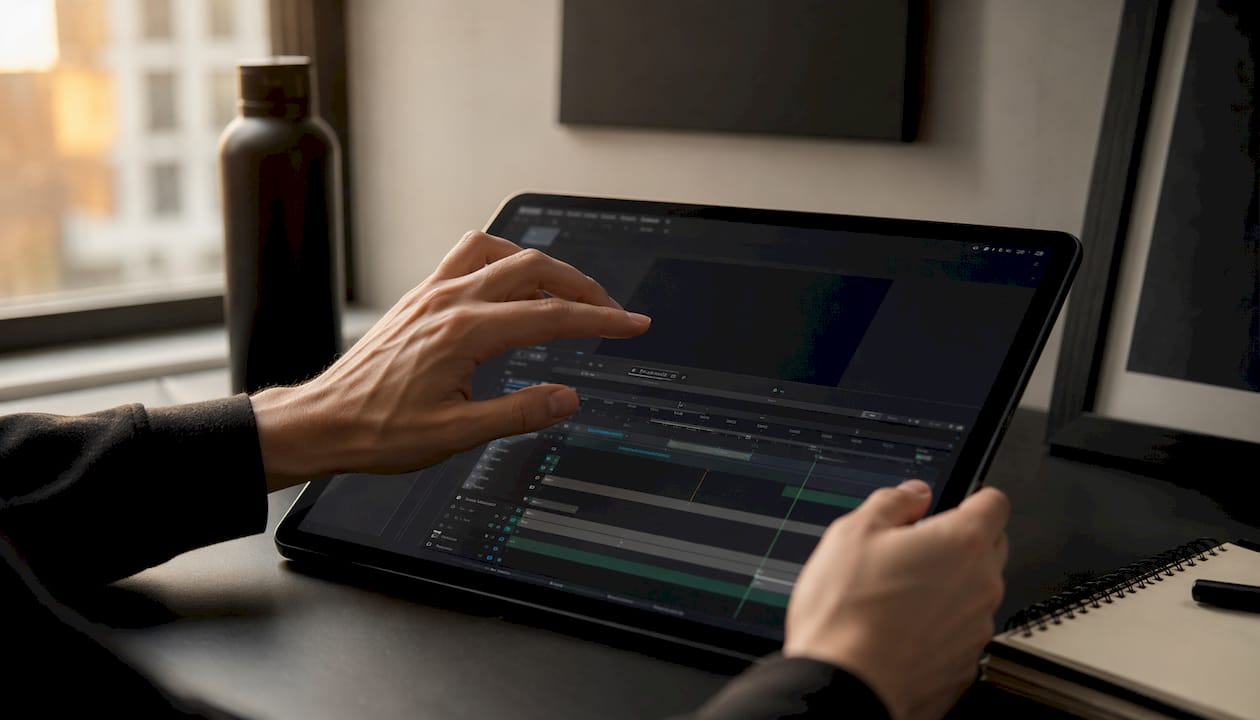
Request master files, platform variants, captions, and source project files in your SOW. A delivery that arrives without these requires a follow-up production cycle.
Required files and metadata at handoff:
- Master file: ProRes 4444 or uncompressed at full resolution
- H.264/HEVC exports for each platform variant
- Square and vertical crops confirmed against platform specs
- SRT caption file and burned-in caption version
- Poster frame / thumbnail at correct platform resolution
- Source project files (After Effects, Premiere, Figma) if specified in SOW
Naming convention example: [ClientName]_[CampaignName]_[Format]_[AspectRatio]_[Version].mp4
Example: Acme_LaunchQ1_SocialAd_9x16_v2.mp4
SRT captions are preferable for flexibility; burned-in captions are required for platforms that don't support external caption files. Agencies that require source files at handoff shorten future refresh cycles and reduce vendor rework costs significantly.
How does MINIM help agencies execute motion graphics campaigns?
MINIM operates as an integrated production partner for agencies, embedding with creative teams rather than functioning as a standalone vendor. The distinction matters: MINIM handles concept through delivery, which means agency leads aren't managing a handoff chain across separate strategy, design, and post-production vendors.
MINIM's production capabilities span 2D and 3D visual effects, brand design, art direction, screenwriting, and in-house studio services. For agencies running multi-format campaigns, that breadth means a single brief can produce a full suite of platform-ready assets without scope creep across multiple suppliers.
What agencies gain from an integrated production model: fewer approval loops, consistent visual language across formats, and a production team that already understands agency review cadences and client-facing deliverable standards.
Client outcomes from MINIM engagements include reduced turnaround on multi-format campaigns, higher ad engagement from platform-optimized creative, and cleaner approval processes built around structured animatic reviews. See the MINIM work portfolio for project examples across commercial video, brand campaigns, and VFX work.
Key Takeaways
Motion graphics ads deliver the best ROI for agencies when format, duration, and delivery specs are locked before production begins, and when a structured brief drives the vendor relationship from day one.
| Point | Details |
|---|---|
| Format first | Lock aspect ratio and platform before briefing any vendor — it determines every production spec. |
| Brief clarity cuts cost | A one-sentence brief format plus 12 vendor questions eliminates most scope disputes before they start. |
| Request the animatic | Approve timing and flow before full animation begins — it's the cheapest point to change direction. |
| Budget by complexity | Entry-level 2D pricing varies; premium 3D campaigns are higher cost and scale with complexity. |
| MINIM as production partner | MINIM integrates with agency teams from concept through delivery, covering 2D/3D VFX, brand design, and multi-format campaign execution. |
The case for treating motion graphics as infrastructure, not a one-off
The agencies I see getting the most out of motion graphics production aren't treating it as a project-by-project expense. They've built it into their workflow the same way they handle media buying: a defined process, a trusted vendor relationship, and a brief template that travels with every campaign.
The operational shift that changes everything is moving the format decision upstream. When aspect ratio and platform specs are confirmed before creative concepting begins, the entire production pipeline tightens. Revision cycles shrink because the vendor isn't guessing at delivery requirements. Approvals move faster because the animatic stage catches timing and messaging issues before they're baked into animation.
Version control is the other thing most agencies underestimate. Requiring source project files at handoff isn't a nice-to-have; it's the difference between a 30-minute refresh and a full repro. Build it into every SOW from the start, and you'll recover that cost on the second campaign.
MINIM delivers motion graphics campaigns built for agency workflows
Agencies that need premium motion graphics production without adding headcount have a direct option: MINIM handles the full production scope, from creative concept and styleframes through animation, sound design, and platform-ready delivery, integrated with your existing team and review process.
MINIM's production model is built for agencies running multi-format campaigns across paid social, brand film, and product content. No separate strategy vendor, no disconnected post-production team. One partner, one brief, full delivery. Review MINIM's production capabilities and current work, then reach out to start a project conversation.
Useful sources
- PlayPlay: Motion Graphics Examples — Platform format guidance, duration benchmarks, and motion-graphics type definitions. Check for updated platform spec notes as algorithm preferences shift.
- Electric Palm Trees: BT Black Friday Kinetic Typography — Production reference for kinetic typography technique, music synchronization, and creative execution. Useful as a briefing reference for typography-led campaigns.
- 299 Lighting: Commercial Lighting Design Guide — Relevant when hybrid or live-action production is in scope; covers lighting planning, fixture selection, and budget considerations for on-set work.
- MINIM Skills Page — Full breakdown of MINIM's production capabilities, from 2D/3D VFX to brand design and in-house studio services.
- MINIM Work Portfolio — Project examples across commercial video, brand campaigns, and VFX; useful for evaluating range and production quality before a brief conversation.
Recommended
- Our Services | Enhance Your Brand Today — MINIM | Content Production Company
- Our Services (Copy) | Elevate Your Brand Today - Explore Our Services — MINIM | Content Production Company
- Work | Elevate Your Content — Get Started Today — MINIM | Content Production Company
- MINIM | Content Production Company