

Outsourcing video production is usually the fastest way for marketing teams to scale quality video output without adding headcount. The decision ladder is simple: if you need a single-format deliverable on a tight budget, hire a freelance video producer through a platform like ProductionHUB or Freelancer.com. If you need episodic content or higher production value, a boutique crew gives you more firepower without full agency overhead. For campaign-scale work where brand alignment, creative strategy, and reliable execution all matter, a full-service production partner like MINIM is the right call.
Table of Contents
- What does outsourcing video production actually mean?
- When should you outsource video production?
- Which video formats do teams typically outsource?
- How do freelancers, boutique crews, and full-service partners compare?
- How do you hire and manage an outsourced video project?
- What should you look for when evaluating a production partner?
- What does outsourced video production cost?
- What mistakes do teams make when outsourcing video?
- How do you keep production moving once the project starts?
- When does a strategic production partner make more sense than a freelancer?
- Key Takeaways
- The brief is the production
- MINIM brings your campaigns to life without the overhead
- Useful resources for hiring and managing video production
What does outsourcing video production actually mean?
"Outsourcing video production" covers a wide range of engagement models, and picking the wrong one wastes time before the first frame is shot. The four models you'll encounter most often:
- Full-service production: The partner handles everything from creative brief through final delivery, including concept, scripting, crew, shoot, and post. Best for product launch campaigns, hero brand films, or any project where you need a single accountable team. This is where MINIM's production capabilities sit.
- Editorial or post-only: You supply the footage; the vendor handles editing, color, sound, and motion graphics. Cost-efficient for teams that shoot in-house but lack post-production depth. Outsourcing video editing this way frees internal staff to focus on strategy rather than timeline assembly.
- White-label or agency partnership: A production company works under your brand or your client's brand, with no public credit. Common in agency environments where the client relationship stays with you. Requires a formal NDA and explicit contract language on IP and portfolio usage before any brand assets change hands.
- Staff augmentation: You embed a specialist (director, editor, motion designer) into your existing workflow for a defined period. Useful when you have a production infrastructure but a skills gap on a specific project.
Each model sits at a different point on the control-cost-speed spectrum. Full-service gives you the least day-to-day control but the most output; post-only gives you maximum control over the source material but requires you to manage the shoot yourself.
When should you outsource video production?
The core benefits of outsourcing are well-documented: access to specialist skills and equipment, on-demand scalability, faster time to market, and predictable per-project costs instead of fixed salaries. For marketing teams, the practical upside is that you get a cinematographer, colorist, and motion designer on one project without hiring three people full-time.

A hybrid approach tends to be the most cost-effective long-term strategy: outsource high-end production while keeping light-touch social edits in-house. That way your internal team owns the brand voice and quick-turn content, and the external partner handles anything that requires a crew, a location, or specialized post work.
Four signals that say "outsource now" rather than later:
- Your team is producing more briefs than it can execute without quality slipping.
- An upcoming campaign requires equipment or crew your team doesn't own (cinema cameras, drone operators, motion capture).
- You have a hard deadline and no production bandwidth to meet it.
- The project is high-stakes enough that a production mistake would damage the brand.
If two or more of those apply, the math almost always favors outsourcing over stretching internal resources.
Which video formats do teams typically outsource?
Not every format needs the same provider. Here's how common deliverables map to provider type:
- Hero campaign spots and brand films: Full-service partner. These require creative strategy, multi-day shoots, and polished post. One-off freelancers rarely have the project management depth to hold a campaign together.
- Product explainer videos (60–180 seconds): Boutique crew or full-service partner, depending on whether animation is involved. Animated explainers often go to specialist studios.
- Social ads (15–60 seconds): Freelancer or boutique crew for straightforward shoots; full-service partner when the ad needs to match a broader campaign system.
- Customer case studies and testimonials: Boutique crew. These are interview-driven, lower-complexity shoots where a two- or three-person crew is sufficient.
- Training and internal communications videos: Editing-only vendor or freelancer. Production values matter less; clarity and pacing matter more.
- Event coverage: Freelance videographer or boutique crew. Usually a day-rate engagement with a defined deliverable (highlight reel, full session recordings).
- Animated explainers and motion graphics: Specialist animation studio or a full-service partner with in-house motion capability, like MINIM.
Formats that benefit from a retained relationship rather than a one-off hire: hero campaign spots, social ad series, and any content that needs to stay visually consistent across multiple releases. Episodic work almost always gets better and faster after the first two or three projects, once the partner understands your brand system.
Pro Tip: For gym and fitness brands running location-based campaigns, video content in local advertising follows the same outsourcing logic — a boutique crew handles the shoot while a full-service partner manages the campaign system.
How do freelancers, boutique crews, and full-service partners compare?
| Provider type | Best for | Cost range | Strengths | Limitations |
|---|---|---|---|---|
| Freelance video producer | Single deliverables, tight budgets | $ | Speed, flexibility, low overhead | You manage coordination; quality varies |
| Boutique production crew | Mid-budget projects, episodic content | $$ | Higher production value, focused team | Limited bandwidth for large campaigns |
| Full-service production partner | Campaign-scale, brand-aligned work | $$$ | End-to-end execution, creative strategy, scalability | Higher cost; requires a clear brief to unlock value |

Full-service partners are differentiated by their ability to integrate into client workflows and manage the complex logistics that a solo freelancer struggles to coordinate: casting, location scouting, crew scheduling, multi-format delivery, and brand governance across a campaign series. For a single explainer video, that infrastructure is overkill. For a six-spot campaign with a broadcast deadline, it's the only model that reliably holds together.
MINIM sits at the full-service end of this matrix, operating as a strategic production partner for agencies and brand teams that need cinematic campaign execution without expanding internal headcount. The engagement model is project-based, so you get the capabilities of a full production department without the overhead of one.
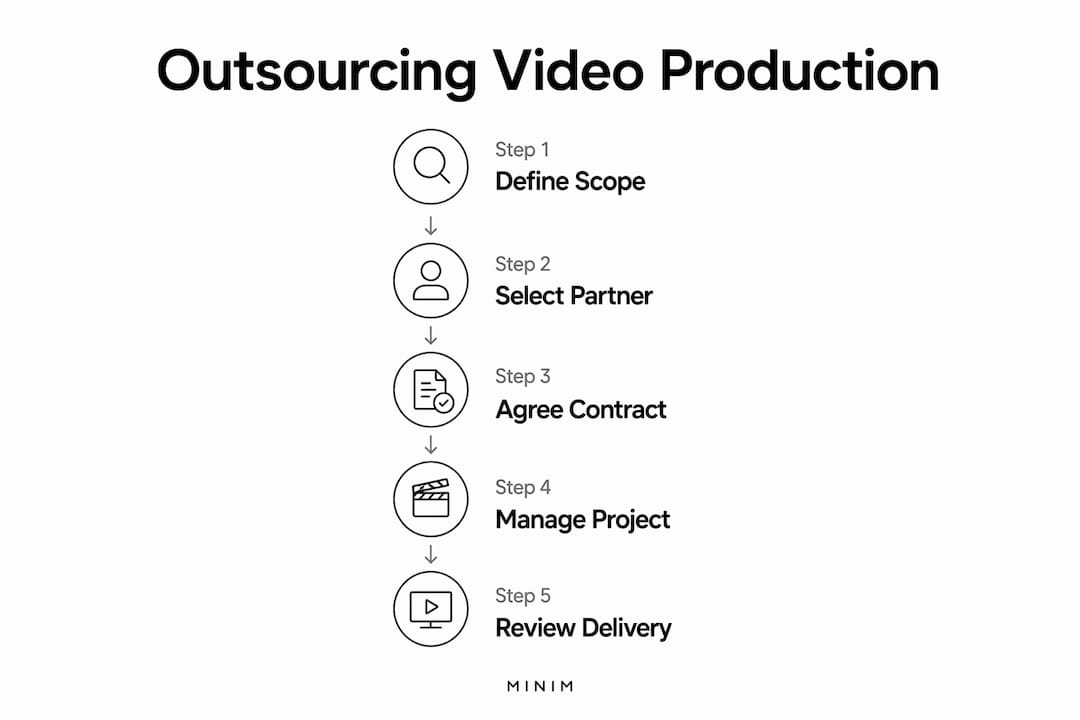
How do you hire and manage an outsourced video project?
A reproducible process prevents the two most common problems: scope creep and missed deadlines. Work through these steps in order.
- Define objectives and KPIs. What does success look like? View-through rate, conversion lift, brand recall? A vague goal produces a vague brief, which produces a vague video.
- Scope deliverables precisely. Number of final cuts, aspect ratios, lengths, language versions, and platform specs. Every undefined deliverable becomes a change order later.
- Set a budget and pricing model. Decide whether you're working on a fixed project fee, a day rate, or a retainer before you shortlist anyone. Mixing models mid-project creates friction.
- Shortlist candidates. Use platforms like Upwork or Freelancer.com for freelancers; direct outreach or referrals for boutique crews and full-service partners.
- Review portfolios and ask the right questions. Request work in your specific format and industry. Ask how they handle revision cycles, what their standard turnaround is, and who owns the final files.
- Run a paid pilot. A short paid test deliverable (a 30-second cut, a style frame, a rough assembly) tells you more about a partner's working style than any proposal.
- Onboard with a formal brief. The brief is the contract's creative counterpart. Ambiguous scope is the leading cause of budget overruns. A solid brief includes: objective, target audience, tone and style references, video length and specs, mandatory assets (logo, music, voiceover), KPIs, approval stakeholders, and deadline.
- Set production milestones with sign-offs. Pre-production approval, shoot day, rough cut, fine cut, final delivery. Each milestone requires a written sign-off before the next phase begins.
- Manage review cycles. Define how many rounds of revisions are included, who has final approval authority, and how feedback is delivered (time-stamped notes in a review tool, not email chains).
- Confirm delivery specs before the final export. Codec, resolution, frame rate, color space, and file naming conventions. Getting this wrong at the end costs a day of re-exports.
What should you look for when evaluating a production partner?
Portfolio evaluation
Watch full pieces, not just showreel highlights. A showreel is curated to impress; a full piece shows pacing, storytelling structure, and how the team handles the middle of a video, not just the opening five seconds. Look for: consistent production quality across multiple projects, relevant category experience (a B2B SaaS explainer and a consumer brand film are different crafts), and evidence that the work performed in the format you need.
Contract essentials
Every engagement should include a written scope of work, a deliverables list with specs, a revision policy (number of rounds, what constitutes a revision), turnaround times per milestone, a payment schedule tied to milestones, and explicit IP ownership language. The default in most production contracts is that the vendor retains copyright until final payment. Make sure the contract transfers all rights to you on payment.
For white-label and agency partnerships, require a formal NDA and define portfolio-use rules explicitly. Do not assume the vendor won't feature your client's work in their own portfolio unless the contract says so.
Red flags
Vague timelines ("we'll get it to you soon"), no references from comparable projects, unwillingness to sign an NDA, no stated revision policy, and unexplained price gaps between bids are all worth investigating before you sign. A vendor who can't explain why their quote is 40% below the next bidder usually can't explain it because they haven't fully scoped the work.
What does outsourced video production cost?
Pricing models vary by engagement type. Freelancers typically work on hourly or day rates; boutique crews on fixed project fees; full-service partners on project fees or retainers. Post-production specialists often charge per finished minute of edited content.
Budget ranges by production tier
| Budget line | Entry tier | Mid tier | Premium tier |
|---|---|---|---|
| Pre-production (script, storyboard, planning) | $500–$1,500 | $2,000–$5,000 | $5,000–$15,000+ |
| Shoot day (crew, director) | $1,000–$3,000/day | $3,000–$8,000/day | $8,000–$25,000+/day |
| Equipment (camera, lighting, sound) | $300–$800/day | $800–$2,500/day | $2,500–$8,000+/day |
| Post-production (edit, color, sound) | $500–$2,000 | $2,000–$6,000 | $6,000–$20,000+ |
| Motion graphics / animation | $500–$2,000 | $2,000–$8,000 | $8,000–$30,000+ |
| Music licensing | $50–$300 | $300–$1,500 | $1,500–$5,000+ |
What does a 3-minute brand or product video actually cost?
At the entry tier (a freelance producer, a one-person crew, minimal post), expect $3,000–$8,000 all-in. At the mid tier (boutique crew, two shoot days, professional edit and color), $12,000–$30,000 is a realistic range. At the premium tier (full-service partner, multiple locations, actors, VFX, broadcast-ready delivery), $40,000–$100,000+ is not unusual for a polished brand film.
The biggest cost drivers are number of shoot days, actor and talent fees, location costs, and the complexity of post-production. A clean interview-driven case study with b-roll costs far less than a scripted narrative spot with actors and a custom score.
A hybrid model, where you outsource the high-end production and handle social cut-downs in-house, often cuts total campaign spend by 30–40% without sacrificing the quality of the hero asset.
What mistakes do teams make when outsourcing video?
The most expensive mistake is starting production without a locked brief. The second most expensive is skipping the paid pilot. After those two, the pattern is usually the same: unclear revision policies lead to unlimited feedback rounds, which blow the timeline; missing IP clauses mean the vendor retains rights to footage you paid for; and underestimating review cycles means the final delivery lands a week after the campaign launch date.
Quick fixes:
- Write the brief before you contact anyone. A one-page brief with objective, audience, tone, specs, and KPIs filters out mismatched vendors before you spend time on calls.
- Run a paid pilot on any new vendor relationship. A $500–$1,500 test deliverable is cheap insurance against a $30,000 disappointment.
- Lock revision rounds in the contract. Two rounds of consolidated feedback is standard. Anything beyond that is a change order.
- Read the IP clause before you sign. If the contract doesn't explicitly transfer all rights to you on final payment, add that language before you proceed.
- Set milestone sign-offs. A written approval at pre-production, rough cut, and fine cut prevents the "we need to go back to the script" conversation after three weeks of shooting.
Red-flag vendor behaviors worth walking away from: overpromising turnaround times without a clear production schedule, inability to show relevant work in your format, and resistance to any contract language around IP or NDAs.
How do you keep production moving once the project starts?
File structure and delivery formats
Agree on naming conventions and folder structure before the first file is shared. A simple standard (ProjectName_AssetType_Version_Date) prevents the "final_FINAL_v3_USE THIS" problem. Specify delivery formats upfront: codec (H.264 or ProRes for most digital work), resolution, frame rate, and color space. For broadcast work, confirm technical specs with the network or platform before production begins.
Review and feedback workflow
Consolidate all feedback in a single review pass per round. Scattered notes from five stakeholders arriving at different times is the fastest way to extend a timeline. Tools like Frame.io allow time-stamped, in-context comments directly on the video, which cuts the back-and-forth of email-based feedback significantly. Assign one internal approver with final sign-off authority. Multiple people with veto power and no clear hierarchy is a reliable recipe for a delayed delivery.
Picture lock is the moment the edit is approved and no further structural changes are permitted. Call it out explicitly in your milestone schedule. Changes after picture lock (color, sound, graphics) are manageable; changes to the edit structure after picture lock are expensive.
Pro Tip: For remote production teams, use a shared cloud folder (Google Drive, Dropbox, or Frame.io) with a clearly labeled "APPROVED" subfolder. When an asset moves into that folder, it's locked. This single convention eliminates most version-control confusion.
Version control for multi-format campaigns
If the project produces multiple aspect ratios or language versions, treat each as a separate deliverable with its own approval chain. A 16:9 master approved for broadcast is not automatically approved for a 9:16 social cut. Build that into your milestone schedule from the start.
When does a strategic production partner make more sense than a freelancer?
The answer usually comes down to complexity and stakes. A freelancer is the right call for a single deliverable with a clear scope and a flexible timeline. A strategic partner is the right call when the work involves multiple formats, multiple markets, a tight deadline, or brand-sensitive execution where a production mistake has real consequences.
MINIM operates as exactly that kind of partner. The engagement model runs from brief through concept, production, post, and final delivery, with the team integrating directly into your agency or brand workflow rather than operating as a separate vendor you have to manage. The MINIM portfolio covers commercial campaigns, brand films, 2D/3D visual effects, photography, and content marketing, all executed under a single production relationship.
For agencies managing multiple client campaigns simultaneously, that integration matters. You're not coordinating a freelancer, a post house, and a motion studio separately. One partner owns the whole chain, which compresses timelines and reduces the coordination overhead that typically eats 20–30% of a project manager's time on complex productions.
The situations where MINIM's model fits best: campaign series that need visual consistency across multiple releases, multi-market shoots with complex logistics, brand-sensitive work where creative strategy and execution need to stay aligned, and any project where the agency needs to present polished, cinematic work to a client without the overhead of building a production department.
Key Takeaways
Outsourcing video production works best when you match the provider type to the project's complexity, budget, and stakes, then lock the brief before any production begins.
| Point | Details |
|---|---|
| Match provider to complexity | Use freelancers for single deliverables, boutique crews for episodic work, and full-service partners for campaign-scale projects. |
| Lock the brief first | Ambiguous scope is the leading cause of budget overruns; a one-page brief with objective, specs, and KPIs prevents most problems. |
| Run a paid pilot | A short test deliverable on any new vendor relationship is cheap insurance before committing to a full production budget. |
| Secure IP in the contract | Confirm all rights transfer to you on final payment; never assume ownership without explicit contract language. |
| MINIM for campaign-scale work | MINIM integrates directly with agency creative teams to deliver cinematic campaigns from brief through final delivery on a project basis. |
The brief is the production
Most outsourcing problems trace back to the same root: the brief was vague, or it didn't exist at all. A vendor can only execute what they understand, and what they understand is exactly what you wrote down. The teams that get the best work out of external partners aren't the ones with the biggest budgets. They're the ones who show up to the first call with a clear objective, a defined audience, a reference reel, and a realistic timeline.
There's a tendency to treat the brief as a formality, something to dash off before the "real" work of production begins. That's backwards. The brief is the production. Every hour spent sharpening it saves three hours of revision cycles later. The best production partners will push back on a weak brief before they start, not after. If a vendor never asks a clarifying question, that's worth noticing.
The other thing teams consistently underestimate is the value of a retained relationship. The first project with any new partner carries a learning curve. By the third project, the partner knows your brand, your approval process, and your stakeholders. That institutional knowledge compounds. A partner who has produced six campaigns for you will outperform a new hire on the seventh, every time.
MINIM brings your campaigns to life without the overhead
When your agency or brand team needs cinematic production quality without the cost of building an internal department, MINIM is the production partner built for that gap. From creative strategy and screenwriting through film, photography, 2D/3D visual effects, and final delivery, MINIM integrates directly with your creative team and executes at the level your clients expect.
Every engagement is project-based, so you get full-service production firepower without a long-term contract or unused retainer. The MINIM services overview covers the full range of production and creative capabilities. If you're ready to see what campaign-grade execution looks like for your format, start the conversation with a scoping call or share your brief directly.
Useful resources for hiring and managing video production
A short list of platforms, tools, and references worth bookmarking:
- ProductionHUB: A production-specific directory for finding vetted crew, directors, and production companies in the U.S. More specialized than general freelance marketplaces.
- Upwork — Video Producers: A broad freelance marketplace useful for sourcing editors, motion designers, and producers for defined-scope projects. Requires careful vetting; review full portfolios and client feedback before hiring.
- Freelancer.com — Video Production: Competitive bidding platform for freelance video producers across formats and budgets. Milestone Payments protect spend until deliverables are approved.
- UPRISER: AI-enabled video personalization and delivery workflows for teams exploring personalized video at scale.
- MINIM portfolio and case studies: Campaign work across commercial, brand film, and content marketing formats, useful for benchmarking production quality before briefing a full-service partner.
- Frame.io: The industry-standard review and approval tool for video production. Time-stamped comments, version control, and client-facing review links replace email-based feedback entirely.