

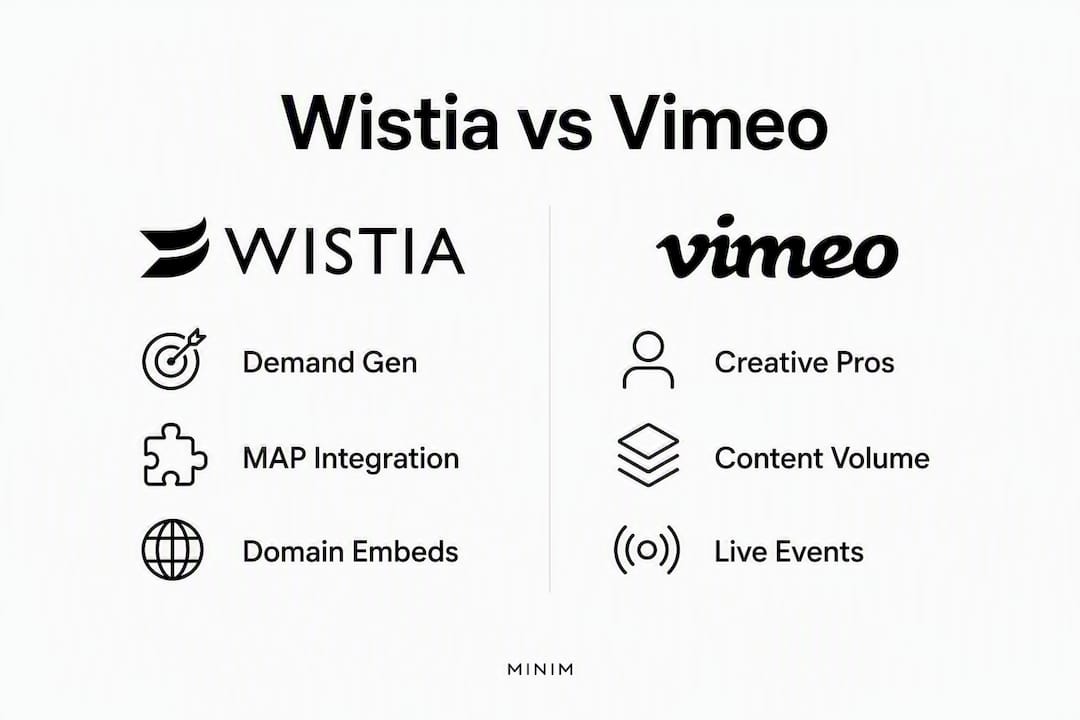
Pick Wistia when video is a primary lead signal feeding HubSpot, Marketo, or Pardot. Pick Vimeo when the brief calls for high-volume hosting, polished portfolio delivery, or recurring live events. The fastest way to validate the choice with a client: ask one question before scoping anything. "Will watch behavior trigger a lead score or automation in your MAP?" A yes points to Wistia. A no, or a blank stare, points to Vimeo. MINIM runs this exact diagnostic at the start of every platform engagement, because the wrong answer here costs more than a platform switch later.
Table of Contents
- How do Wistia and Vimeo compare for agency work?
- Which platform fits which agency project?
- What are the real trade-offs agencies need to understand?
- How does migrating between platforms actually work?
- How well does each platform scale as client needs grow?
- Key Takeaways
- The platform decision most agencies get wrong
- MINIM handles the execution so you don't have to scope it twice
How do Wistia and Vimeo compare for agency work?
Wistia is the stronger fit for demand-gen workflows where contact-level viewer events — rewatches, skips, drop-offs — feed directly into MAP lead scoring. Vimeo wins on volume, live infrastructure, and creative tooling for teams managing large asset libraries or recurring webinars.
| Dimension | Wistia | Vimeo |
|---|---|---|
| Best for | Demand-gen teams using video as an intent signal | Creative teams needing high-volume hosting and live events |
| Pricing & storage | Per-video pricing model; incentivizes a smaller, high-converting library | Favorable for large libraries; Advanced plan at $75/month includes live |
| Analytics & conversion | Contact-level events, in-player lead capture, A/B testing | Aggregate watch-time summaries; less granular per-contact data |
| Player & branding | Domain-first embeds, branded player, in-video CTAs | Polished player; embeds may route viewers back to Vimeo if unconfigured |
| Integrations & API | Deep webhook support; native sync with HubSpot, Marketo, Pardot, ActiveCampaign, Klaviyo | MAP integrations available; typically aggregate-level, not per-contact |
| Team & workflow | Review tools, folder permissions, asset organization | Browser-based recording, AI-assisted editing, template-driven workflows |
| Security & privacy | Domain-level privacy, signed embeds, DRM options | Password protection, domain-level controls, privacy settings |
| Support / SLAs | Dedicated account support on higher tiers | Priority support on Advanced; community-based on lower plans |
| Cost trap | Webinar functionality is a paid add-on; costs rise fast for webinar-heavy programs | Live features built into Advanced plan; lower TCO for recurring events |
Pro Tip: Before presenting either platform to a client, confirm whether their MAP is actually configured to receive video events. Wistia's contact-level data is only as useful as the automation on the other end.
Which platform fits which agency project?
The use case, not the feature list, should drive the pick. Here is how the most common agency project types map out.
-
Campaign demand gen. Client wants video to qualify leads and trigger nurture sequences. Wistia's in-player lead capture and CRM sync make it the clear choice. Validation question: "Is your MAP configured to score contacts based on video engagement?"
-
Sales enablement. Short product demos embedded in outbound sequences. Wistia's per-contact tracking tells reps exactly who watched what and for how long. Validation question: "Does your sales team use video engagement data to prioritize follow-up?"
-
Portfolio and showcase. Agency or brand needs a polished public-facing library. Vimeo's browser-based recording, AI editing tools, and template workflows handle high-volume creative output without a separate production stack. Validation question: "Is the primary goal presentation quality over lead capture?"
-
High-volume library. Client has hundreds of assets across campaigns, markets, or product lines. Vimeo's pricing structure and support for up to 8K streaming make it materially cheaper at scale. Validation question: "How many videos will you host in year one, and what resolution do you need?"
-
Recurring webinars and events. Monthly or bi-weekly live programs with Q&A, polls, and DVR. Vimeo Advanced builds all of this in. Running the same cadence on Wistia means paying for a webinar add-on separately, which raises total cost of ownership significantly for teams doing two or more events per month.
-
Internal comms and training. Secure, permissioned video for internal audiences. Both platforms handle this, but Wistia's domain-level privacy and signed embeds give compliance-conscious clients more control.
What are the real trade-offs agencies need to understand?
Analytics and CRM sync
Wistia functions as a data-collection engine with a video player on top. It pushes discrete viewer events to HubSpot, Marketo, Pardot, ActiveCampaign, and Klaviyo, which means a contact's rewatch of a pricing page video can trigger a sales alert automatically. Vimeo's MAP integrations exist, but they typically deliver aggregate watch-time summaries rather than per-contact event streams. For B2B video advertising campaigns where intent data matters, that gap is significant.
"If the team is not building lead-scoring models or automation around individual viewer behavior, Wistia's premium data capabilities are essentially wasted. Conversely, using Vimeo for lead gen without recognizing its analytics limits can blind an agency to audience intent signals." — The GTM Directory
Storage, pricing shape, and cost traps
Wistia's model rewards a curated library of high-converting videos. As video count grows, costs climb. Vimeo's pricing scales more favorably for large catalogs, and the Advanced plan at $75/month bundles live streaming, Q&A, polls, DVR, and multi-destination broadcasting. A five-person marketing team running two webinars per month will find Vimeo materially cheaper than Wistia plus a separate webinar tool. The rule of thumb: if webinars are a recurring line item, calculate full TCO before signing a Wistia contract.
Player behavior and SEO
Wistia's domain-first embeds keep engagement signals on the client's domain, which supports SEO and branded experience. Vimeo embeds can route viewers back to Vimeo.com unless the embed is specifically configured to prevent that. For clients where domain-level engagement metrics matter, this is a configuration step that must be scoped into onboarding, not discovered after launch.

Integrations, webhooks, and when custom pipelines are required
Wistia's webhook support and native MAP coverage are deeper. When a client's stack includes a less common CRM or a custom data warehouse, Wistia's API gives agencies more to work with. Vimeo's API is capable, but agencies building complex media asset management pipelines around per-contact behavioral data will hit limits faster.
Streaming performance and mobile
Both platforms use adaptive bitrate streaming for smooth playback across connection speeds. Vimeo supports up to 8K, which matters for clients in architecture, automotive, or luxury goods where resolution is a brand signal. Mobile apps exist for both platforms; Vimeo's creative tooling extends to mobile recording workflows, which suits agencies managing distributed production.
Security, privacy, and compliance
Domain-level privacy, password protection, and signed embeds are available on both platforms. For clients handling regulated content or operating under GDPR, neither platform replaces a formal data processing agreement, and agencies should confirm DPA terms directly with each vendor before handling EU audience data.
How does migrating between platforms actually work?
Moving a library from Wistia to Vimeo, or the reverse, is manageable but not trivial. Both platforms provide APIs and bulk export options, so the video files themselves transfer cleanly. The harder work is preserving embed behavior.
Every embedded video on a client's site has a platform-specific URL. When you switch platforms, those embed codes break unless you update them across every CMS page, landing page, and email template where they appear. For large libraries, that means a full embed audit before migration, not after. Sitemap updates and reindexing are also required to avoid losing any SEO value tied to video-rich snippets.
The practical sequence: export assets, update embed codes in staging, run a redirect check, update the sitemap, and submit for reindexing before cutting over in production. Budget two to four weeks for a library of meaningful size, longer if the client's CMS is fragmented across multiple properties.
How well does each platform scale as client needs grow?
Wistia scales well for clients where video is a precision instrument, a small set of high-intent assets tied directly to pipeline. Its pricing model and feature depth reward that use case. As video volume grows beyond that focused library, the per-video cost structure becomes a friction point.
Vimeo scales better for clients with growing content operations: product lines expanding, markets multiplying, event cadences increasing. The platform's infrastructure handles high-resolution streaming at volume, and the Advanced plan's live features mean a client can grow from occasional webinars to a full event program without switching tools. For agencies managing production management workflows across multiple clients, Vimeo's folder and team permission structure also handles multi-project organization more gracefully at scale.
A hybrid approach works for clients at the inflection point: use Wistia for gated, lead-gen assets tied to MAP workflows, and Vimeo for the public-facing library, portfolio, and live events. The added operational overhead is real, but for clients where both use cases are active, the TCO math often justifies it.
Key Takeaways
Wistia wins when video must feed a MAP; Vimeo wins when volume, live events, or creative distribution are the primary brief, and a hybrid stack serves clients where both demands are active simultaneously.
| Point | Details |
|---|---|
| MAP integration is the deciding factor | If video won't trigger lead scoring in HubSpot or Marketo, Wistia's analytics depth adds cost without ROI. |
| Webinar TCO favors Vimeo | Vimeo Advanced plan includes live features bundled into the price; Wistia requires paying separately for webinar functionality, so calculate the full total cost of ownership before committing. |
| Embed behavior affects SEO | Wistia keeps traffic on the client's domain by default; Vimeo requires configuration to prevent off-site routing. |
| Migration needs a full embed audit | Switching platforms breaks existing embed URLs; plan two to four weeks for a library of meaningful size. |
| MINIM as execution partner | MINIM runs platform fit assessments and manages production, CRM integration, and campaign delivery for agency partners. |
The platform decision most agencies get wrong
The Wistia vs. Vimeo debate is usually framed as a features comparison. It shouldn't be. It's a workflow question, and most agencies answer it too late.
The pattern is predictable: a creative director picks Wistia because the analytics sound impressive in a pitch deck, the client's MAP never gets configured to receive video events, and six months later the "contact-level data" is sitting unused in a dashboard nobody checks. The platform didn't fail. The workflow was never built.
The inverse happens with Vimeo. An agency uses it for a demand-gen campaign, assumes the watch-time data is enough to qualify leads, and misses the intent signals that a properly configured Wistia integration would have surfaced. Neither platform is wrong. The selection process was.
What actually works: treat the platform decision as a MAP audit. Before recommending either tool, confirm whether the client has a documented lead-scoring model, someone who owns it, and the technical capacity to act on video-triggered events. If those three things exist, Wistia earns its price. If they don't, Vimeo is almost always the more practical and cost-effective choice, and the agency's energy is better spent on production quality and distribution strategy than on analytics infrastructure the client won't use.
The hybrid stack is underused and underrated. Using Wistia for gated assets and Vimeo for the public library and live events is not a compromise. For clients with active demand-gen and a growing content operation, it's often the most defensible architecture.
MINIM handles the execution so you don't have to scope it twice
Choosing between Wistia and Vimeo is one decision. Building the production, integration, and reporting infrastructure around it is another. MINIM works as a production partner for agencies that need cinematic campaign execution without adding headcount: creative strategy, screenwriting, film, 2D/3D visual effects, CRM integration, and post-production, all delivered on a project basis and integrated directly with your creative team.

A typical pilot engagement covers platform fit assessment, one hero video asset produced to broadcast spec, embed configuration, MAP sync validation, and a reporting framework your team can hand to the client. Timeline: four to six weeks from brief to live. For agencies evaluating both platforms for a specific client, MINIM can scope the pilot around the client's existing stack and deliver a recommendation grounded in actual campaign data, not a vendor comparison page.
See the full scope of what MINIM delivers on the MINIM services page, or review recent campaign work to assess production fit before the first conversation.
Useful sources
- Wistia vs. Vimeo — Wistia's official comparison — feature documentation and positioning from Wistia's perspective
- Vimeo vs. Wistia — Vimeo's official comparison — feature documentation and positioning from Vimeo's perspective
- Wistia product overview and pricing — official feature and plan documentation
- Vimeo vs Wistia 2026 | The GTM Directory — third-party comparison covering MAP integrations, webhook depth, and TCO analysis
- Vimeo vs Wistia | EarnifyHub — analysis of storage pricing, streaming resolution, and library-scale economics
- Vimeo vs Wistia | Toolradar — independent evaluation of workflow fit and platform selection criteria
- Vimeo vs Wistia | TrustRadius — user reviews and verified ratings across both platforms
- Wistia vs Vimeo | Wyzowl — editorial comparison covering mobile, storage, and support
- B2B video advertising strategies | MINIM blog — campaign structure and KPI frameworks for demand-gen video
- Media asset management for agencies | MINIM blog — integrating hosting platforms with DAM and asset pipelines
- AI content repurposing workflows | ClipForge — partner resource for repurposing long-form assets into social clips and short-form distribution