
A B2B brand film sells trust and identity, not product specs. It works when it leads with one human story, backs that story with real proof, and gets planned for reuse before a single frame is shot.
Three moves separate the films that get watched from the ones that get skipped:
- Single idea. One claim, one feeling, said clearly enough that a viewer could repeat it back.
- Human proof. Real employees, customers, or partners, not stock actors reading lines.
- Distribution plan. A cutdown strategy locked in before production, not improvised in the edit bay.
Most agencies quote six to ten weeks from kickoff to delivery, with budgets commonly landing in the $15,000 to $50,000 range depending on scope and ambition.
Key Takeaways
A B2B brand film earns trust through one honest human story, not a features list, and it only pays off when reuse and measurement get planned before the shoot.
| Point | Details |
|---|---|
| Lead with one idea | A viewer should be able to repeat your single claim in one sentence after watching. |
| Cast real people | Employees and customers outperform actors on trust almost every time. |
| Budget realistically | Most brand films run $15,000 to $50,000 across six to ten weeks. |
| Plan distribution first | Lock your cutdown list during scripting, not after the final edit is delivered. |
| Loop stakeholders early | Get legal, compliance, and regional leads into the brief stage to avoid late revision cycles. |
| Work with a production partner | MINIM integrates with agency and brand teams to execute brand films from strategy through final cutdowns. |
Table of Contents
- What Is a B2B Brand Film, Exactly?
- What Makes Great B2B Brand Films Actually Work?
- Which B2B Brand Films Should You Study First?
- How Do You Brief a B2B Brand Film?
- Where Should You Distribute a B2B Brand Film?
- MINIM's Four-Step Framework for Briefing or Evaluating a Brand Film Partner
- What Does a B2B Brand Film Cost?
- What Goes Wrong When Companies Make Brand Films?
- What Marketers Get Wrong About Brand Film Timelines
- Ready to Brief Your Own B2B Brand Film?
- Frequently Asked Questions
- Sources
What Is a B2B Brand Film, Exactly?
A brand film expresses who a company is. A corporate video explains what it does. A product spot sells a specific offer. The distinction matters because each format gets judged by different metrics: a corporate video is functional and information driven, while a brand film aims for emotional connection and trust.
Teams commission brand films for reputation repair, long sales cycles that need warming before a rep ever calls, recruitment pages, investor decks, and homepage heroes. If your market is confused about who you are, if prospects trust your category more than your name, or if you just repositioned, that's the signal to commission one instead of another explainer video.
What Makes Great B2B Brand Films Actually Work?
The best ones share five traits: a single idea stated plainly, human proof instead of actor read-throughs, cinematic craft that doesn't call attention to itself, a specific named audience, and honest specificity over vague claims about "innovation" or "excellence."
Each trait maps to a business outcome. The single idea drives recall, because a viewer who can't repeat your point in one sentence won't repeat it to a colleague either. Human proof drives trust, since audiences discount scripted actors faster than they discount a real employee stumbling slightly over a true story. Cinematic craft drives completion rate. Nobody finishes a film that looks like a training video. Specificity drives pipeline, because "we help you scale" convinces nobody, but "we cut order processing from four days to six hours for a distributor with 40 warehouses" gets forwarded to a decision maker.
The audience question deserves its own scrutiny. A brand film aimed at "enterprise buyers" is aimed at nobody. A brand film aimed at "the VP of operations who just inherited a broken supply chain and needs to justify a vendor switch to her CFO" has a shot at landing.
Pro Tip: Creative risk pays off exactly when it's anchored to a real claim. A documentary-style film with handheld camera work and unscripted interviews reads as brave when the story underneath is true and specific. The same style on a generic script just reads as expensive and confused. Match the risk to the substance, not the budget.
Industry strategists increasingly frame this as selling trust over technical specs, which is a real shift from the feature-dump video that dominated B2B for a decade. The films that still work in 2026 treat the viewer like someone who already knows what the product does and wants to know if the company behind it can be trusted with a six-figure contract.
Which B2B Brand Films Should You Study First?
These examples span company size and category, and each one offers a specific lesson you can steal for your next brief.
-
Deloitte's "who we are" film. A global professional services firm used a high-level brand video to communicate purpose and values to clients, employees, and communities rather than pitch a specific service line. The takeaway: when your audience is everyone (clients, recruits, regulators, media), the single idea has to be about identity, not offer. This kind of film belongs on a corporate homepage and in recruiting decks, not in a sales deck.
-
Volvo Trucks' stunt-driven campaigns. Volvo built a series of films around dramatic physical demonstrations of vehicle capability, most famously stunts featuring real drivers and real risk. The lesson: even in an industrial category, spectacle earns attention if it's tied to a specific, verifiable claim about performance. Cut a 15 second version for social preroll and a full version for the dealer network.
-
Slack's workplace culture films. Slack has leaned on lightly humorous, character-driven films that dramatize workplace friction their product solves, favoring recognizable office frustration over feature walkthroughs. The single idea: work communication is broken in specific, relatable ways. This format reuses well as a trade show loop because the humor lands even without sound.
-
HubSpot's founder and customer story format. HubSpot has built brand content around real marketer voices describing genuine growth problems, leaning on testimonial style storytelling instead of scripted actors. The takeaway: when your buyer is a marketer, showing another marketer's unscripted voice outperforms a polished spokesperson every time. This travels well as a homepage hero with captions for silent autoplay.
-
Salesforce's Trailblazer content. Salesforce built an entire brand platform around customer transformation stories under a consistent "Trailblazer" identity, prioritizing repeatable format over one-off production. The lesson: a brand film series with a consistent visual language compounds in value, because each new film reinforces recognition built by the last one.
-
Adobe's creativity-first brand storytelling. Adobe frequently centers real creators and their work rather than software screens, treating the tool as a supporting character in someone else's story. The takeaway: showing the outcome your product enables is often more persuasive than showing the product itself.
-
ServiceNow and Zendesk's category-education films. Both companies have used brand-level video to explain a shift in how work gets managed, aiming the story at an industry problem before naming their platform. The lesson: when you're selling a new category, the film's job is to make the problem feel urgent and named, saving the solution reveal for later in the funnel.
-
Dropbox, Snowflake, Airtable, SurveyMonkey, and Dialpad's remote-work identity pieces. Each of these SaaS brands has invested in brand-level films that dramatize how distributed teams actually work, rather than demoing dashboards. The shared takeaway: infrastructure and tooling companies win by showing the human behavior their product quietly supports, not the interface itself. These work best as LinkedIn native uploads with captions, since that audience scrolls with sound off.
A pattern runs through all eight: every one names a specific audience internally, even if the film never says the audience out loud on screen. That discipline is what separates a brand film with a job to do from an expensive vanity project.
How Do You Brief a B2B Brand Film?
Gather four inputs before you talk to any production partner: a specific audience profile (not a persona deck, an actual description of one real buyer), the single idea in one sentence, one to three measurable outcomes tied to the film, and the name of the person who owns final sign-off. That last one prevents the most common production delay: unclear approval chains that surface only after the rough cut lands.
A workable brief template looks like this:
- Project objective: what business outcome this film supports (recruiting, repositioning, sales enablement).
- Single idea: one sentence a viewer should be able to repeat.
- Audience insight: the specific tension or belief this audience holds today.
- Proof points: two or three concrete facts, numbers, or stories that back the idea.
- Tone and visual references: three films or brands that show the register you want.
- Legal and regulatory notes: anything compliance needs to review before a rough cut.
On deliverables, plan for a hero film (usually two to four minutes), at least three cutdowns for social, a silent captioned version, a trade show loop, and raw asset handoffs for your internal team. Building this list into the brief upfront, rather than requesting it after delivery, is one of the fastest ways to avoid a second, unbudgeted production round. For a longer walkthrough of brief construction, MINIM's field guide to video creative briefs covers the format in more depth.
Where Should You Distribute a B2B Brand Film?
A brand film's natural homes are the homepage hero slot, a dedicated YouTube upload, LinkedIn native video, trade show loops, and sales decks for late-stage prospects. Each channel wants a different cut: three minutes for the homepage, 30 to 60 seconds for LinkedIn, and a silent 15 second loop for trade show floors.
Track these signals to know if it's working:
- View-through rate and completion at the 50% and 75% marks.
- Website engagement lift on pages where the film is embedded.
- MQL signups that can be traced back to a session where the film played.
- Sales team reports of prospects referencing the film unprompted in calls.
Expect meaningful signal within 60 to 90 days of full distribution, and connect film-driven engagement to pipeline stages by tagging leads that watched past the halfway point before their first sales call.
MINIM's Four-Step Framework for Briefing or Evaluating a Brand Film Partner
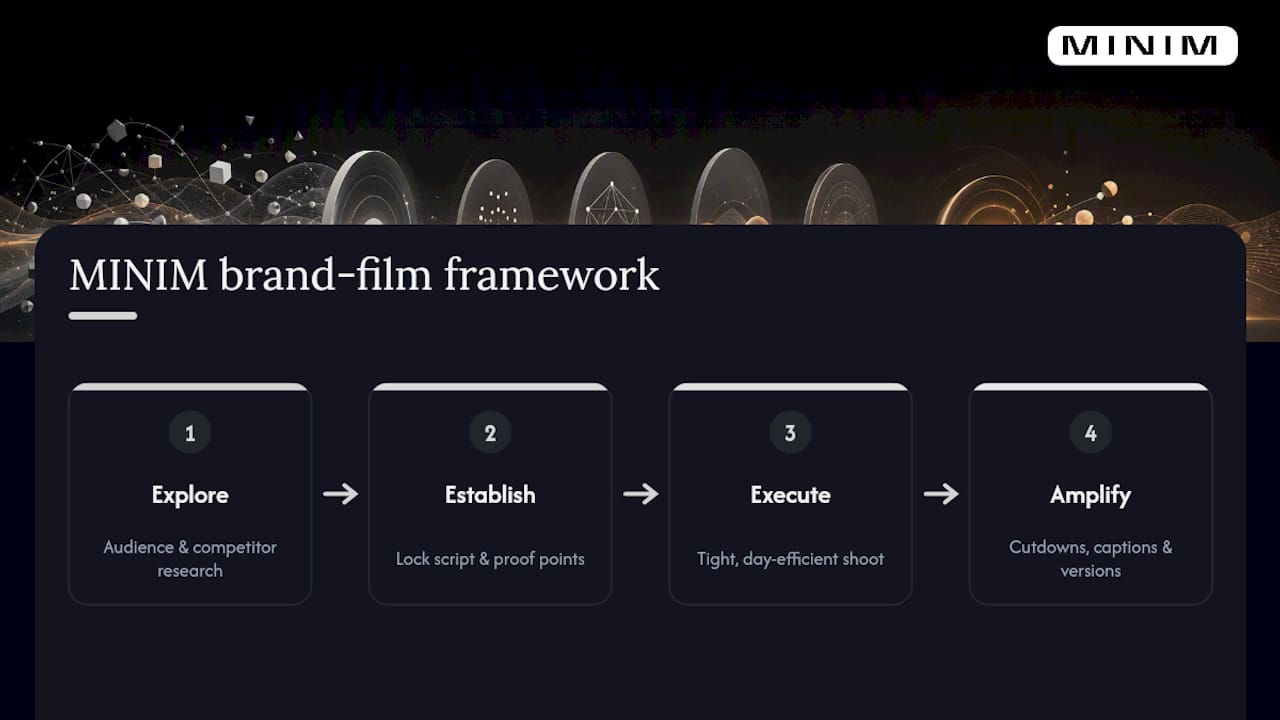
Explore, Establish, Execute, Amplify. Explore is discovery: audience research, competitive scan, and the search for the one true idea worth building around. Establish locks the script, visual references, and proof points before anyone books a crew. Execute is production days, kept tight and day-efficient rather than sprawling across weeks. Amplify is the reuse phase: cutdowns, captions, and channel-specific versions built from footage captured with reuse in mind, not as an afterthought.

The highest-value decision inside this framework is usually casting. Real employees and customers outperform actors on trust almost every time, even when the actor delivers cleaner lines.
Pro Tip: Build your cutdown shot list during the Establish phase, not the edit. Crews that know they need six versions from one shoot day will frame differently than crews expecting to deliver a single three-minute film, and that planning alone can save a second production day.
Script-first planning, tight shoot days, and reusable edit templates keep budgets sane without shrinking the ambition of the final film.
What Does a B2B Brand Film Cost?
Most B2B brand films run $15,000 to $50,000, depending on shoot days, crew size, and how many cutdowns get delivered alongside the hero film. A single-location shoot with two or three interview subjects sits at the lower end. Multi-location productions with drone footage, custom motion graphics, or a large cast push toward the top.
Three levers control cost without touching quality. First, consolidate shoot days: interview six subjects across two days instead of six separate half-day shoots, and you cut crew travel and setup costs substantially. Second, plan cutdowns during scripting, not after delivery. Requesting five additional social edits after the final cut is locked almost always costs more than building those versions into the original scope. Third, reuse b-roll libraries. A company that shot a facility tour last year may already own footage a new brand film can incorporate, trimming a full shoot day from the schedule.
Where teams overspend: chasing production value (drone shots, elaborate sets, celebrity voiceover) before locking the single idea. A gorgeous film built around a vague message costs the same as a gorgeous film built around a sharp one, but only the second one moves pipeline. Spend the early budget on strategy and scripting, where a cheap mistake is easy to fix, and save the expensive decisions for production, where mistakes are locked into the final cut.
What Goes Wrong When Companies Make Brand Films?
The most common failure is trying to say everything. A brand film that attempts to cover five product lines, three audience segments, and a company history ends up saying nothing memorable about any of them. Fix this by forcing a single idea decision before scripting starts, and treating anything that doesn't serve that idea as material for a different asset.
The second failure is casting problems. Executives who insist on appearing on camera, regardless of comfort or delivery, weaken films that would otherwise work. A CEO who reads stiffly from a teleprompter undercuts trust faster than no executive appearance at all. Cast for comfort on camera, not org chart position.
The third failure is skipping distribution planning until after the edit. Teams that treat the hero film as the entire deliverable end up with one asset and no budget left for the cutdowns that actually drive most of the impressions. Build the cutdown list into the original scope, the way Astor Film Productions frames a brand film as a source asset meant to feed multiple shorter edits.
The fourth failure is stakeholder ambush. Legal, compliance, or a regional GM who sees the film for the first time at the final review stage will find something to object to, almost on principle. Loop every approver into the brief stage, not the delivery stage, and you'll cut revision cycles significantly.
What Marketers Get Wrong About Brand Film Timelines
Most delays I've seen trace back to three habits: skipping the audience-insight step and jumping straight to script, letting more than one person "own" creative approval, and treating the shoot day as the finish line instead of the midpoint. None of these are hard to fix, but they require deciding early, not during the rough cut review.
Tie the film's objective to one measurable outcome before you brief anyone. A film built to "increase brand awareness" gets debated forever. A film built to "shorten the sales cycle by giving reps a trust asset for the second call" gets approved fast and evaluated honestly.
Ready to Brief Your Own B2B Brand Film?
MINIM works as an embedded production partner for agencies and brand teams that need a brand film executed at a cinematic level without hiring a full internal crew. Our team handles creative strategy, script development, production, and the cutdown library your distribution plan actually needs, integrating directly with your existing creative team rather than replacing it.
If you already have a single idea and an internal champion, the fastest next step is a discovery call to scope shoot days, deliverables, and timeline against your budget. Review MINIM's production services to see the full scope of what's included, or look at completed work to check craft and casting quality before you commit. Bring your rough brief, even an incomplete one. We'll help you tighten the single idea before we talk about cameras.
Frequently Asked Questions
What is a B2B brand film? A B2B brand film is a story-led video built to communicate a company's identity and values, aimed at building trust rather than explaining a specific product or service.
How is a B2B brand film different from a corporate video? A corporate video is functional and explains what a company does. A B2B brand film is emotive, cinematic, and focused on who the company is.
How long should a B2B brand film be? Most hero brand films run two to four minutes, with shorter cutdowns of 15 to 60 seconds built for social and trade show distribution.
How much does a B2B brand film cost? Budgets commonly fall between $15,000 and $50,000, depending on shoot days, crew size, and how many cutdowns get delivered.
How long does production take? Expect six to ten weeks from kickoff to final delivery, depending on approval speed and location complexity.
What KPIs should marketers track for a B2B brand film?
Sources
For definitions and production benchmarks, see Nutmeg Productions and BLARE Media. For curated example collections, LinkedIn's roundup of B2B video campaigns is a strong companion. For broader digital marketing context around how video fits paid strategy, Justin Savage's marketing resources cover adjacent ground. MINIM's own B2B video advertising guide rounds out the production side.
- StackAdapt — B2B video marketing blog
- Nutmeg Productions — What is a brand film?
- Astor Film Productions — What Is a Brand Film?
- Deloitte — New 'who we are' brand video