

A production budget breakdown is the itemized plan that translates a script or creative concept into dollar amounts across every department, phase, and payment date. Done right, it produces three concrete outputs: a one-page topsheet for quick approval, a full line-item budget for department accountability, and a cash-flow schedule that tells you when money actually leaves the account. The rest of this guide walks through templates, sample allocations, and the mistakes that blow past even careful estimates.
TL;DR:
- The one-page topsheet provides a quick overview, but the full line-item budget is essential for detailed department tracking and accountability.
- Fringe calculations, union crew rates, and hidden costs like permits and fuel can significantly inflate estimates if not carefully accounted for upfront.
- Budget percentages vary by phase, with pre-production often taking a larger share for branded videos, while features tend to allocate more to above-the-line costs.
- Proper script breakdown and vendor quotes are crucial early steps to prevent costly surprises during production or post-production.
- Contingency should be risk-driven and documented, especially for remote locations, stunts, or multi-city shoots, to avoid unapproved overages.
Table of Contents
- Topsheet vs. full budget: which one do you need?
- What does each production department actually cost?
- Percentage templates you can copy into a spreadsheet
- How to build a production budget breakdown step by step
- Common budgeting mistakes and how to catch them early
- An agency-facing take on commercial budgeting
- Get a budget built by people who run this process weekly
- Where to find union minima, templates, and calculators
- Sources
Topsheet vs. full budget: which one do you need?
The topsheet is the one-page summary: a handful of category totals (Above the Line, Below the Line, post, other) that give a financier or creative director the number in ten seconds. The full line-item budget is the working document underneath it, broken into hundreds of individual cost codes, one per vendor, crew role, or rental.
Every production budget breaks into four major buckets. The remainder, often 5 to 10%, covers insurance, legal, and contingency.
Lead with the topsheet in any pitch or greenlight meeting. Financiers rarely want to see 400 line items before they've approved the concept, and a bloated first presentation kills momentum. Save the full budget for due diligence, when a producer, accountant, or completion guarantor needs to verify how each total was built. Keeping both documents in sync, so the topsheet totals always match the sum of the detailed lines, is the single most common accounting failure on productions that outsource budgeting to spreadsheets built by different people.
What does each production department actually cost?
Underestimate scouting days here and you inherit location problems that cost far more once cameras are rolling.
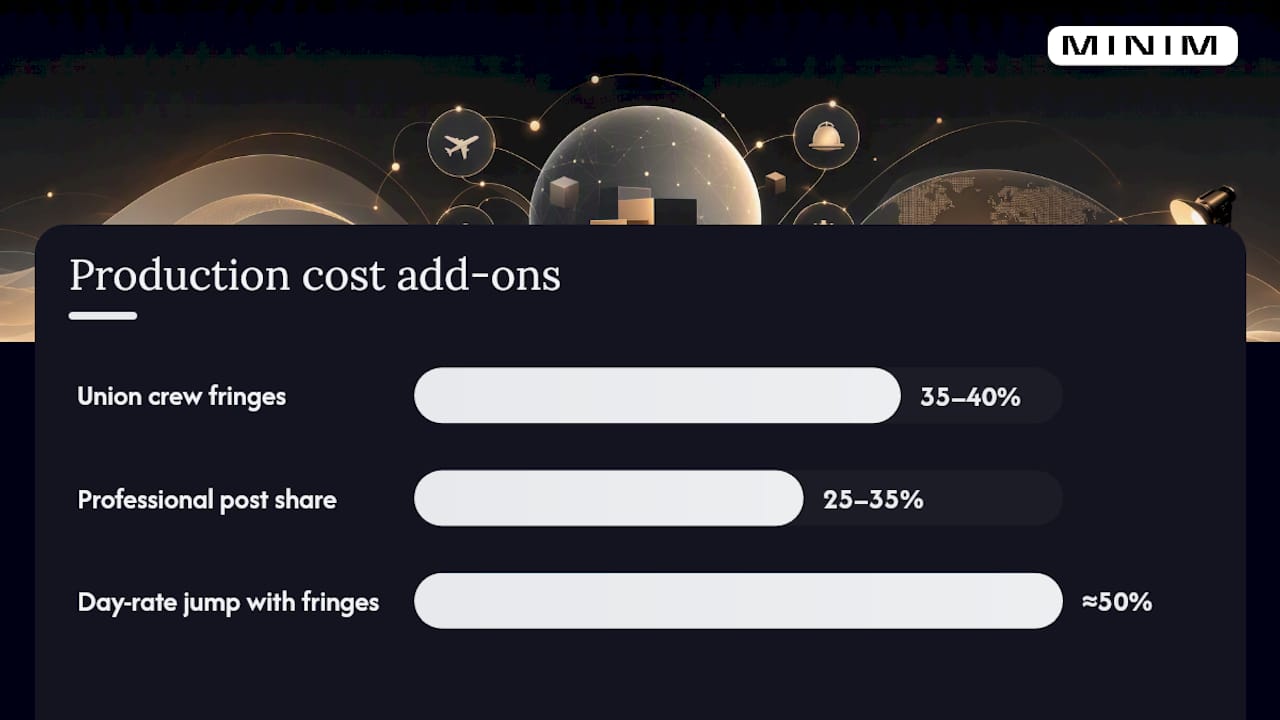
Below the Line detail is where most budgets live or die. Camera and lighting packages, grip equipment, art and set construction, wardrobe, locations, transport, and catering all get their own cost code, and each one needs a fringe calculation on top of the base rate. Union crew fringes, particularly IATSE positions, commonly add 35 to 40% on top of base wages once you factor in health, pension, and payroll taxes. A day rate that looks reasonable on paper can jump by nearly half once fringes land.
Pro Tip: *Never quote a crew day rate to a client without the fringe multiplier attached.
Key production-phase line items to track:
- Camera package and lens rentals, quoted per week, not per day, once shoots exceed three days
- Lighting and grip, including generator fuel, which almost never appears in first-pass estimates
- Art department and set dressing, budgeted separately from wardrobe even on small shoots
- Locations, including permit fees, police details for street closures, and parking for crew vehicles
- Transport and catering, scaled to crew headcount and shoot duration, not a flat daily number
Professional post can command 25 to 35% of total project costs when color, sound design, original music, and VFX finishing are done at a quality level that matches an expensive shoot. Indie features often compress this by trading time for money; commercial and branded work rarely has that luxury given tight delivery deadlines.
Hidden costs cluster in the same handful of places every time: generator fuel on remote shoots, off-duty police for public locations, parking permits, and the fringe multipliers producers forget to apply to overtime hours. None of these show up on a rate card. All of them show up on the invoice.
Percentage templates you can copy into a spreadsheet
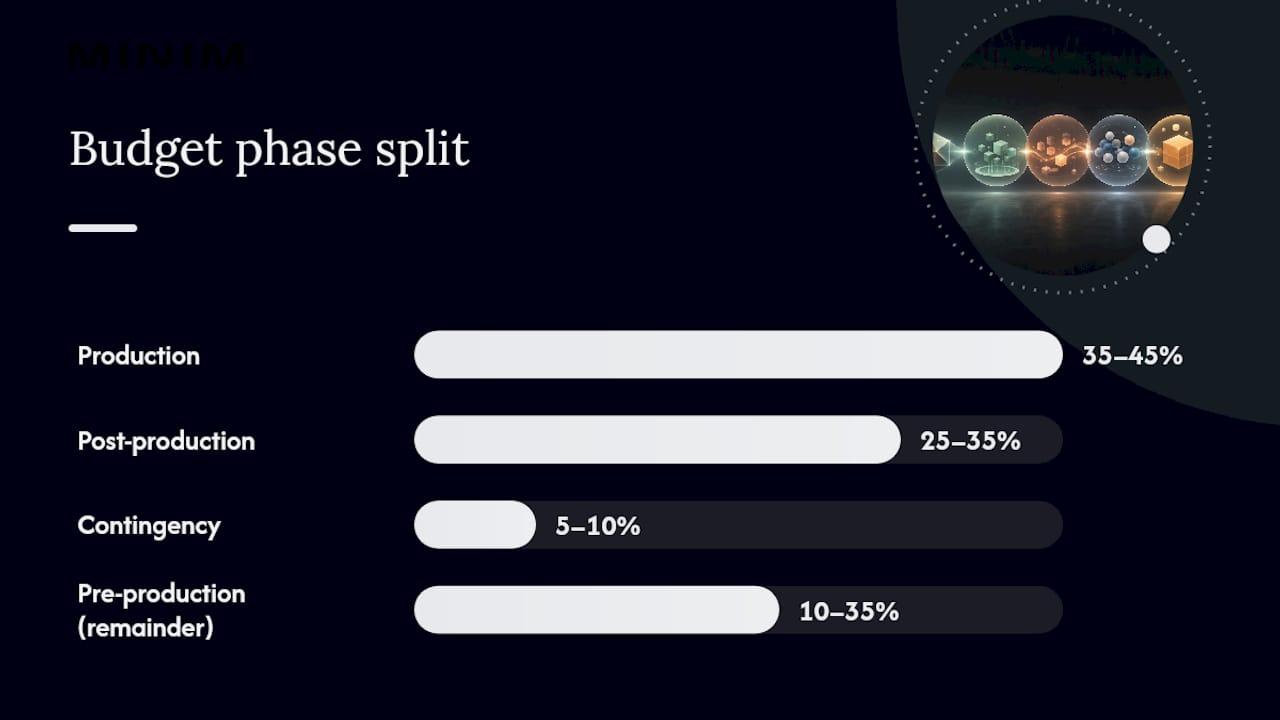
Once you know the phase percentages, building a first-draft budget is mostly arithmetic. Pre-production commonly runs a significant share of the total, production runs 35 to 45%, and post runs 25 to 35% for a typical branded video project. Feature productions skew differently, with a heavier ATL share for name cast and a leaner post percentage relative to total spend.
Two sample budgets show how this plays out in real dollars.
| Post-production (edit, color, sound, VFX) | — | — | | Contingency and insurance | budget 5% to 10% depending on risk and project complexity |
Adjust these percentages upward on the post-production line for any project carrying heavy VFX or a music composition budget, since finishing costs scale faster than shoot-day costs once you add compositing hours. Union productions need the fringe multiplier baked into production-phase dollars before you apply the percentage split, not after, or the whole template understates the true crew cost.
How to build a production budget breakdown step by step
Start with the script, not the spreadsheet. A proper script breakdown identifies every shoot day, extras count, VFX shot, stunt, and location need before a single vendor gets a call. Skipping this step is the fastest way to discover a location requirement three weeks into pre-production, when the schedule has no room left to absorb it.
- Break down the script or creative brief scene by scene, tagging cast, locations, props, and any visual effects or stunt work that needs specialist quotes early.
- Collect vendor quotes for camera, lighting, locations, and post-production, and convert every quote into a committed line item with a vendor name attached, not a placeholder number.
- Assign cost codes to each line so spend can be tracked by department in real time rather than reconciled after the shoot wraps.
- Build the cash-flow schedule week by week, mapping each committed cost to the date it's actually due, and align that schedule with financing draws and vendor payment terms.
Pro Tip: *Ask every vendor for payment terms up front, not just a total.
Common budgeting mistakes and how to catch them early
The same lines get underbudgeted on nearly every production: post-production finishing, permit and police fees, generator fuel, and crew fringes. Each one is easy to skip in a first draft because none of them shows up until you're deep into production or delivery.
Contingency should scale with risk, not sit at a flat percentage out of habit. Completion bonds typically cost a small percentage of the total budget, and bonded productions usually carry higher formal contingency requirements than unbonded ones. Remote locations, stunts, and multi-city shoots all justify pushing contingency above the standard range, and that reserve should move through a documented approval path rather than an informal buffer anyone can dip into.
- Track every line running over budget the moment it's flagged, not at the next scheduled review
- Require a written variance approval before drawing on contingency, even on small overages
- Reforecast the cash-flow schedule immediately after any line change, since one overrun shifts every downstream payment date
An agency-facing take on commercial budgeting
Commercial budgets fail in different places than feature budgets. The line items agencies most often underscope are talent usage rights, the cost of producing multiple cuts for different platforms, and the number of deliverable versions baked into a single production day. A shoot priced for one 30-second spot often needs to fund six or eight versions once social cutdowns and regional variants enter the conversation.
MINIM's own commercial budgeting checklist starts with versioning and usage before a single camera package gets quoted, because those two variables move the total more than any lighting or grip decision will. Hybrid workflows that batch shoot days and reuse asset banks across a content program can lower recurring costs by roughly 30 to 40% for agencies running ongoing campaigns, but that savings only holds up if the flagship hero deliverable still gets full production value. Cutting corners on the lead asset to fund volume rarely serves the campaign.
— Steven Reina
Get a budget built by people who run this process weekly
Templates and percentage guides get you a solid first draft. They don't replace a team that has priced hundreds of commercial shoots and knows exactly where a quote is missing a fringe calculation or an underscoped usage line. MINIM works directly inside agency creative teams to build the topsheet, the full line-item budget, and the cash-flow schedule together, then carries that budget through production and final delivery without adding headcount to your roster.

That means one point of contact for a campaign that might otherwise require separate producers for concept, shoot, and post. MINIM's production teams build budgets around your actual creative brief, not a generic percentage template, and flag the versioning and deliverable costs agencies most often miss before a quote goes to the client. If you're scoping a campaign right now, explore MINIM's production and creative services and request a budget review before you finalize the number your client sees.
Where to find union minima, templates, and calculators
For legal minimums on crew rates and fringe percentages, check current union scale sheets before finalizing any BTL line. For an adjustable percentage template by project type, the budget breakdown allocator lets you plug in a total and see category splits instantly. For longer-form or multi-year projects, documentary budgeting guidance covers scheduling differences that standard commercial templates don't address.
Sources
- Film budget breakdown by department — Saturation
- How much does video production cost in 2026? — Visla