

Start by downloading the master pre-production checklist bundle — a printable PDF, editable Google Sheet/Excel (.xlsx), stripboard, and .docx call-sheet template — then work through it department by department before a single camera rolls. Pre-production begins at greenlight and ends the moment principal photography starts; every hour you invest here saves three on set.
Must-lock items before production begins:
- Script lock: Final, dated draft with all revisions archived
- Budget approved: Top sheet signed, contingency reserve confirmed
- Shooting schedule: Stripboard built, 1st AD signed off
- Locations secured: Permits pulled, location agreements executed
- Insurance: Certificate of Insurance (COI) in hand, covering cast, crew, and equipment
- Key crew contracted: Department heads confirmed in writing
The bundle includes: a printable PDF master checklist, an editable Google Sheet/Excel version, an .xlsx stripboard, a .docx call-sheet template, a script breakdown sheet, a talent release, a location release, and a production bible template.
Credibility anchor: Industry benchmarks recommend that pre-production take roughly 33% of the total project timeline — the "one-third rule" — giving the planning phase the same weight as production and post combined.
Key Takeaways
A locked script is the single most important pre-production decision — every downstream workstream depends on it, and locking late multiplies rework across budget, schedule, casting, and locations simultaneously.
| Point | Details |
|---|---|
| Lock script first | Every department budget, schedule, and hire depends on a locked, dated script. |
| Apply the one-third rule | Pre-production should take roughly 33% of the total project timeline. |
| Use the 48/24-hour gate | Unresolved gate items at 48 hours escalate; at 24 hours, a go/no-go must be documented. |
| Budget 10%–15% contingency | Commercials need a minimum 10% reserve; VFX-heavy shoots often carry 15%–20%. |
| MINIM as production partner | MINIM delivers full pre-production management for agencies, from production bible to call sheets. |
Table of Contents
- What is pre-production, and who owns each workstream?
- Your complete pre-production checklist, department by department
- How to adapt this checklist to your project size and timeline
- What templates and tools belong in your production bundle?
- How MINIM runs a 6–8 week pre-production workflow
- The most common pre-production mistakes and how to avoid them
- Why the checklist is only half the answer
- MINIM handles pre-production so your agency doesn't have to
- Sources
What is pre-production, and who owns each workstream?
Pre-production is the planning phase that converts a greenlit concept into an executable shoot plan. It starts the day the project is approved and ends when the camera rolls on day one of principal photography. Everything that happens in between — script lock, hiring, budgeting, scheduling, casting, location scouting, equipment prep, and legal clearances — is pre-production.
The parallel workstreams and their owners:
| Workstream | Owner |
|---|---|
| Script lock and breakdown | Writer / Director / Producer |
| Budget and financing | Producer / Line Producer |
| Shooting schedule | 1st AD / Production Manager |
| Casting and talent agreements | Casting Director / Producer |
| Locations and permits | Location Manager |
| Production design, props, wardrobe | Production Designer |
| Camera, grip, and lighting | Director of Photography (DP) |
| Insurance and legal (releases, music) | Producer / EP |
| VFX/SFX planning | VFX Supervisor / Director |
| Safety and health protocols | Production Manager / Safety Officer |
The benefits are straightforward: a thorough pre-production process reduces on-set risk, controls costs before they spiral, and gives every department creative clarity so they can prepare in parallel rather than waiting on each other.
Your complete pre-production checklist, department by department
StudioBinder's stepwise guide and Darb Productions' gate-rule framework both confirm the same order of operations: lock the script first, then break it down, then let every other department build from that foundation. The checklist below follows that logic.
Gate rule: Any item marked 🔴 must be confirmed 48 hours before the shoot day. Items still open at 24 hours require a documented go/no-go decision from the Producer or Line Producer.
Creative and script
- Script locked, dated, and version-stamped; all prior drafts archived
- Script breakdown complete (scenes, cast, props, VFX, stunts, special equipment flagged per scene)
- Shot list drafted and reviewed by Director and DP
- Storyboards completed for key sequences; VFX boards finalized
- Video creative brief approved by client or stakeholder
- Director's treatment locked
Budget and finance
- 🔴 Top-sheet budget approved and signed
- Line-item budget distributed to department heads
- Contingency reserve confirmed (10%–15% for commercials is the standard benchmark)
- Purchase orders issued for all major vendors
- Petty cash float allocated and tracked
Schedule and 1st AD
- 🔴 Stripboard built; shooting schedule distributed
- Day-out-of-days (DOOD) issued to cast and key crew
- Turnaround times confirmed (minimum 12 hours between wrap and call)
- Overtime and meal-penalty thresholds documented
- Contingency days identified on the schedule
Casting and talent
- 🔴 Cast confirmed; deal memos and contracts executed
- Talent releases signed (on-camera talent, extras, minors with guardian co-signature)
- Fitting and rehearsal dates scheduled and confirmed with talent
- Stand-ins and photo doubles booked if required
- Union or non-union status documented; SAG-AFTRA paperwork filed if applicable
Locations and permits
- 🔴 Location agreements signed for every location
- 🔴 Film permits pulled from the relevant city or county film office
- Parking, base camp, and holding areas confirmed
- Power source verified (amperage, generator requirements, noise ordinances)
- Neighbor notifications sent where required
- Backup location identified for weather-dependent exteriors
Pro Tip: Pull permits at least three weeks out in major US markets — Los Angeles, New York, and Chicago film offices can take 10–15 business days, and some locations require additional neighborhood council approval.
Production design, props, and wardrobe
- Art department breakdown complete; set dressing list approved
- Props sourced, rented, or fabricated; hero props confirmed on set
- Wardrobe fittings completed; continuity photos taken
- Expendables (paint, tape, hardware) ordered and on-hand
- Breakaway or stunt props cleared with safety coordinator
Camera, grip, and lighting
- 🔴 Camera package confirmed with rental house; pickup scheduled
- Lens tests completed; approved lens list distributed
- Lighting plan reviewed by Gaffer and DP
- Grip package confirmed (dollies, cranes, specialty rigs)
- Generator or venue power confirmed for lighting load
- Backup camera body reserved
Sound and data management
- 🔴 Sound package confirmed; boom operator and mixer contracted
- Location sound report template prepared
- Data management plan in place: primary drive, backup drive, cloud sync
- DIT (Digital Imaging Technician) contracted if required
- LTO or RAID backup confirmed for multi-day shoots
Stunts, VFX, and SFX
- Stunt coordinator contracted; stunt breakdown reviewed with Director and 1st AD
- 🔴 VFX brief finalized; on-set VFX supervisor confirmed
- Practical SFX permits pulled (pyrotechnics, water, wind)
- Pre-visualization (animatics or VFX boards) approved by Director
- Post-production VFX handoff format agreed with VFX house
Health, safety, insurance, and legal
- 🔴 Certificate of Insurance (COI) issued; additional insured endorsements sent to locations
- Workers' compensation coverage confirmed for all crew
- Safety meeting scheduled for day one (or day before)
- COVID or other health protocols documented and distributed
- Music clearances confirmed or sync licenses in process
- All third-party IP (logos, artwork, signage) cleared or removed from frame
- Location releases and talent releases filed
Logistics and catering
- Catering vendor confirmed; dietary restrictions collected
- Craft services order placed
- Transportation plan: production vehicles, talent transport, equipment trucks
- Hotel blocks confirmed for out-of-town crew
- Walkie-talkie and communication equipment reserved
Call sheets and contact lists
- 🔴 Day-one call sheet issued (24 hours before first shoot day)
- Full crew contact list distributed (name, role, cell, department head)
- Emergency contact list posted at base camp and shared digitally
- Hospital and nearest urgent care addresses included on call sheet
- Client and agency contact list distributed to Producer and 1st AD
Post-production handoff and media management
- Post-production supervisor briefed; editorial workflow agreed
- Codec, frame rate, and resolution specs confirmed with editor and colorist
- Sound mix deliverable specs confirmed with mixer
- VFX deliverable specs confirmed with VFX house
- Archive and asset management plan documented
How to adapt this checklist to your project size and timeline
The same checklist applies whether you're shooting a two-day social campaign or a three-month feature. What changes is how much time you spend on each item and how many people share the load.
Scale variants at a glance:
- Micro/lean shoot (1–3 days): Compress budget and schedule sections; one person often covers Producer, Line Producer, and 1st AD roles. Focus on script lock, location permits, and insurance — those three cause the most last-minute problems on small shoots.
- Standard commercial (4–10 shoot days): Full department structure applies. Casting, location scouting, and tech scouts each get dedicated time blocks.
- Multi-location commercial: Add a location manager and a dedicated logistics coordinator. Permit timelines drive the master schedule.
- Feature-length narrative: Every workstream expands. Pre-production typically runs 8–16 weeks; casting alone can take 4–6 weeks.
Pre-production converts a script and a budget into an executable plan through parallel workstreams — and the order matters. Script lock must come first. Everything downstream (breakdown, budget, schedule, casting) is built on the locked script, so locking late multiplies rework across every department.
Suggested pre-production timelines and milestones
| Milestone | 2-week micro | 4-week standard | 6–8 week commercial | 3+ month feature |
|---|---|---|---|---|
| Script lock | Day 1 | Day 1–2 | Week 1 | Week 1–2 |
| Script breakdown | Day 1–2 | Day 2–3 | Week 1–2 | Week 2–3 |
| Budget approved | Day 2–3 | Day 3–5 | Week 2 | Week 3–4 |
| Casting complete | Day 3–5 | Day 5–10 | Week 3–4 | Week 4–8 |
| Locations locked | Day 4–6 | Day 7–12 | Week 3–4 | Week 4–6 |
| Tech scout | Day 7–8 | Day 14 | Week 5–6 | Week 6–8 |
| Camera/gear booked | Day 5–7 | Day 10–14 | Week 4–5 | Week 6–8 |
| Rehearsals | Day 8–10 | Day 16–20 | Week 6–7 | Week 8–10 |
| Final run-through | Day 13 | Day 26 | Week 7–8 | Week 10–12 |
| Call sheet issued | Day 13 | Day 27 | 24 hrs before day 1 | 24 hrs before day 1 |
Signature owners by milestone:
- Script lock: Director + Producer
- Budget approval: Producer / Executive Producer
- Shooting schedule: 1st AD + Line Producer
- Locations locked: Location Manager + Producer
- Tech scout sign-off: DP + 1st AD + Production Designer
- Final go/no-go: Producer / Line Producer
48-hour and 24-hour gate rules: Per Darb Productions' escalation framework, any 🔴 item unresolved at 48 hours escalates to the Production Manager. At 24 hours, the Producer must either resolve it, accept documented risk, or postpone the shoot day. No exceptions.
Contingency guidance: Industry benchmarks recommend a 10%–15% contingency reserve for commercials.
What templates and tools belong in your production bundle?
Editable templates speed coordination and reduce errors — the difference between a call sheet that gets filled in correctly the first time and one that gets revised four times the morning of the shoot is almost always the template quality.
Templates included in the master bundle:
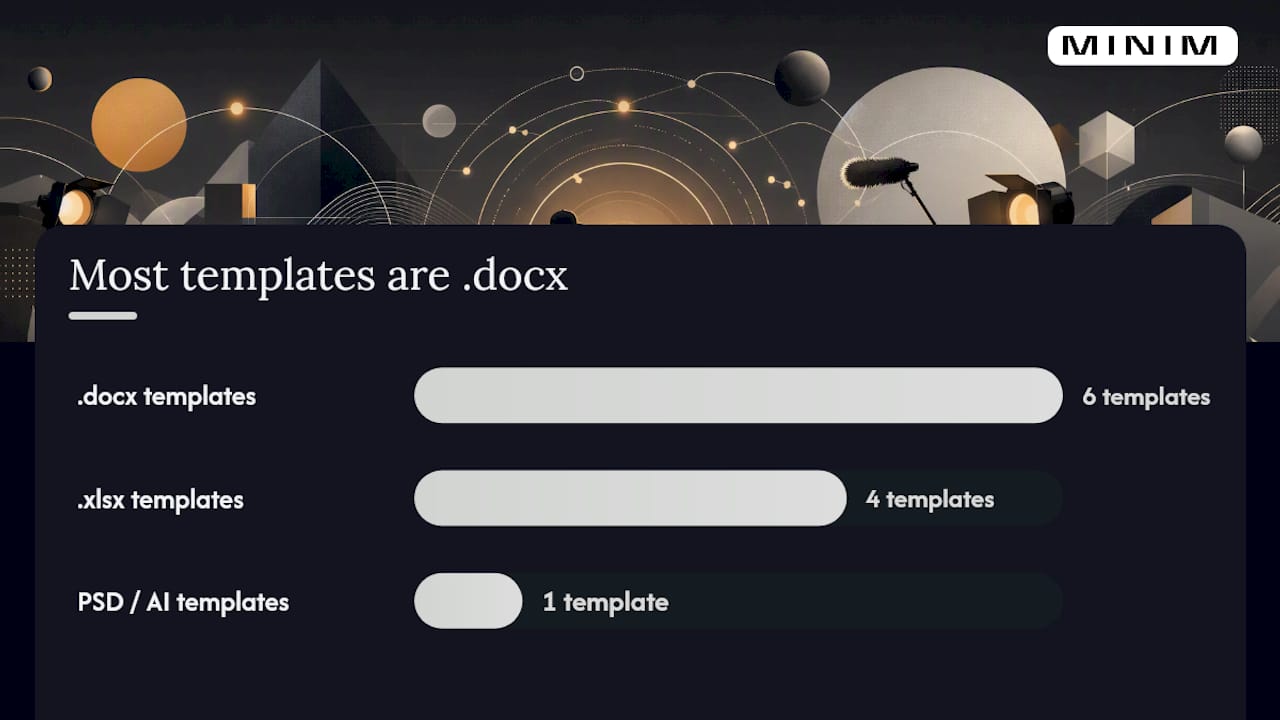
- Production bible (.docx): Project overview, key contacts, schedule summary, location addresses, and emergency procedures
- Script breakdown sheet (.xlsx): Scene-by-scene breakdown with cast, props, VFX, wardrobe, and special requirements
- Stripboard/one-line schedule (.xlsx): Drag-and-drop scene ordering with day totals and DOOD
- Call sheet (.docx): Daily logistics, crew call times, location details, and emergency contacts
- Shot list (.xlsx): Scene, shot number, description, lens, camera movement, and notes
- Storyboard template (.psd / .ai): Panel grid with action and dialogue fields
- Budget top sheet (.xlsx): Summary by department with contingency line
- Talent release (.docx): On-camera appearance and likeness rights
- Location release (.docx): Property use and filming rights
- Insurance COI checklist (.docx): Required coverage types and minimum limits
- VFX brief (.docx): Shot-by-shot VFX requirements, delivery specs, and on-set notes
File format notes: Keep editable master files in Google Sheets for real-time collaboration, plus a timestamped PDF for each sign-off. That combination prevents version drift — the Google Sheet is the working document; the PDF is the record. Import the .xlsx stripboard directly into scheduling software; most platforms accept standard Excel format.
Recommended tools for production planning:
- Scheduling software: Platforms like production management tools reviewed for agencies handle stripboards, DOOD reports, and schedule distribution in one place.
- Storyboard tools: Boords offers a browser-based storyboard builder with frame-by-frame export; useful for quick animatics on commercial shoots.
- Cloud file management: Google Drive or Dropbox for shared access; a locked local copy on an encrypted drive for archival.
- Call sheet software: SetHero and Assemble both generate call sheets from a shared crew database, cutting the time to issue a daily call sheet from 90 minutes to under 20.
Required fields on every template: production title, version number, date, owner name, and a contact escalation tree. A template missing any of these creates ambiguity the moment something goes wrong on set.
Pro Tip: Fill the production bible first — it forces you to consolidate every key decision (title, schedule, locations, key contacts) into one document, and every other template draws from it. If you can't fill the production bible, you're not ready to shoot.
How MINIM runs a 6–8 week pre-production workflow
This is what a professional commercial pre-production looks like in practice, week by week.
Weeks 1–2: Script lock, breakdown, and initial budget
The project kicks off with a creative alignment meeting between MINIM's production team and the agency's creative director. The script is reviewed, locked, and version-stamped by the end of week one. The script breakdown follows immediately — scenes are tagged by cast, props, VFX requirements, and location type. A preliminary budget top sheet is drafted by the end of week two, with department heads given their initial budget envelopes.
Structured creative checkpoints at this stage reduce downstream rework significantly. Decisions made in week one cost a fraction of what they cost to reverse in week five.
Weeks 3–4: Casting, location scouting, and department hires
Casting sessions run in week three; deal memos go out by the end of week four. The location manager scouts primary and backup locations; permit applications are filed the moment a location is shortlisted. Department heads — Gaffer, Key Grip, Production Designer, Sound Mixer — are contracted and given the script breakdown to begin their own prep.
Pre-visualization work starts here: the DP and Director work through the shot list together, and storyboards for key sequences are drafted. This lets the Production Designer and Gaffer begin sourcing and planning in parallel rather than waiting for a final shot list.
Weeks 5–6: Tech scouts, rehearsals, and camera/gear booking
Tech scouts happen with the DP, Gaffer, Production Designer, 1st AD, and Location Manager present. Every location gets a power audit, a lighting plan, and a logistics walkthrough. Camera and grip packages are confirmed with the rental house; specialty gear (cranes, underwater housings, specialty lenses) is booked with enough lead time to arrange backups.

Rehearsals with principal cast are scheduled in week six. The 1st AD runs a table read of the shooting schedule with all department heads to surface conflicts before they become problems on set.
Weeks 7–8: Final prep, call sheets, safety meeting, and dress rehearsals
The 72-hour checklist covers: final location confirmations, equipment pickup scheduled, catering confirmed, all releases and permits in the production binder, COI sent to all locations, and the day-one call sheet drafted.
The 24-hour checklist covers: call sheet issued to full crew, emergency contacts posted at base camp, safety briefing agenda prepared, all 🔴 gate items confirmed closed, and the go/no-go decision documented by the Producer.
A safety meeting runs the morning of day one — or the evening before for early calls — covering emergency procedures, stunt or SFX protocols, and any location-specific hazards.
Communication workflow: MINIM runs daily check-ins via a shared project channel (Slack or equivalent), with decisions logged in a running production notes document. All assets — scripts, schedules, call sheets, releases — live in a shared Google Drive folder with version control. A locked PDF copy is generated at each sign-off milestone.
Pro Tip: Scope creep in pre-production almost always starts with a single "small addition" to the script after lock. Establish a formal change-order process on day one: any script change after lock requires written approval from the Producer and a documented assessment of schedule and budget impact. One page added to a locked script can mean a full location day added to the schedule.
The most common pre-production mistakes and how to avoid them
Most production overruns trace back to the same handful of decisions made — or not made — before the shoot.
Not locking the script before hiring
Every department builds its plan from the script. A script that changes after the breakdown is complete forces the Production Designer, DP, and 1st AD to redo work they've already done. Lock the script before issuing any department budgets or hiring below-the-line crew.
Skipping a full script breakdown
A breakdown takes time, but it's the only way to surface hidden costs: a scene that reads as "INT. WAREHOUSE - NIGHT" might require a generator, a full lighting package, and a fire marshal on set. Skipping the breakdown means those costs appear as surprises during production.
Under-budgeting contingency
Contingency is not padding; it's the cost of operating in an environment where variables are genuinely unpredictable.
Late location permitting
Permit timelines in major US markets are non-negotiable. Los Angeles, New York, and Chicago all require applications well in advance, and some locations require additional approvals. A location that isn't permitted at 48 hours before the shoot is a location you don't have.
Poor data and backup planning
Losing a day's footage because a card failed and there was no backup is a production-ending event. The data management plan — primary drive, backup drive, cloud sync — must be confirmed before day one, not improvised on set.
Failing to secure music and rights clearances
Music clearances and third-party IP clearances take time. A track that sounds perfect in the edit may be unavailable or prohibitively expensive to license. Identify music needs during pre-production and either clear them or brief the composer early enough to deliver alternatives.
Unclear escalation rules
When a problem surfaces on set, everyone needs to know immediately who makes the call. Define the escalation chain in writing during pre-production: department head to 1st AD to Line Producer to Producer. The 48/24-hour gate system formalizes this for the days immediately before the shoot.
Why the checklist is only half the answer
Most productions that struggle in pre-production don't fail because they lacked a checklist. They fail because the checklist existed but no one owned it.
A checklist is a coordination tool, not a management substitute. The items on it are only as useful as the person responsible for closing each one. Productions that run well assign a named owner and a hard deadline to every gate item — not "locations team" but "Sarah Chen, Location Manager, confirmed by March 14." That specificity is what turns a checklist into a schedule.
There's also a tendency to treat pre-production as a linear process: finish the script, then do the breakdown, then build the budget. In practice, these workstreams run in parallel and feed each other. The budget informs casting decisions; casting decisions affect the schedule; the schedule shapes the location search. The checklist gives you the items; the production manager's job is to manage the dependencies between them.
One more thing that gets underestimated: the value of a tech scout that actually includes everyone who needs to be there. A DP and a Gaffer walking a location without the Production Designer will miss set-dressing constraints. A 1st AD who hasn't walked the location can't build an accurate schedule for it. The tech scout is the one moment where every department's assumptions get tested against physical reality — treat it as a mandatory gate, not an optional walkthrough.
MINIM handles pre-production so your agency doesn't have to
Agencies that need commercial-grade execution without adding production headcount get a concrete advantage working with MINIM: a full pre-production infrastructure — production management, scheduling, location scouting, casting coordination, and production bible creation — delivered as part of every project engagement, not billed as add-ons.

Where most production vendors hand you a quote and wait for direction, MINIM integrates directly with your creative team from brief to final delivery. That means your creative director stays focused on the work, not on chasing permits or managing crew logistics.
What MINIM brings to pre-production:
- Creative strategy and production bible creation
- Script breakdown and shooting schedule
- Location scouting and permit coordination
- Casting coordination and talent agreements
- Department head hiring and crew management
- Full template bundle (call sheets, shot lists, storyboards, releases)
See MINIM's production work to evaluate execution quality, or review the full services overview to scope a pre-production engagement. If you're weighing whether to bring in an external partner, this guide on outsourcing video production lays out exactly when it makes sense and what to hand off first.
Sources
The following sources informed the checklist structure, gate rules, timeline benchmarks, and template recommendations throughout this guide.
- Pre-production - Wikipedia
- Pre-Production Checklist | Film Production Saudi | Darb Productions
- Plan Like a Pro: Your Essential Guide to Pre-Production and Post-Production Success
- What Is Pre-Production? Definition | StudioBinder
- The Ultimate Video Pre-Production Checklist Template - Boords