
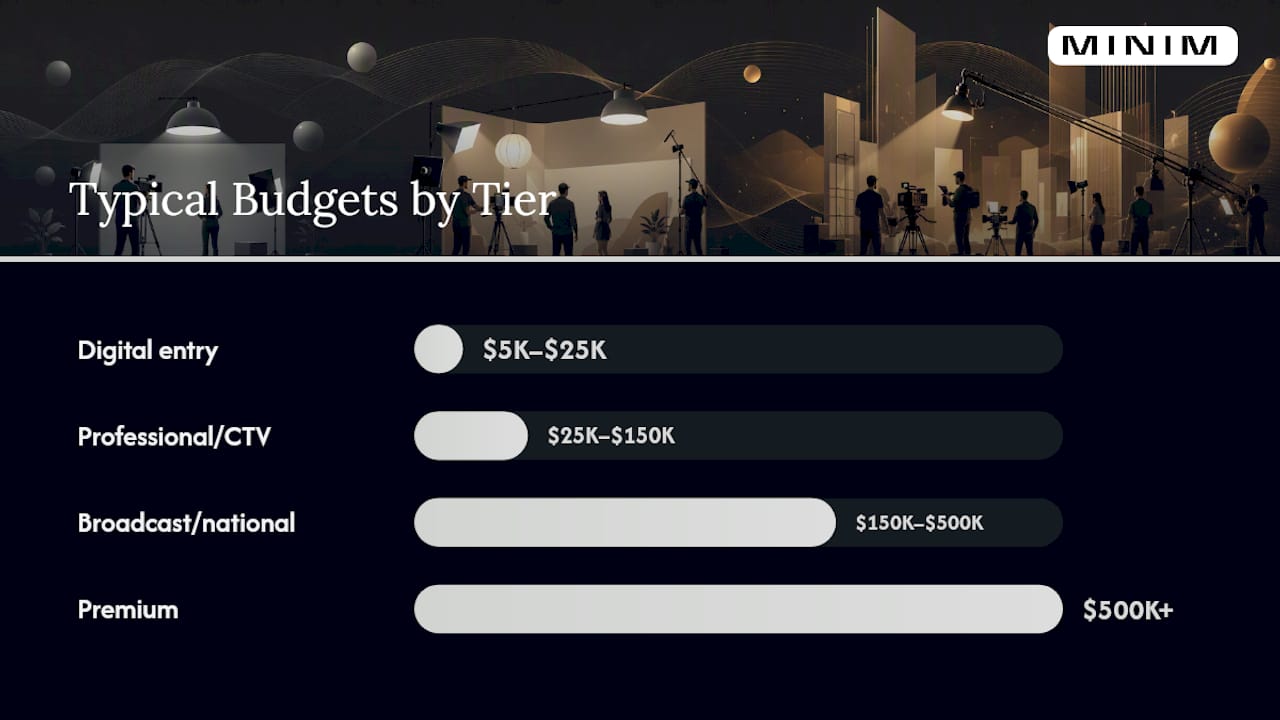
Most commercial video projects in the United States land somewhere between $5,000 and $500,000, with the extreme range running from roughly $2,000 for an AI-assisted digital spot to $10–20 million for a Super Bowl production, according to recent public case reporting. The practical tiers most agencies and brand teams work within are simpler: entry-level digital ($5K–$25K), professional/CTV-ready ($25K–$150K), broadcast-quality national ($150K–$500K), and premium ($500K+).
One thing that trips up first-time buyers: production cost and distribution cost are separate budgets. Production covers everything from script to final file. Distribution covers media placement, and on many campaigns it is the larger of the two. A common scenario is for media buy budgets to exceed production budgets by several times, such as a production budget paired with a significantly larger media buy, especially for CTV and national broadcast.
Here is what each tier typically buys at a glance:
- Entry-level digital ($5K–$25K): One to two shoot days, small crew, basic edit, social-ready formats, no union talent
- Professional/CTV-ready ($25K–$150K): Experienced director and DP, polished post-production, multiple deliverables, limited usage rights
- Broadcast-quality national ($150K–$500K): Full crew, union talent, color grade, sound mix, broadcast master, broad usage
- Premium/Super Bowl ($500K+): A-list director, celebrity talent, VFX-heavy post, global usage rights
Overtime, weather delays, and last-minute creative changes are the three most common reasons final invoices exceed the original estimate.*
Key Takeaways
Commercial video production costs in the US range from $5,000 for entry-level digital to $500,000+ for national broadcast, with distribution often exceeding production spend on mid-to-large campaigns.
| Point | Details |
|---|---|
| Production vs distribution | Budget both separately; media buy often exceeds production cost on CTV and national campaigns. |
| Tier expectations | Entry digital: $5K–$25K; professional/CTV: $25K–$150K; broadcast national: $150K–$500K. |
| Hidden cost risks | Usage fees, music licensing, overtime, and revision rounds are the most common sources of budget overrun. |
| Cost reduction lever | Tighten the shot list and plan all deliverable formats before the shoot, not after. |
| MINIM's approach | MINIM delivers line-item proposals with staged breakdowns, reducing quote variance for agency campaigns. |
Table of Contents
- What do commercial video production costs look like by tier?
- How does budget break down across pre-production, production, and post?
- How does platform choice change what you actually spend?
- What hidden costs push commercial budgets over estimate?
- Freelancer, boutique agency, or full-service production company: which model fits your budget?
- What do $5K, $15K, and $50K actually buy you?
- How do you write an RFP and negotiate a production quote?
- What questions should you ask production companies before signing?
- How MINIM delivers predictable commercial budgets for agencies
- What are typical production timelines?
- How do you cut commercial production costs without losing quality?
- How does video length and format affect what you pay?
- How do production costs vary outside the US?
- What the budget conversation usually gets wrong
- MINIM: production partner for agencies that need predictable budgets
- Sources
What do commercial video production costs look like by tier?
The gap between tiers is not just about production quality — it reflects fundamentally different crew sizes, shoot structures, and post-production scopes. GreenFrogLabs' pricing breakdown shows the median production cost for a broadcast-quality national 30-second spot is substantially higher than that for a digital-first 30-second spot, illustrating how dramatically expectations shift between channels.
| Tier | Typical Budget | Crew/Shoot | Post Scope | Best For |
|---|---|---|---|---|
| Digital entry | $5K–$25K | 2–4 person crew, 1 shoot day | Basic edit, color, 2–3 formats | Paid social, startup ads |
| Professional/CTV | $25K–$150K | 6–12 person crew, 1–2 shoot days | Full edit, grade, sound, 4–8 formats | Mid-market CTV, regional campaigns |
| Broadcast/national | $150K–$500K | 15–30+ person crew, 2–4 shoot days | Broadcast master, VFX, music license | National TV, OTT campaigns |
| Premium | $500K+ | Full union crew, multiple days | Full VFX, celebrity talent, global rights | Super Bowl, tentpole campaigns |
Entry-level digital suits a startup running paid social on Meta or YouTube. You get a competent crew, a clean edit, and a handful of format cuts. What you do not get: a dedicated colorist, a sound designer, or union-scale talent. For a direct-response ad that lives on Instagram, that trade-off is often fine.
Professional/CTV-ready is where most mid-market brands should be operating. The crew is larger, the director has a real reel, and post-production includes a proper color grade and sound mix. This tier produces work that holds up on a 65-inch screen, which matters as CTV viewership continues to grow.
Broadcast-quality national production involves union considerations, a full department structure (art direction, wardrobe, hair/makeup), and post-production that meets network technical specs.
Pro Tip: AI-augmented production workflows can compress entry-level and professional-tier costs by reducing shoot days. A well-produced AI-assisted spot can hit $10K–$30K with a quality level that would have cost $50K+ five years ago — but it requires a director who knows how to brief and curate AI outputs, not just generate them.
Statistic: According to IAB's 2025 video ad spend report, digital video and CTV now represent a growing majority of total video ad dollars, which means the professional/CTV-ready tier is increasingly the minimum viable production standard for brands that want their creative to perform across channels.
How does budget break down across pre-production, production, and post?
Pre-production line items:
- Creative strategy and script: $1,500–$15,000 depending on agency involvement
- Storyboards: $500–$5,000 (a well-executed storyboard prevents expensive on-set decisions)
- Casting: $500–$5,000+ for principal talent, more for celebrity
- Location scouting and permits: $500–$3,000 per location
- Production design/props: $1,000–$20,000+
Production line items:
Shoot days are the single biggest cost lever. CMS Productions' industry analysis shows that daily production costs, excluding talent, can run from $5,000 for a lean digital crew to $50,000+ for a full broadcast crew.
- Director day rate: $1,500–$15,000+
- Director of photography: $800–$5,000/day
- Camera and grip package: $500–$5,000/day
- Location fees: $500–$10,000/day
- Production insurance: $500–$3,000 per project
Post-production line items:
- Editing: $1,500–$20,000
- Color grading: $500–$8,000
- Sound design and mix: $500–$5,000
- Music licensing: $500–$50,000+ (a major variable)
- VFX and motion graphics: $1,000–$100,000+
| Stage | % of Production Budget | Key Cost Driver |
|---|---|---|
| Pre-production | 15–25% | Script complexity, casting scope |
| Production | 40–50% | Shoot days, crew size, union status |
| Post-production | 25–30% | Deliverable count, VFX, music |
Pro Tip: Invest in format masters during post. Cutting a 30-second, 15-second, and 6-second version from the same session costs a fraction of what it costs to re-edit later. Build the deliverable set into the original post budget.
How does platform choice change what you actually spend?
Production cost is only half the equation. For most campaigns, the media buy exceeds production spend, sometimes by a factor of three or four. Adwave's TV advertising cost breakdown explains the two-bucket model clearly: production is the creative cost, and the media buy is the placement cost, measured in CPM (cost per thousand impressions) or GRP (gross rating points) for broadcast.
Here is how platform costs compare:
- Local TV: Airtime runs roughly $200–$1,500 per 30-second spot depending on market size and daypart. Production expectations are lower, but the spot still needs to meet broadcast technical specs.
- Regional cable: $500–$5,000 per spot, wider reach, more consistent CPMs.
- National broadcast: $10,000–$100,000+ per 30-second spot in primetime; Super Bowl spots have reached $7–8 million per 30 seconds.
- Digital/social (Meta, YouTube, TikTok): CPMs range from $5–$30 depending on targeting, format, and platform. A $10,000 media budget can generate 500,000–2,000,000 impressions.
- CTV/OTT: CPMs typically run $25–$60, higher than social but with better completion rates and living-room reach.
Statistic: IAB's 2025 video ad spend data confirms that CTV and digital video now command a growing share of total video ad budgets, with distribution costs frequently exceeding production costs on mid-to-large campaigns.
The format of your creative directly affects distribution pricing. A 15-second pre-roll on YouTube costs less to place than a 30-second mid-roll. On CTV, 15-second and 30-second spots are priced similarly because completion rates are high and inventory is limited. For social, 6-second bumpers and 15-second stories often outperform 30-second spots on a cost-per-view basis, which is worth factoring into your production scope from the start.
What hidden costs push commercial budgets over estimate?
The base quote rarely reflects the final invoice. These are the cost drivers that most commonly cause overruns:
- Talent usage fees: On-camera talent is paid a session fee for the shoot, then usage fees for each platform, market, and time period the spot runs. A $2,000 session fee can become $15,000 in usage if the spot runs nationally for 12 months.
- Music licensing: Stock music runs $500–$5,000. A recognizable track from a major label can cost $50,000–$500,000 or more. Many clients underestimate this until the music supervisor sends the quote.
- Overtime and meal penalties: Union shoots have strict rules. A 10-hour day that runs to 12 hours triggers overtime at 1.5x, then 2x. Missed meal breaks trigger penalties. These are not negotiable on union productions.
- Holding fees: If you cast a principal actor and delay the shoot, you owe holding fees, typically a percentage of the session rate, for each 13-week cycle the talent is held.
- Permit and location fees: City permits in Los Angeles or New York can run $500–$2,000 per day. Private locations add negotiated fees on top.
- Agency markups: Production companies working through agencies often carry a 15–25% markup on third-party costs (equipment, locations, catering). Ask for itemized budgets.
- Usage renewals: If the spot performs well and you want to keep running it past the contracted usage period, renewal fees apply. These are often not budgeted in year one.
- Revision rounds: Post-production quotes typically include two rounds of revisions. Additional rounds are billed at hourly or day rates.
Pro Tip: Specify usage terms in writing before the shoot: platform, geography, duration, and exclusivity. A vague "digital use" clause will cost you when you want to run the spot on CTV or extend the campaign.
Freelancer, boutique agency, or full-service production company: which model fits your budget?
From least to most expensive: a solo videographer or freelance crew runs cheapest but carries the most coordination risk. A boutique agency sits in the middle. A full-service production company is the most expensive but delivers the most predictable outcome at scale. Clutch's video production pricing data shows how widely rates vary across these models depending on deliverable set and geography.
| Model | Typical Day Rate / Project Range | Best For | Risk Level |
|---|---|---|---|
| Freelance/solo videographer | $500–$3,000/day; $2K–$15K projects | Simple social content, testimonials | High (single point of failure) |
| Boutique agency | $3,000–$10,000/day; $15K–$75K projects | Mid-market digital and CTV | Medium |
| Full-service production company | $8,000–$20,000+/day; $50K–$500K+ | National campaigns, broadcast | Low |
Freelance crews work well for social-first content where the brief is tight and the deliverable set is small. The risk is coordination: if the videographer gets sick or the edit runs long, there is no bench.
Boutique agencies often offer the best value in the $25K–$75K range. They have a core team, established vendor relationships, and enough process to manage a mid-complexity shoot without the overhead of a large production house.
Full-service production companies bring department heads, production management, insurance, and established union relationships. For a national campaign or anything that will run on broadcast, this is where you need to be.
- Use a freelancer when: the brief is simple, the timeline is flexible, and the deliverable is one or two social cuts
- Use a boutique agency when: you need a director with a real reel, a polished edit, and multiple format deliverables
- Use a full-service production company when: the spot will run on broadcast or national CTV, union talent is required, or the campaign has multiple shoot days
Pro Tip: Hybrid models work well for agencies: pair a full-service production partner like MINIM with your internal creative team. You get broadcast-grade execution without adding headcount, and the production partner manages the vendor relationships, insurance, and union compliance.
What do $5K, $15K, and $50K actually buy you?
These three sample budgets cover the range most small-to-mid-market brands operate within. Use them as starting templates for internal planning or an RFP.
$5K scenario: One shoot day, two-to-three person crew, basic edit, two social format cuts. Realistic for a founder-led testimonial or a simple product demo. Timeline: 2–3 weeks from brief to delivery. Common add-ons that push this up: additional talent, a second location, or more than two format cuts.
$15K scenario: One to two shoot days, five-to-six person crew, experienced editor, color grade, three to five format deliverables. Suitable for a paid social campaign with a real production feel. Timeline: 4–5 weeks. Add-ons: motion graphics, additional talent, extended usage.
$50K scenario: Two shoot days, eight-to-ten person crew, director with a reel, full post-production suite, eight-plus format deliverables, multi-platform usage for 12 months. This is the entry point for CTV-ready work. Timeline: 6–8 weeks. Add-ons: VFX, celebrity talent, broadcast master.
Must-include RFP fields for any of these budgets:
- Deliverable list with exact formats and specs
- Usage rights: platform, geography, duration
- Number of revision rounds included
- Contingency percentage and what triggers it
- Insurance requirements and certificate of insurance
- Union or non-union production status
- Timeline with milestone dates
For a detailed brief template, MINIM's video creative brief guide covers every field you need to include.
How do you write an RFP and negotiate a production quote?
Start with scope clarity before you talk to a single vendor. Vague briefs produce vague quotes, and vague quotes produce budget surprises.
- Define your deliverable set first. List every format, length, and platform before you send the RFP. A quote for "one commercial" means nothing without specs.
- Specify usage rights in the RFP. Platform, geography, duration, and exclusivity must be stated. Vendors price usage differently, and you cannot compare quotes that define usage differently.
- Ask for an itemized budget. A single line-item quote ("production: $40,000") tells you nothing about where the money goes. Insist on pre-production, production, and post broken out separately.
- Set a contingency expectation. Ask vendors to include a 10% contingency line and explain what triggers it.
- Clarify revision rounds. Two rounds is standard. Know the hourly rate for additional rounds before you sign.
- Request a timeline with milestones. Script approval, shoot date, first cut, final delivery. If a vendor cannot give you milestone dates, that is a process problem.
- Ask about insurance. General liability and worker's compensation certificates should be standard. For union shoots, ask about entertainment insurance.
Negotiation levers that actually work:
- Reduce shoot days by tightening the shot list in pre-production
- Swap licensed music for a custom score or stock track to cut music costs
- Limit usage rights to the platforms you actually plan to use
- Bundle multiple deliverables into one post-production session
- Ask for a package rate instead of day rates if the project is multi-day
Pro Tip: MINIM structures proposals with line-item transparency across every stage, so agencies can see exactly where budget is allocated and adjust scope without renegotiating the whole contract. That structure is what makes budget variance predictable rather than a surprise at delivery.
For a deeper look at outsourcing video production, MINIM's procurement guide covers brief-writing, vendor evaluation, and scope management in detail.
What questions should you ask production companies before signing?
Six questions every buyer should ask before signing a production contract:
- Can you provide an itemized budget with pre-production, production, and post broken out separately?
- What usage rights are included, and what do extensions cost?
- Are you union or non-union, and how does that affect talent costs?
- What insurance do you carry, and can you provide a certificate of insurance?
- How many revision rounds are included, and what is the rate for additional rounds?
- Can you share references or case studies from projects at this budget level?
Red flags to watch for:
- Vague usage language ("digital use" with no platform, geography, or duration specified)
- No itemized budget, just a single project total
- Missing or inadequate insurance documentation
- Timelines that seem unrealistically short for the scope
- No references or portfolio work at the quoted budget level
- Reluctance to put revision rounds and contingency terms in writing
Required documentation to request before signing:
- Certificate of general liability insurance
- Worker's compensation documentation
- Sample contract or terms of service
- Itemized budget with contingency line
- Portfolio or case studies at comparable budget levels
- References from at least two recent clients
A contract that is vague on usage renewals or exclusivity can cost you significantly more than the original production fee when the campaign performs and you want to extend it.
How MINIM delivers predictable commercial budgets for agencies
MINIM reduces budget variance by integrating directly with agency creative teams and structuring every proposal with transparent line-item breakdowns across pre-production, production, and post. Agencies get a clear picture of where every dollar goes before the contract is signed, which means fewer surprises at delivery and cleaner internal budget reporting.
MINIM's core commercial production services include:
- Creative strategy and campaign development
- Screenwriting and art direction
- Full-crew production and cinematography
- 2D/3D visual effects and motion graphics
- Color grading, sound design, and post-production
- In-house studio services
- Multi-format deliverable packaging for social, CTV, and broadcast
Pro Tip: Agencies that bring MINIM in at the brief stage, rather than after creative is locked, consistently get more deliverables for the same budget. Early production input shapes the shot list and format strategy before scope is set in stone.
MINIM's proposals include milestone-based timelines, defined revision rounds, and usage terms specified by platform and duration, so the quote you receive reflects the final invoice. For agencies managing multiple campaigns simultaneously, that predictability is the difference between a smooth quarter and a budget reconciliation problem.
Explore MINIM's full production capabilities to see how the service model maps to your next campaign.
What are typical production timelines?
Timeline scales with budget and complexity, but here are the ranges most projects fall into:
A $5K–$15K digital project typically runs 2–4 weeks from signed contract to final delivery: one week of pre-production, one shoot day, and one to two weeks of post-production with two revision rounds.
A $25K–$75K professional project runs 4–7 weeks: two weeks of pre-production (casting, location scouting, storyboards), one to two shoot days, and two to three weeks of post-production.
A $100K–$500K broadcast project runs 8–14 weeks: three to four weeks of pre-production, two to four shoot days, and four to six weeks of post-production including color, sound mix, VFX, and broadcast master delivery.
Rush timelines are possible but expensive. Build realistic timelines into your RFP from the start.
How do you cut commercial production costs without losing quality?
The most effective cost reductions happen in pre-production, not post. By the time you are on set, the expensive decisions are already made.
Tighten the shot list. Every shot that gets cut from the list is a setup that does not need to be lit, blocked, and executed. A disciplined shot list is the single highest-leverage cost control tool in production.
Use stock footage strategically. For establishing shots, B-roll, and background elements, stock footage sites can replace expensive location shoots. A $500 stock clip can substitute for a $5,000 location day.
Limit locations. Each new location adds scouting, permitting, travel, and setup time. Two locations in one day costs significantly more than one location for a full day.
Plan your deliverables before the shoot. Cutting a 30-second, 15-second, and 6-second version in post costs a fraction of what it costs to re-edit from scratch. Build the full deliverable set into the original edit session.
Consider animation for certain concepts. Motion graphics ads can achieve high production value at lower cost than live action for product demonstrations, data visualization, or abstract concepts. A well-executed motion piece at $15K can outperform a live-action spot at $30K for the right brief.
Avoid rush fees. A six-week timeline costs less than a three-week timeline for the same scope. Build production time into your campaign calendar.
How does video length and format affect what you pay?
Duration and format are two of the most direct cost levers in commercial production.
A 6-second bumper costs less to produce than a 30-second spot, but not proportionally less. Pre-production, crew, and location costs are largely fixed regardless of final length. The savings come in edit time and talent usage fees.
A 15-second spot is the current sweet spot for digital and CTV. Most professional productions now shoot for a 30-second primary cut and plan the 15-second and 6-second versions in the edit.
A 30-second spot remains the broadcast standard and the most common format for national campaigns. It is the baseline against which all other lengths are priced.
Long-form content (60 seconds to several minutes) costs more in post-production due to edit complexity, but the per-second production cost is lower because crew and location costs are amortized over more content. Long-form works well for B2B campaigns and brand storytelling where video advertising strategy favors depth over brevity.
Format also matters. Vertical 9:16 for social, horizontal 16:9 for broadcast and CTV, and square 1:1 for some social placements all require different framing decisions on set.
How do production costs vary outside the US?
For agencies managing international campaigns or clients with global distribution needs, production costs vary substantially by market.
United Kingdom production costs in London are broadly comparable to mid-tier US markets. Crew day rates are lower than Los Angeles but post-production costs are similar. UK productions benefit from HETV and commercial production tax relief programs that can reduce qualifying costs.
Location costs in major cities like Paris or Amsterdam can be high, but overall production budgets tend to be lower than equivalent US productions.
Southeast Asia (Thailand, Philippines, Vietnam) offers significant cost advantages for productions that can accommodate international logistics.
Latin America (Mexico, Colombia, Argentina) has become a popular production destination for US brands.
For any international production, factor in travel costs, time zone coordination, local permit requirements, and currency risk. Always work with a local production service company (a "fixer") who knows the local permit and union landscape.
What the budget conversation usually gets wrong
Most buyers focus on the production quote and treat distribution as a separate problem to solve later. That sequencing is backwards.
The platform you are buying for should determine the production spec, not the other way around. A spot built for national broadcast needs a broadcast master, union talent, and a color grade that meets network technical specs. A spot built for paid social needs vertical cuts, short-form edits, and a hook in the first two seconds. Building a broadcast-spec spot and then trying to adapt it for social is expensive and usually produces mediocre results on both channels.
The other thing buyers consistently underestimate is the cost of iteration. Two rounds of revisions sounds like plenty until the client sees the first cut and wants to rethink the concept. Revision discipline is a budget discipline. Every additional round of revisions at the post stage costs more than a day of pre-production spent getting the brief right. A clear video creative brief is not a nice-to-have — it is the cheapest insurance against a blown post-production budget.
The third underestimated cost is time. Agencies that bring production partners in after creative is locked consistently get less for their budget than agencies that involve production at the brief stage. Production input at the concept phase shapes the shot list, the location strategy, and the format plan before any of those decisions become expensive to change.
MINIM: production partner for agencies that need predictable budgets
Agencies that need broadcast-grade commercial execution without adding internal headcount have a clear alternative to the traditional production house model. MINIM integrates directly with your creative team, from concept through final delivery, with transparent line-item proposals that make budget variance predictable rather than a quarterly surprise.
Where a traditional production house hands you a single project total and a timeline, MINIM gives you a staged breakdown: pre-production, production, post, deliverables, and usage, all specified before the contract is signed. That structure means your internal budget reporting stays clean and your clients stay informed. MINIM handles creative strategy, cinematography, 2D/3D VFX, sound, and multi-format delivery, so your team focuses on the campaign, not the vendor coordination.
If you are planning a commercial production and want a scoped quote with line-item transparency, explore MINIM's production services or view recent work to see the output at different budget levels.
Sources
- IAB Video Ad Spend Report 2025
- 30 Second Commercial Cost: Full Pricing Breakdown (2026)
- How Much Does a Commercial Cost in 2026? $2K–$20M