

When agencies talk about advertising producer roles, they mean four distinct jobs: the creative producer, the line producer or production manager, the executive producer, and the post-production lead. Each carries different decision authority and different deliverables. A production partner supplying these functions should name who owns what before the first call sheet goes out, because vague titles are how budgets and approvals fall apart. A production partner should structure every engagement around this clarity from the kickoff meeting forward.
TL;DR:
- Clear ownership of roles is essential, with the creative producer handling the creative brief and the line producer managing logistics and schedules.
- The agency producer focuses on client vision, budget oversight, and approval chains, while the production partner handles execution details and logistics.
- Contracts must explicitly outline approval timelines, usage rights, change processes, and deliverables to prevent scope creep and budget overruns.
- An embedded, strategic production partner provides early involvement, daily communication points, and documentation during all production phases.
- A typical four- to eight-week production timeline includes final brief lock, pre-production, shoot, and post-production, with built-in buffers for schedule shifts.
Table of Contents
- What Do the Core Advertising Producer Roles Actually Do?
- Who Owns What: Agency Producer vs. Production Company Producer
- How Does a Strategic Production Partner Fit Into an Agency's Workflow?
- What Should Be in the Contract Before Production Starts?
- How Should Agencies Evaluate a Production Partner?
- What Does a Typical 4 to 8 Week Production Timeline Look Like?
- Why Role Clarity Protects Both the Creative and the Budget
- Get an Integrated Producer Team Without Adding Headcount
- Sources
- FAQ
What Do the Core Advertising Producer Roles Actually Do?
Titles get used loosely in this industry. An "integrated producer" at one shop does what a "line producer" does at another, and agencies that hire based on title alone often end up with duplicated work or, worse, gaps nobody notices until shoot day. What matters is the actual scope of decision authority and deliverables tied to each function.
Creative producer. Owns the creative brief's translation into a shootable plan: shot lists, treatment alignment, casting input, and locking the director's vision against the client's expectations. A red flag: if nobody can articulate who approved the final treatment, this role has a gap.
Line producer / production manager. Runs the logistics: crew hiring, location permits, day-of-day schedules, call sheets, and the shooting budget. This is the person who tells you whether day three is actually achievable. Missing coverage here shows up as blown schedules and surprise overtime.
Executive producer. Holds final accountability for budget, quality, and client relationship at the production company level. Escalations land here. If a proposal doesn't name an EP with real authority to make calls, that's a warning sign.
Post-production lead. Manages the edit, VFX, sound, and color pipeline against the delivery schedule, coordinating rough cut reviews and final approvals. Handoffs matter most here: footage, notes, and brand guidelines need to transfer cleanly from set to post.
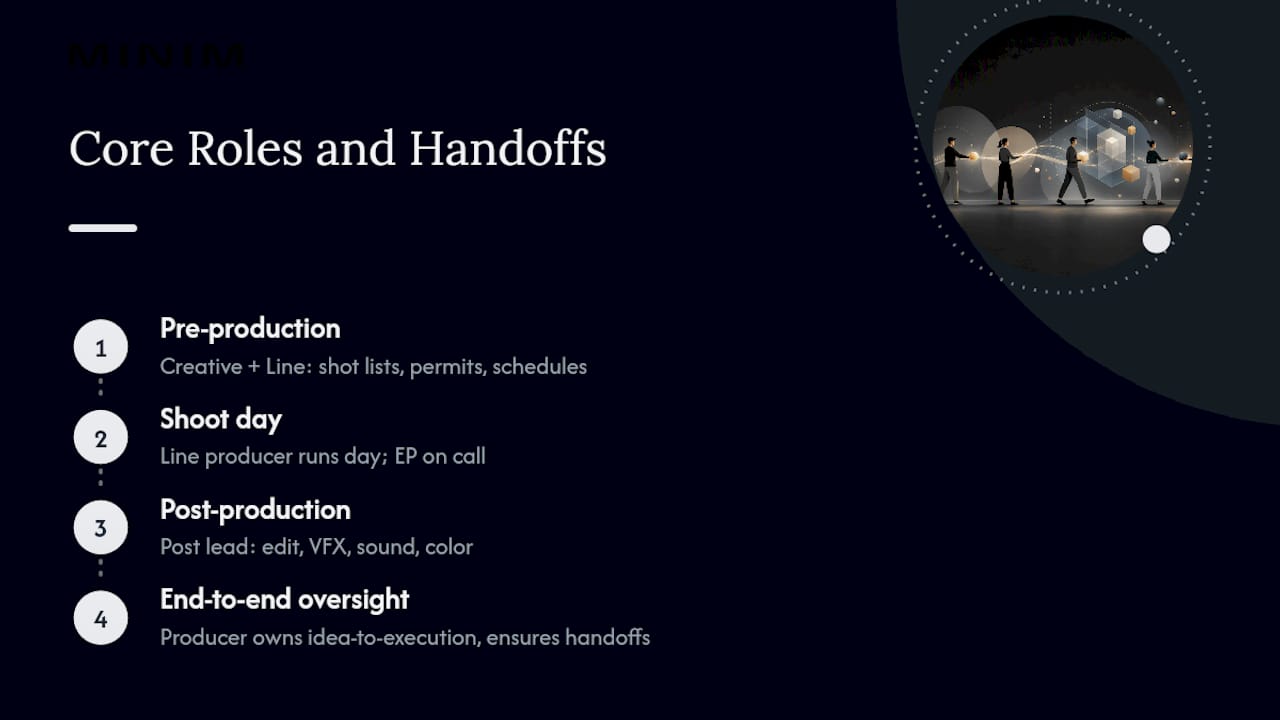
Cross-role handoffs happen constantly. Pre-production is creative producer and line producer working in parallel. Shoot day belongs to the line producer with the EP on call. Post is the post lead's territory, but the creative producer stays involved through final approval. A producer manages the entire process from idea to execution, which means these handoffs, not any single role, determine whether a campaign stays on brief.
Who Owns What: Agency Producer vs. Production Company Producer
The cleanest way to think about this split is macro versus micro. An agency producer serves as the liaison focused on client vision, budget oversight, and schedule, while the production company producer executes the shoot logistics underneath that vision.
- Agency producer owns the "why." Client relationship, creative approval chain, brand safety, and overall budget ceiling stay with the agency side.
- Production partner owns the "how." Crew, vendors, location logistics, technical delivery specs, and day-to-day problem solving belong to the partner's team.
- A single point of contact prevents duplication. Name one person on each side responsible for daily communication, and put that name into the approval matrix in writing.
- Common failure mode: both sides think the other is tracking usage rights. Assign this explicitly in the contract, not verbally on a call.
Skipping this codification is the single most common reason projects run over budget without anyone catching it until invoicing.
How Does a Strategic Production Partner Fit Into an Agency's Workflow?
An embedded partner shows up well before cameras roll and stays engaged after final delivery. During pitch and pre-production, the partner's producer joins budget conversations early enough to flag unrealistic timelines before they become promises to the client. On shoot day, the line producer runs a single liaison channel back to the agency so questions get one answer, not three conflicting ones.
Experienced producers argue that most scope creep happens in the silence between check-ins, not in the big decisions. A strategic production partner consolidating logistics and rollout coordination reduces operational risk precisely because that partner is watching for the small drifts, not just the obvious ones.
What to expect from an integrated partner:
- A named point of contact for daily shoot communication, not a rotating cast
- A defined escalation path when creative and budget conflict on set
- Post handover documentation: raw footage logs, VFX shot notes, and a locked delivery checklist
- Institutional infrastructure that a solo fixer typically can't offer, including redundancy and proactive problem solving
Pro Tip: Ask a prospective partner to walk you through what happens the moment a shoot day goes over schedule. Their answer tells you more about their process than any case study will.
What Should Be in the Contract Before Production Starts?
Budgeting and contract clarity is where most agency headaches originate, and it's almost always preventable. A production agreement should list team roles, an approval matrix, usage rights, and change-order processes explicitly, not as boilerplate but as working documents both sides reference.
Before signing, confirm the following:
- Approval matrix with time limits. Who approves creative, production, and post milestones, and how many business days does each side get before a default approval kicks in?
- Usage rights and territories. Spell out where the ad can run, for how long, and whether talent or music buyouts need renewal.
- Change orders and kill fees. Define what triggers a change order, how overtime gets billed, and what expenses pass through versus what's absorbed.
- SOW deliverables. List every deliverable, the contact responsible for each, and confirm the partner carries production insurance.
Contracts that spell out approval windows and default-approval clauses keep schedules from slipping and protect the agency's margin on the back end. Building contingency into the schedule, typically in the range of single-digit to mid-teens percentage on crew days, absorbs the change orders that would otherwise eat that margin.
How Should Agencies Evaluate a Production Partner?
The evaluation process should test process, not just portfolio. Look for a partner with integrated capabilities across production and post, national rollout experience if your campaign spans markets, and real references who can speak to how the team handled a problem, not just a success story.
- Ask about their project management system. A partner running everything through email and memory will lose track of approvals eventually.
- Ask for a real escalation scenario. "Walk me through the last time a shoot went sideways" reveals more than any pitch deck.
- Check union and insurance experience. If your campaign requires union crew or specific coverage, confirm they've handled it before, not that they're willing to learn.
- Watch for vague deliverables in the proposal. If the SOW doesn't name specific deliverables and dates, that ambiguity will resurface mid-production.
Pro Tip: A shared production timeline with frozen deliverable checkpoints, visible to both teams, cuts decision delays on set more than any single hire does.
What Does a Typical 4 to 8 Week Production Timeline Look Like?
Timelines compress or stretch depending on scope, but the milestone order rarely changes.
- Week 1: Final brief lock. Creative producer confirms the brief and treatment with the client.
- Weeks 2 to 3: Pre-production. Line producer builds the crew, locations, and budget; creative producer finalizes casting and shot lists.
- Week 4: Shoot. Line producer runs the set; executive producer is on call for escalations.
- Weeks 5 to 6: Post-production first pass. Post lead delivers a rough cut for review.
- Weeks 7 to 8: Revisions and delivery. Two revision rounds are typical; final delivery includes all specified formats and assets.
Building in a buffer week between shoot and rough cut absorbs the inevitable schedule slip without triggering a change order.
Why Role Clarity Protects Both the Creative and the Budget
Most agencies underestimate how much scope creep traces back to unclear producer accountability, not creative disagreement. When nobody owns the escalation path, small decisions stall until they become expensive ones. An effective operating model treats role clarity as the mechanism that keeps a cinematic campaign on budget without diluting the creative. That discipline is what separates a production partner from a vendor.
— Steven Reina
Get an Integrated Producer Team Without Adding Headcount
MINIM is the alternative to expanding your internal team every time a campaign scales up. Instead of hiring a line producer, an executive producer, and a post lead for one project, you plug into a team that already runs this playbook, covering creative strategy, campaign development, and full production execution as one integrated unit.

Typically, every engagement starts with a one-page brief, and the partner's team builds a realistic timeline and budget sample before any commitment. If you're deciding between growing headcount and bringing in a partner who already runs the process, discussing real numbers can help clarify the choice. Request a scope call to see what a sample timeline looks like for your next campaign.
Sources
- Agency producer: what they do and how they work | Wrapbook blog
- Video ad production agreement: team roles and usage rights | Contractable
- Why every growing agency needs an agency production partner | Phase 3
FAQ
What Is the Difference Between a Line Producer and an Executive Producer?
The line producer manages day-to-day shoot logistics, crew, and schedule, while the executive producer holds final accountability for budget and quality at the production company level. Escalations that the line producer can't resolve on set go to the executive producer.
Who Handles Approvals on a Commercial Shoot?
The agency producer owns client-facing approvals on creative direction and budget, while the production partner's producers execute the approved plan. A written approval matrix should name who approves what and by when.
How Long Does a Typical Commercial Production Take?
Most campaigns run four to eight weeks from final brief to delivery, covering pre-production, a shoot week, and two revision rounds in post. Complex rollouts or union productions can extend that window.
Does MINIM Provide Full Producer Coverage or Just Crew?
MINIM supplies the full range of producer functions, from creative strategy through full service production and post delivery, integrated directly with an agency's existing creative team. Pricing depends on project scope and is available through a direct conversation with the team.
What Should Be in a Production Partner's Contract?
At minimum, the contract should specify an approval matrix, usage rights and territories, change-order and kill-fee terms, and a full list of SOW deliverables with named points of contact. Missing any of these is a common source of budget disputes mid-production.