
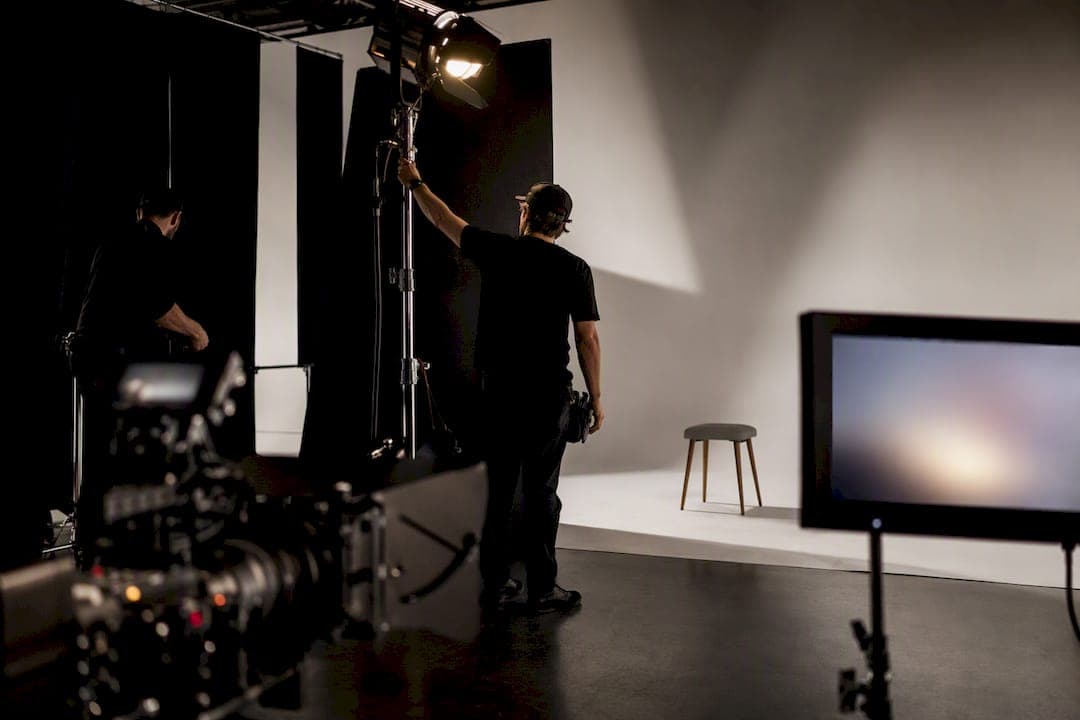
A broadcast-ready commercial moves through six practical stages: brief, concept and script, pre-production, production, post-production, and delivery. A single-day shoot project typically runs several weeks end to end, and rushing that window trades planning time for overtime costs and reshoot risk. Most of the quality gets locked in before the camera rolls and after it stops, not on the shoot day itself.
TL;DR:
- Most of a commercial's quality is determined during pre-production and scripting, not on the shoot day itself, so thorough planning reduces costly reshoots.
- A clear brief including objectives, audience, message, brand guidelines, and schedule is essential for accurate quoting and scope clarity, preventing scope creep.
- Pre-production tasks like casting, location permits, and insurance are critical for avoiding delays and budget overruns, especially with multiple locations or stunt work.
- Post-production typically requires 1 to 3 weeks for editing, color grading, and sound, with detailed planning for asset formats and delivery standards essential to avoid last-minute rework.
- Compressing the 4 to 8-week timeline increases costs and the risk of lower quality, which is why maintaining a balanced schedule is crucial for quality and budget control.
Table of Contents
- What Is the Commercial Production Process?
- How Do You Develop the Concept, Script, and Storyboard?
- What Does Pre-Production Planning Actually Involve?
- Who Does What on Shoot Day?
- What Happens During Post-Production and Finishing?
- How Do You Deliver a Commercial for Broadcast and Digital?
- How Long Does a Commercial Take to Make, and What Does It Cost?
- How MINIM Runs Production for Agency Partners
- Start a Production Engagement With MINIM
- Resources for Planning Your Production
- Sources
- FAQ
What Is the Commercial Production Process?
The term "commercial production process" gets used loosely, but agencies and studios generally mean the same thing production houses call the advertising production workflow: the sequence from creative brief to final delivered asset. Some marketers also call this the TV commercial production process or the commercial video production process, and all three describe the same pipeline.
Understanding how commercials are made starts with the brief, because everything downstream depends on it. Here's what a working brief needs before a production partner can quote accurately:
- Objective and KPI: what the commercial needs to do (brand lift, direct response, launch awareness) and how you'll measure it
- Audience definition: who the spot targets, specific enough to guide casting and tone
- Single-message sentence: one line every stakeholder can test creative against later
- Brand guidelines: logo usage, tone, color palette, and any legal or compliance constraints
- Length and placements: 30-second broadcast spot, 15-second cutdown, vertical social versions
- Budget band: even a range keeps concept development grounded in reality
- Timing: air date, and whether the schedule allows for a normal timeline or requires compression
A one-line creative objective forces alignment early. If a stakeholder can't measure a concept against that sentence, the concept isn't ready to pitch. Agencies that skip this step tend to pay for it later in scope creep and inaccurate quotes, because a production partner is essentially guessing at intent rather than pricing a defined deliverable.
How Do You Develop the Concept, Script, and Storyboard?
Most of the creative value in a commercial gets decided before anyone books a location. A strong process runs concept pitches first, narrows to one or two directions, then moves into script drafts and storyboards, and detailed storyboards let teams catch problems while they're still cheap to fix instead of expensive to reshoot.
The sequence usually looks like this:
- Concept pitches: two to four creative directions, each tied back to the one-line objective
- Concept selection: narrow to one or two, informed by client feedback and budget reality
- Script drafts: dialogue, VO, and pacing locked with timecodes
- Storyboards or mood frames: shot-by-shot visuals showing composition, movement, and tone
Each deliverable needs enough detail for a producer to price it. A storyboard without a shot count or VFX notes leaves too much guesswork in the quote. Flag location needs, cast size, and any visual effects at this stage, not after the budget is set.
Pro Tip: Lock music and voiceover licensing during scriptwriting, not during the edit. Licensing negotiations can take days, and discovering a track isn't clearable after picture lock forces a rework nobody budgeted for.
What Does Pre-Production Planning Actually Involve?
Pre-production is where a schedule either holds or falls apart. It's also where budget overruns most often start, and missing permits or insurance are among the most common causes of shoot delays.
The core checklist:
- Casting: talent search, callbacks, and contracts, including usage terms
- Location scouting and permits: municipal permits, property releases, and insurance certificates for each site
- Props and wardrobe: sourced, fitted, and approved against brand guidelines
- Production insurance: liability coverage scaled to the shoot's complexity
- Crew and equipment booking: camera package, lighting, grip, and specialty gear reserved in advance
- Schedule and contingency plans: a shooting order with weather or talent backup built in
A single-location shoot with a small cast is straightforward to schedule. Add a second or third location, stunt work, or a large group of extras, and both budget and timeline scale faster than most first-time producers expect.
On negotiation, day rates versus package pricing matters more than most creative directors realize. A day rate crew charges for hours worked; a package deal bundles gear and personnel at a flat rate, which usually favors you on longer days. Watch overtime thresholds closely. A shoot that runs past 10 or 12 hours often triggers a rate jump that can add thousands to the final invoice, and talent buyouts (paying once for unlimited usage rights instead of per-placement fees) are almost always cheaper than licensing footage repeatedly across multiple campaigns.
Following the full pre-production checklist before the shoot date is the single biggest lever for staying on budget.
Who Does What on Shoot Day?
Shoot day runs on roles, not vibes. The producer manages logistics and budget in real time. The director owns performance and creative interpretation. The director of photography (DP) controls the camera and lighting. The assistant director (AD) runs the schedule and keeps the set moving. A script supervisor tracks continuity across takes, a sound mixer captures clean audio, and a gaffer manages the lighting rig under the DP's direction.
Creative changes on the fly need one clear decision maker, usually the creative director or agency producer on set, so a director isn't fielding conflicting notes from three people at once.
A solid run sheet keeps the day honest:
- Shot list ordered by location and light, not by scene number, to avoid wasted setup time
- Coverage priorities flagged, so if time runs short, the editor still gets what's needed for the 15-second cutdown and vertical versions
- Buffer blocks built into the schedule for setup delays, weather, or extra takes
- Sign-off checkpoints so the AD knows when a shot is locked and the crew can move on
Safety and risk management aren't optional line items. Confirm permits are on-site, insurance certificates cover the specific locations and activities planned, and any stunt work has a qualified stunt coordinator, not just an enthusiastic performer.
Pro Tip: Shoot your safety or B-roll coverage before your hero shots whenever light is fading fast. You can always cut B-roll short; you can't recreate a sunset.
What Happens During Post-Production and Finishing?
Post-production is where the raw footage becomes the actual commercial, and it runs through a fairly predictable set of stages: assembly, rough cut, fine cut, and picture lock, with client review built into each round.
- Assembly edit: raw selects strung together in rough sequence, no polish
- Rough cut: story structure locked, pacing roughed in, first client review
- Fine cut: refined pacing and transitions, typically one or two more review rounds
- Picture lock: no further edits to timing; everything downstream builds on this cut
Once picture is locked, finishing begins. Color grading sets mood and brand consistency. The final audio mix balances dialogue, music, and sound effects against broadcast loudness targets, since networks and streaming platforms enforce specific standards. VFX and motion graphics (lower thirds, logos, legal supers) get added last, and captions plus vertical or square social edits get cut from the same master.
Deliverables typically include a broadcast master, a mezzanine file for archiving and re-editing, web-ready compressed cuts, isolated audio stems for future remixing, and metadata tagging the creative for tracking. Planning these formats before the shoot, not after, preserves the creative hook instead of forcing an awkward crop later. Larger deliverable lists mean larger file transfers, so build that into your post-production timeline too. A detailed post-production workflow guide helps editors and producers plan around this without last-minute surprises.
How Do You Deliver a Commercial for Broadcast and Digital?
Delivery specs vary by broadcaster and platform, and getting this wrong at the last minute means expensive re-renders. Confirm codec, wrapper format, frame rate, and color space with the buyer or network before finishing begins, not after. Loudness standards differ too: some digital platforms target around -24 LKFS, while broadcast networks often follow different regional standards, so never assume one spec fits every placement.
Assets typically move through one of three routes:
- Direct playout delivery to a broadcaster's ingest system, tagged with the required trafficking metadata
- Ad server upload for digital and streaming placements, formatted to each platform's specs
- Cloud transfer to a media agency, who then handles final distribution and scheduling
Media teams also need tracking assets alongside the creative itself: creative ID codes, viewable proof-of-play versions, and timestamped airing logs. Without these, measuring campaign performance against the KPI set in the original brief becomes guesswork. A solid media planning checklist at this handoff stage keeps creative and media teams working from the same specs.
How Long Does a Commercial Take to Make, and What Does It Cost?
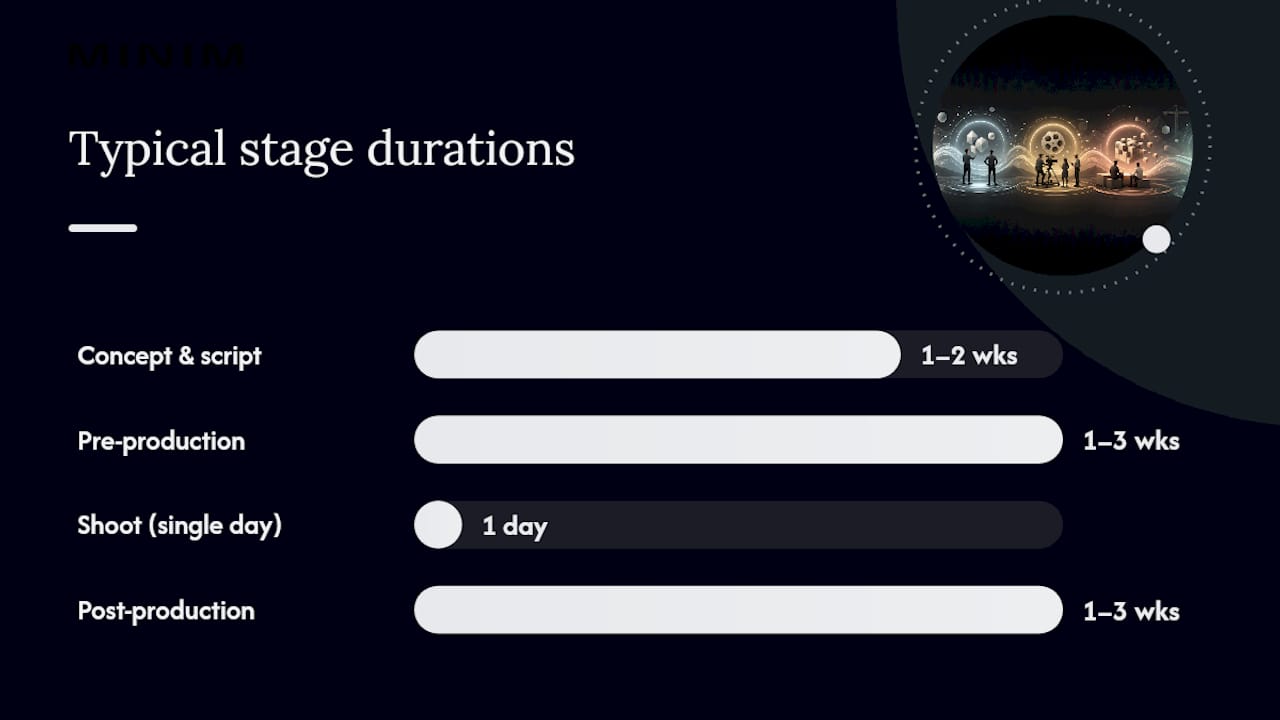
A single-day shoot project runs about 4 to 8 weeks from brief to delivery. Concept and scriptwriting typically take 1 to 2 weeks, pre-production planning runs 1 to 3 weeks depending on location and casting complexity, the shoot itself is usually a single day, and post-production takes another 1 to 3 weeks depending on how many versions and review rounds are needed.
Compressing that timeline has real costs. Rushing pre-production means less time to negotiate crew rates, which often pushes overtime charges higher. Rushing the shoot means less coverage for editors to work with, and rushing post means fewer review rounds, which raises the odds of expensive rework after the client sees a "final" cut they don't like.
| Timeline approach | Typical duration | Trade-off |
|---|---|---|
| Standard schedule | 4 to 8 weeks | Full review rounds, better crew rates, lower rework risk |
| Compressed/rush | As short as 2 weeks | Higher overtime costs, reduced coverage, higher reshoot risk |
If budget is tight, cut smart rather than cutting corners: fewer locations, a smaller cast, practical effects instead of heavy VFX, and reusing existing brand assets where the creative allows. Those choices protect quality while trimming cost, unlike compressing the schedule, which tends to just move cost from the budget line to the risk column.
How MINIM Runs Production for Agency Partners
A partner production company can integrate directly into agency creative teams to own execution, from casting logistics to final delivery, allowing the agency to avoid adding permanent production headcount. That means the agency keeps creative control over concept and client relationships while MINIM handles the operational weight of getting a commercial made.
Keeping timelines predictable at scale comes down to disciplined pre-production and clear approval gates between every stage, the same structure outlined throughout this piece. When agencies bring in a partner who already runs this process repeatedly, fewer things get discovered for the first time on someone else's shoot day.
— Steven Reina
Start a Production Engagement With MINIM
MINIM is the alternative to building out an in-house production team: you get cinematic execution on a project basis, without the overhead of hiring, equipment, or a permanent crew roster. That matters most when an agency wins a campaign that needs broadcast-quality output on a deadline no internal team was staffed to hit.

A production partner can handle creative strategy, scriptwriting, art direction, filming, and 2D/3D visual effects as one integrated engagement, so agency teams get one point of contact instead of juggling multiple vendors. That structure is built specifically for predictable timelines and scaled output when an agency's internal bandwidth can't stretch to cover every client campaign in-house.
Review examples of finished campaigns on the work page, then start with a discovery call to scope your timeline and budget band against the standard 4 to 8 week production window.
Resources for Planning Your Production
A few external and internal resources go deeper on specific phases covered here:
- How to Make a Commercial: Step-by-Step Guide for concept and scripting detail
- The Ultimate Guide to TV Commercial Production for post and delivery specs
- MINIM's pre-production checklist and storyboard workflow guide for ready-to-use templates
- MINIM's guide to remote production workflows for agency collaboration models
Sources
- How to Make a Commercial: Step-by-Step Guide (2026)
- The Ultimate Guide to TV Commercial Production - Assemble
- Advertising Production Process
FAQ
What Are the Five Steps in the Production Process?
The core stages are concept and script development, pre-production planning, the shoot itself, post-production, and final delivery, with the creative brief acting as the foundation that shapes every stage after it.
What Is a Commercial Production?
A commercial production is the full process of turning a marketing objective into a finished video advertisement, covering everything from scriptwriting and casting through editing, color, sound, and delivery to broadcast or digital platforms.
How Long Does It Take for a Commercial to Air After Filming?
Post-production typically takes 1 to 3 weeks after filming, covering editing rounds, color, sound mixing, and finishing versions for each placement, before the final asset ships to broadcasters or ad platforms.
Do Actors Get Paid Every Time Their Commercial Airs?
It depends on the contract: some talent agreements pay residuals each time a spot airs in a specific market, while others use a buyout structure, paying a single flat fee upfront for unlimited usage rights.