

Creative campaign development turns a single idea into a measurable, multi-channel marketing program. It's the full arc from a scribbled positioning statement to a produced, tracked, and optimized set of assets running across paid, owned, and earned channels. The output is a market-ready campaign with a locked measurement plan, not just a nice-looking video or a clever headline.
If you're starting one this week, skip the brainstorm and do this first: write a one-page creative brief and define your KPIs before anyone touches a script or a storyboard. Everything downstream, timeline, budget, production scope, depends on getting that page right.
That one page should answer:
- What business problem is this campaign solving, and for whom?
- What's the single-minded message, in one sentence?
- What are the primary and secondary KPIs, and who owns reporting on each?
- What's the hard deadline, and what's the real budget ceiling?
Get those four answers locked, and the rest of the process below moves fast. Skip them, and you'll spend more time in revision cycles than in production.
Key Takeaways
Creative campaign development succeeds when the brief, the KPIs, and early concept testing are locked before a single final asset gets built.
| Point | Details |
|---|---|
| Lock the brief first | Write a one-page brief with a single-minded message and named KPIs before any concepting starts. |
| Test concepts early | Quick 24 to 48 hour testing can lift creative effectiveness by roughly 48% versus skipping it entirely. |
| Set tracking before production | Install pixels, UTMs, and dashboards before assets go live, not after launch day. |
| Build the timeline backward | Work back from launch date and group activities by paid, owned, and earned media. |
| Bring in production support at scale | MINIM integrates with agency creative teams to execute tested concepts into cinematic, multi-format campaigns without added headcount. |
Table of Contents
- The Creative Campaign Development Process, Step by Step
- How Should You Measure and Optimize a Live Campaign?
- What Should Your Campaign Timeline and Checklist Look Like?
- What Common Mistakes Sink Creative Campaigns?
- When Should You Bring in a Production Partner?
- Sources
The Creative Campaign Development Process, Step by Step
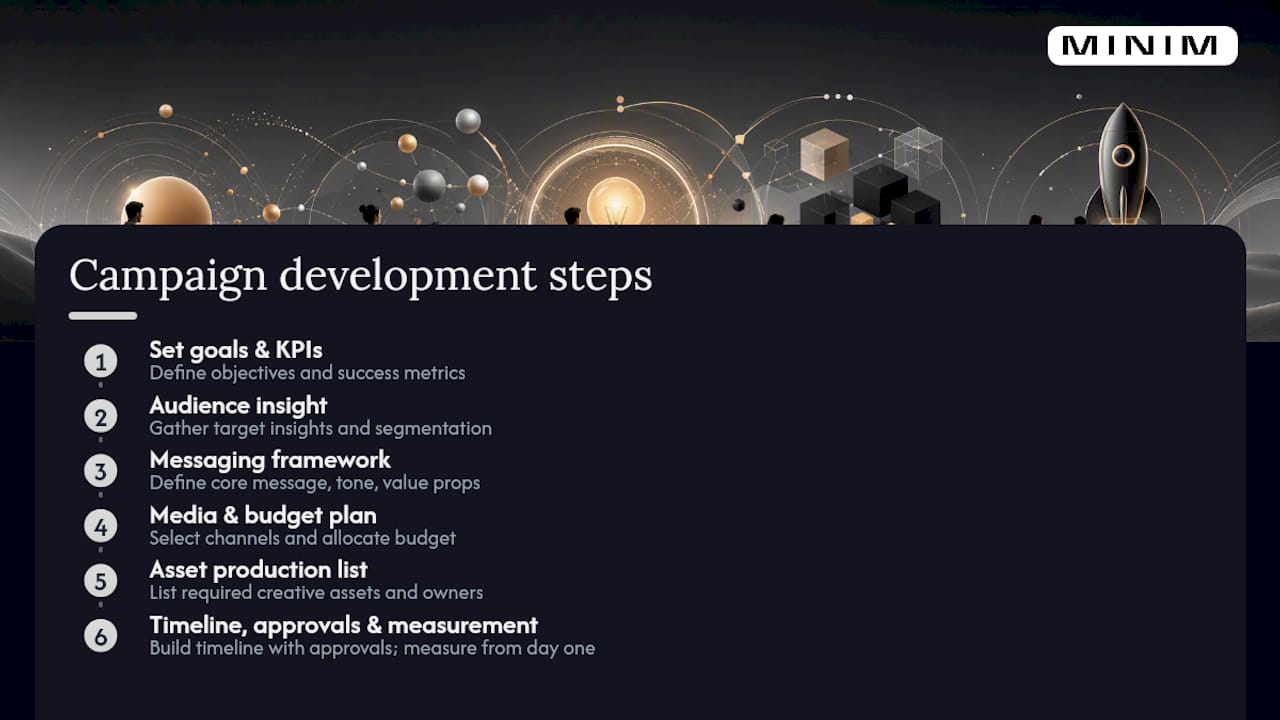
Most campaigns don't fail in production. They fail in the two weeks before anyone opens a design file, when the brief is vague, the audience is guessed at, and nobody has agreed on what winning looks like. A well-structured campaign plan needs goals and KPIs, audience insight, a messaging framework, a media and budget plan, an asset production list, a timeline with approvals built in, and a measurement plan from day one. Below is the nine-stage version of that structure, built for teams who need to move fast without skipping the parts that prevent rework.
1. Discovery and alignment
Before anyone generates a single concept, get the stakeholders in a room (or on a call) and pin down the business objective, the scope, and the real budget. This sounds obvious. It's also the stage teams rush most often, and rushing it is why campaigns get killed in week six over a disagreement that should have surfaced in week one.
Ask directly: Who signs off on creative? Who owns the media budget? Is this campaign replacing something, or adding to the mix? What does the CMO actually care about, awareness, pipeline, or share of voice? Write the answers down. A video creative brief template built around these questions gives you a shared document everyone can point back to when priorities start drifting midcampaign.
2. Research and audience insight
You need three things here: a clear audience segmentation, a read on what competitors are doing in the same space, and a realistic sense of channel sizing (how much reach is actually available on the platforms you're considering, at the budget you have).
Skip the 40-slide audience deck. What matters is specific: what does this segment believe right now that your campaign needs to shift? What have competitors already said, so you don't repeat it? Where does this audience actually spend attention, and at what cost per channel? Answer those three questions and you have enough to brief creative.
3. Write the creative brief
This is where the campaign either gets a spine or doesn't. The brief needs a single-minded message, a plain-English campaign idea sentence, and the primary KPIs stated in numbers, not adjectives.
One format that works well here: [audience] believes [X], but [brand] proves [Y]. It's blunt, it fits on one line, and it forces you to state a tension instead of a vibe. A soft drink brand doesn't need "refreshing and fun" as its idea. It needs something like: "Gen Z believes canned drinks are interchangeable, but this brand proves flavor innovation is worth paying for." That sentence becomes the filter for every creative decision that follows, including which drafts to kill.
Add a short "not list" to the brief too, a few lines on what the campaign explicitly is not (not slapstick, not celebrity-led, not stock-footage aesthetic). It sounds like a small addition. In practice, it's what stops tone drift when three different vendors or freelancers touch the same campaign over eight weeks.
4. Brainstorm and concepting
Here's where the industry has genuinely shifted. For years, campaign development meant chasing one "big idea" that could stretch across a Super Bowl spot, a billboard, and a banner ad. That model still has a place for major brand moments, but a lot of current campaign thinking has moved toward social-first, micro-campaign structures: smaller creative bets, tested and iterated in near real time, rather than one monolithic concept baked for months before launch.

Both approaches are valid, and the choice depends on your KPI. If you're building brand equity over a year, invest in the bigger idea. If you're driving weekly conversion lift on paid social, build five small concepts and let performance data pick the winner. Don't default to "big idea" just because that's the traditional model. It's often the wrong tool for a performance-driven brief.
However you structure the ideation session, run it as a genuinely collaborative process. Cross-discipline brainstorming consistently produces stronger concepts than a single writer or art director working in isolation and presenting a finished idea for approval. Get strategy, creative, and media planning in the same room before anyone starts sketching.
5. Tissue meeting and refinement
Before you take anything to formal testing, run a tissue meeting: an informal internal review where creative shows rough concepts (sketches, scripts, boards, not finished work) to stakeholders for a gut check. The goal isn't polish. It's catching a feasibility problem, a legal red flag, or a tone mismatch before you've spent real money refining a concept that was never going to survive contact with the client.
This step gets skipped constantly under deadline pressure, and it's almost always a mistake. A 45-minute tissue meeting costs you almost nothing. A concept that dies in week five of production, after boards, after a locked shot list, costs you real weeks and real budget.
6. Concept testing
This is the stage with the clearest evidence behind it, and the one teams cut first when timelines get tight. Early-stage testing of creative concepts, run as quick qualitative reactions or a small quantitative pulse survey, can lift creative effectiveness by roughly 48% compared with skipping testing entirely. That's not a marginal edge. That's close to half your creative's eventual performance, determined before a single final asset gets built.
The trick is speed. Testing doesn't need to be a three-week research project. Pressure-test your top two or three concepts within a 24 to 48 hour window, using a rough cut, a static mock, or even a script read. You're not trying to predict exact performance. You're checking that the message lands, the brand is recognizable, and nothing in the concept confuses or alienates the audience you researched in stage two.
Pro Tip: Test the idea sentence before you test the execution. If reviewers can't restate your campaign's core message in their own words after seeing a rough concept, no amount of production polish in stage 7 will fix that gap.
7. Production and execution
Now, and only now, you build. This is the stage MINIM operates in daily, and it's also where sloppy upstream work gets expensive fast. Before a single camera rolls or a single design file gets finalized, lock three things: your asset list (every format, every aspect ratio, every platform-specific cut you'll need), your version control process, and your tracking setup.

That last point deserves emphasis. Tracking, pixels, UTM parameters, conversion events, needs to be configured and tested before assets go live, not scrambled together the morning of launch. A repeatable campaign process treats build and QA as a distinct phase precisely because skipping it is how campaigns lose their first week of performance data. If your tracking breaks on day one, you don't get that data back.
QA at this stage means checking every link, every landing page, every caption for accessibility, and every legal disclaimer, not just admiring the final cut in a screening room. A media asset management workflow also earns its keep here, especially on campaigns running a dozen or more cuts across markets and formats, where version confusion is the single most common production headache.
8. Launch and live optimization
Launch day is not the finish line. It's the start of the highest-leverage two weeks in the whole campaign. Build a rapid iteration plan before launch: which creative variants get tested against each other, what threshold triggers a budget shift, and who has authority to make that call without a three-day approval chain.
Set your reallocation rules in advance. If Variant B is outperforming Variant A by a meaningful margin within the first 72 hours on paid social, someone should be able to shift spend that day, not wait for the weekly status meeting.
9. Reporting and learning
Separate your short-term demand metrics (clicks, conversions, cost per lead) from your longer-term brand measures (awareness lift, message association, share of voice). Report both, on different timelines, to different stakeholders. A sales-focused executive wants the demand numbers weekly. A CMO tracking brand health wants the awareness data monthly or quarterly. Confusing the two, or reporting only one, is how good campaigns get killed for looking like they underperformed when they were never designed to move that particular number.
How Should You Measure and Optimize a Live Campaign?
Set your KPIs before you set your budget, not after. Primary KPIs are the numbers tied directly to the business objective from stage one: conversion rate, cost per acquisition, or pipeline influenced for a demand-gen push; reach and message recall for a brand campaign. Secondary KPIs (click-through rate, engagement rate, video completion) tell you whether the creative is working mechanically, even if the primary number takes longer to move.
Before any creative goes live, get the technical foundation in place:
- Pixels and conversion events installed and tested on every landing page
- A consistent UTM taxonomy so channel performance doesn't fragment across a dozen naming conventions
- Tag management configured to avoid a mid-campaign scramble when marketing wants a new event tracked
- One dashboard as the single source of truth, so creative, media, and leadership are all looking at the same numbers
That last point matters more than it sounds. Nothing derails a Monday status meeting faster than two teams pulling different numbers for the "same" metric from two different tools.
The Ipsos research on early concept testing is worth repeating here for a specific reason: that 48% effectiveness lift isn't just a production-stage finding. It's evidence that your measurement plan and your testing plan are the same investment made twice. Test early, and you're optimizing a concept that already had a fighting chance. Skip it, and your "optimization" phase is really just damage control on an unproven idea.
Run optimization on three cadences, not one. Daily: check spend pacing and technical delivery, are ads actually serving, is tracking firing correctly. Weekly: swap underperforming creative variants and adjust targeting. Monthly: step back and ask whether the strategic direction, not just the execution, still matches what the market is telling you. Modern campaign management increasingly leans on data-driven optimization and advanced segmentation to make that weekly and monthly cadence faster and more precise, particularly for teams running campaigns across five or more channels simultaneously.
Translate creative signals into budget language before you walk into a leadership review.
What Should Your Campaign Timeline and Checklist Look Like?
Build your timeline backward from launch, not forward from kickoff. Working-back planning, standard in frameworks like SOSTAC and RACE, forces you to confront hard deadlines (media booking cutoffs, legal review windows, platform ad-approval lag) before they become emergencies.
A basic work-back structure for an eight-week campaign:
- Weeks 8 to 7: Discovery, research, and audience insight
- Week 6: Creative brief locked and signed off
- Weeks 5 to 4: Concepting, tissue meeting, and concept testing
- Weeks 3 to 2: Production, asset build, and QA
- Week 1: Tracking verification, legal signoff, and final approvals
- Launch week: Go live, monitor daily
- Weeks +1 to +4 post-launch: Optimization and first reporting cycle
Group your activities by paid, owned, and earned media, since each has different lead times. Paid media needs booking lead time and platform approval. Owned assets (your site, email, app) need development and QA time. Earned media, PR, influencer, organic, moves on its own schedule and should get built into the timeline rather than treated as a bonus.
Before anything goes live, run through a prelaunch checklist:
- Every link tested, including on mobile
- Landing pages load-tested and mobile-responsive
- Creative reviewed for accessibility (captions, alt text, color contrast)
- Legal and brand signoffs documented, not just verbally confirmed
- Tracking verified with a live test conversion, not just a code check
Once you're live, the first 30 days need their own checklist: daily performance monitoring against your KPI thresholds, a documented A/B test plan for creative variants, and a scheduled asset refresh (fatigue sets in faster on paid social than most teams plan for, often within two to three weeks of continuous exposure).
What Common Mistakes Sink Creative Campaigns?
Most failed campaigns share the same two root causes: a brief that never got specific, and a measurement plan bolted on after launch instead of built in before it. A vague brief produces vague creative, and vague creative produces vague results that nobody can diagnose, because nobody agreed in advance on what "working" looks like.
Skipping concept testing is the second most expensive mistake, and it's expensive twice. You lose the effectiveness lift testing would have given you, and you risk building full production assets around an idea that a 48-hour test would have flagged as confused or off-brand. The UNICEF Tap Project is a useful counter-example: a single clear creative concept held together across channels and delivered a measurable result precisely because the idea was tested and unified before it scaled.
Watch for these red flags in your first two weeks of live data:
- Click-through rate is healthy but conversion is flat (usually a landing page or offer mismatch, not a creative problem)
- Engagement is strong but sentiment or comments show audience confusion about the message
- One channel wildly outperforms another with the same creative (a targeting or channel-fit issue, not proof the creative failed)
Pro Tip: Set your pause/pivot decision rule before launch, not during the first bad week. Agree in advance: "If cost per lead exceeds $X after $Y in spend, we pause and revise." Deciding that threshold under pressure almost always leads to either panic-pivoting a campaign that needed one more week, or stubbornly funding one that was already dead.
Where should leadership actually spend their time?
Senior leaders add the most value in exactly three moments: approving the brief, weighing in on concept selection before testing, and signing off on the measurement plan before launch. Everything else, execution details, asset variations, day-to-day optimization, should be delegated to the team closest to the work.
Set clear approval gates at those three points and nowhere else. A leader who inserts opinions into every production review isn't adding quality control. They're adding rework cycles that push your timeline and erode the team's ability to iterate quickly once the campaign is live and every day of delay costs measurable performance.
When Should You Bring in a Production Partner?
Every stage above assumes your team has the bandwidth to execute at the level your brief demands. Often it doesn't, not because the strategy is wrong, but because cinematic production, multiple format cuts, and tight turnaround windows require a scale of crew and post-production capacity that doesn't make sense to build in-house for one campaign cycle.
That's the gap MINIM fills. MINIM works as a production partner that integrates directly with your existing creative team rather than replacing it, taking a concept that's already been through brief, testing, and approval and carrying it through screenwriting, art direction, photography, film, and 2D/3D visual effects to final delivery.
Bring MINIM in at stage seven, production and execution, when your concept is tested and your brief is locked but your internal team doesn't have the crew, the studio capacity, or the turnaround speed to hit a hard launch date. That's also the point where version control and QA get hardest to manage without dedicated production infrastructure, and where an agency without in-house production depth typically starts outsourcing anyway. The difference with MINIM is scale without the overhead of hiring: you get full creative and production services on a per-campaign basis, without adding permanent headcount your agency has to justify after the campaign wraps.
If you're scoping a campaign that's outgrowing your internal production capacity, the practical next step is to bring your locked creative brief to MINIM and start a conversation about your production needs. Review recent work examples to see how the integration typically runs, then request a scope conversation based on your timeline and asset list.
Sources
- Ipsos — Creative development research
- SmartInsights — Structure an effective campaign plan
- Sprinklr — Campaign Management 101
- Monday
- UNICEF USA — Tap Project case study