
A production brief is the document that tells a video team what to make, who it's for, where it will run, and what result it needs to drive. It exists to make quoting, scheduling, and delivery accurate before a single frame is shot. Whoever owns the outcome, whether that's a marketing director, creative lead, or agency producer, should own the brief. MINIM treats a strong brief as the single biggest predictor of whether a shoot stays on budget.
TL;DR:
- A production brief must clearly state a measurable business objective supported by specific deliverables, formats, and distribution locations to prevent costly rework.
- Including actual approver names with turnaround times and a defined budget range early improves quoting accuracy and scope control.
- The brief should be concise, ideally one to three pages, focusing on key facts like deadlines, legal requirements, and target viewing contexts to avoid delays.
- Missing or vague distribution specs and approval chains are common mistakes that lead to project delays, emphasizing the need for detailed, specific instructions upfront.
- Handling complex production planning and scheduling requires turning the brief's constraints into a realistic timeline with milestones and documented scope changes.
Table of Contents
- What a Production Brief Is (and What It Isn't)
- The Essential Fields Every Production Brief Needs
- How to Write a Production Brief, Field by Field
- Common Mistakes That Make a Brief Unusable
- A One-Page Sample Brief You Can Copy
- From Brief to Production Plan: Approvals and Handoff
- How MINIM Uses Production Briefs to Cut Revisions
- When to Bring in a Production Partner
- Sources
- FAQ
What a Production Brief Is (and What It Isn't)
A production brief is not a script, and it's not a creative brief. A creative brief sets tone, positioning, and messaging strategy. A production brief takes that strategy and translates it into the operational facts a crew needs to bid the job correctly: durations, formats, locations, legal constraints, and deadlines. The two documents often travel together, but confusing them is how projects get quoted wrong from day one.
Length matters more than people assume. The best production briefs run one to three pages, with anything longer pushed into attachments. If a producer can't read it once and know what to shoot and what to quote, it has failed its job.
- Distribution specs and an approval chain aren't optional extras; they're the two fields most likely to be missing, and both cause the most expensive rework—knowing how brand standards apply to digital screens effectively helps reduce such costly mistakes.
- A cut for broadcast and a very short cut for a social story are different productions with different budgets, even from the same shoot day.
- Skipping the approval chain is how a "finished" video gets rejected in week six because legal never signed off on a claim.
The Essential Fields Every Production Brief Needs
Every reliable brief, regardless of industry or budget size, runs through the same set of fields. Miss one, and a producer is guessing, which means the quote is guessing too.
Business objective, written as a measurable outcome, not a mood.
Target audience and viewing context matters beyond a demographic label. Note whether the audience will watch with sound on or off, on a phone or a boardroom screen, scrolling fast or sitting through a meeting. That context shapes pacing, captioning, and shot selection.
Deliverables specification should list every cut by duration, aspect ratio, file format, and language or subtitle requirement. This is the field most often left vague, and it's the one that causes the most rework when it's missing.
Distribution and usage mapping tells the team where each cut actually runs, since broadcast, connected TV, paid social, and a website hero placement all demand different specs from the same core footage.
- Mandatory inclusions and exclusions: required legal disclaimers, logos, brand colors, and anything the client explicitly does not want shown.
- Approval chain: named individuals, not job titles, with a maximum turnaround time attached to each review round.
- Budget range and timeline: milestone dates from kickoff to final delivery.
Pro Tip: Stating a budget range early isn't about tipping your hand. Producers treat an unstated budget as a scope risk and often quote high to cover the unknown. A range narrows their guesswork and narrows your bid spread.
How to Write a Production Brief, Field by Field
A brief works when each field has a minimum viable answer. Here's the order to fill it in, with example phrasing for each.
- State the objective as a single measurable sentence. Skip "raise awareness." Write "Increase qualified investor meetings booked in the four weeks following the Q2 roadshow." A vague goal forces the production team to guess at success, which is a background factor in why so many production budgets run over.
- Name the audience and how they'll watch. Example: "Series A investors, viewing on a laptop during a scheduled call, sound on."
- List every deliverable with specs. Example: ":30 broadcast cut, 16:9, ProRes; :06 and :15 social cuts, 9:16, H.264, burned-in captions."
- Map distribution to each cut. Example: "Broadcast cut runs on connected TV; social cuts run on Instagram and LinkedIn paid."
- List mandatory inclusions and hard exclusions. Example: "Must include the updated logo lockup and the FDA disclaimer text; do not show competitor product names."
- Name approvers and turnaround windows. Example: "Creative director: 48-hour turnaround on scripts. Legal: 72-hour turnaround on final cut."
- Set the budget range and milestone dates. Keep this in the core brief. Everything else, mood boards, shot references, brand guideline PDFs, belongs in attachments.
The Video Creative Brief field guide walks through a full template if you want a version to adapt directly.
Common Mistakes That Make a Brief Unusable
Most bad quotes trace back to one of five recurring problems.
- Vague objectives. "Build awareness" gets rewritten as a measurable outcome tied to a specific action and timeframe.
- Missing distribution specs. List every platform and required format before the shoot, not after the edit starts.
- No approval chain. Name the actual people who sign off, with turnaround limits, or the project stalls in review purgatory.
- Late-surfacing legal or rights requirements. Get legal, compliance, and brand teams to flag constraints during brief drafting, not during final review.
- Overlong briefs that bury the decision. If the core document runs past three pages, move reference material into attachments and keep the brief itself decision-focused.
A One-Page Sample Brief You Can Copy
This is the minimum viable structure. Paste it, fill it in, and hand it to your production partner.
- Objective: One sentence, measurable. ("Increase trial signups from the homepage hero video by 15% over 90 days.")
- Audience: One sentence, including viewing context. ("Mid-market SaaS buyers, desktop, sound on.")
- Deliverables: List each cut with duration, aspect ratio, and format. (":60 hero, 16:9, MP4; :15 social, 1:1, MP4.")
- Mandatory inclusions/exclusions: Logos, legal text, brand colors, anything banned.
- Deadline and milestones: Final delivery date, plus key dates in between.
- Budget range: A number range, not a single figure.
- Approvers: Names and their turnaround commitment.
- Attachments note: "See attached deck for brand guidelines, reference footage, and shot list template."
From Brief to Production Plan: Approvals and Handoff
A brief is not a schedule. Production planning is the separate process that turns brief constraints into a working timeline, assigning crew, dates, and resources against the deliverables the brief defines.
- Milestone map: script sign-off, casting, location lock, shoot day, rough cut, fine cut, final delivery.
- Each milestone needs a named approver and a stated turnaround, mirroring the approval chain from the brief itself.
- Change orders should be logged in writing against the original brief, so scope creep is visible and budget adjustments are documented, not assumed.
Plans built on optimistic assumptions rather than realistic capacity, with no feedback loop back to the plan, are the ones most likely to blow their timeline. The same logic applies to a shoot schedule as it does to a factory floor.
How MINIM Uses Production Briefs to Cut Revisions
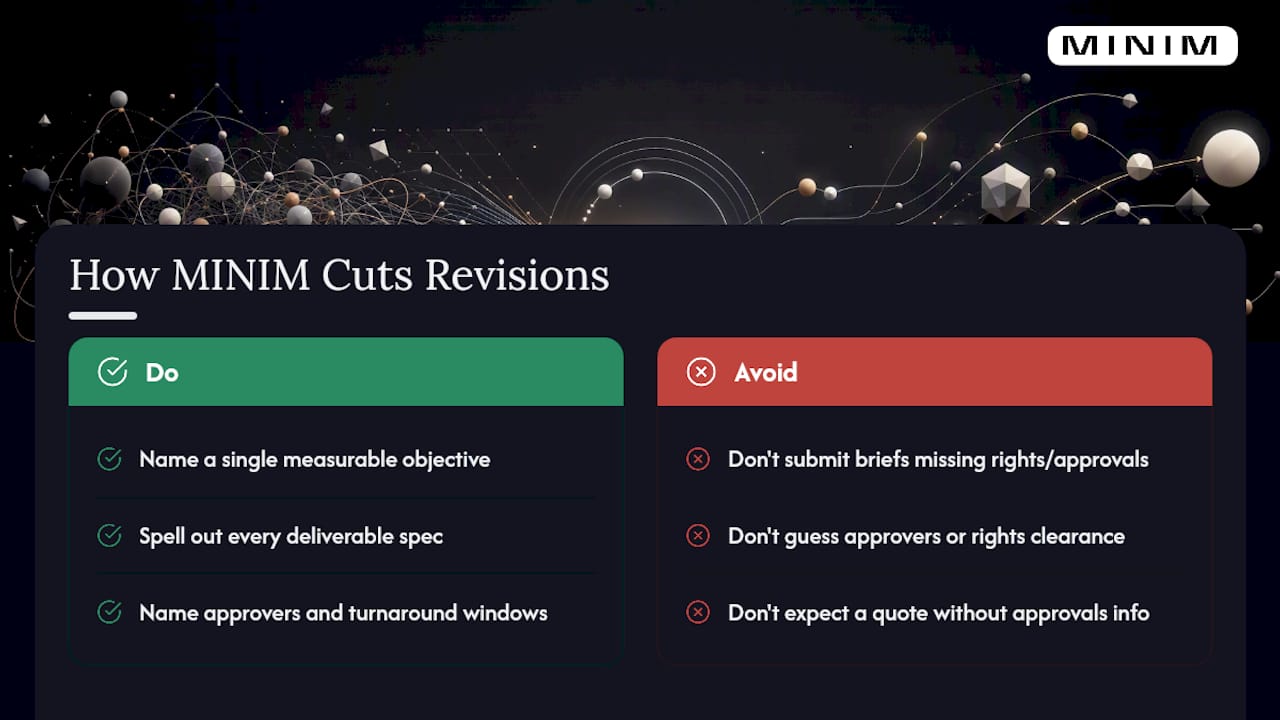
Most briefs that land on our desk need editing before they're quoteable, and that's normal. We push clients to name the single measurable objective, spell out every deliverable spec, and name actual approvers with turnaround windows, because those three fields are what let us build a schedule we can actually hold to.
A brief missing rights clearance or approval names doesn't get quoted. It gets sent back with questions, because guessing on either one is how projects run over budget.
— Steven Reina
When to Bring in a Production Partner
Handling production in-house makes sense when your team already has the crew relationships, the studio access, and the bandwidth to run a shoot without pulling focus from everything else on your plate. Most agencies and brand teams don't, and that's the gap MINIM fills. We integrate directly with your creative team and take a brief from concept through final delivery, covering creative strategy, art direction, film, photography, and visual effects, without you having to staff up internally.

What that means in practice: you hand us a brief, even a rough one, and we turn it into a real quote, a real schedule, and a finished campaign that matches the specs you set. If you're staring at a brief right now and wondering whether it's actually ready to shoot, check what MINIM's team can take off your plate and get a straight answer on scope and timeline.
Sources
FAQ
What is a production brief example?
A short example is a one-page document stating a measurable objective, the audience and viewing context, a deliverables list with durations and formats, mandatory inclusions, named approvers, a deadline, and a budget range.
What are the core parts of a production brief?
The core parts are the business objective, target audience, deliverables specification, distribution mapping, mandatory inclusions and exclusions, approval chain, and a deadline paired with a budget range.
What is an example of a creative brief versus a production brief?
A creative brief sets tone and messaging strategy, while a production brief, the kind MINIM builds with clients, turns that strategy into shootable specs like durations, formats, and approval turnaround times.
What is the purpose of a production brief?
Its purpose is to give producers everything they need to quote accurately, schedule realistically, and deliver the correct formats without guesswork or late-stage rework.
Who should write the production brief?
The person accountable for the project's outcome, typically a marketing director, creative lead, or project manager, should write or own the brief before handing it to a production team or partner.