
A well-planned 30-second spot runs three to five weeks from signed brief to final master. Add a celebrity, multiple locations, or heavy visual effects, and that window stretches to 8 to 12 weeks or more. The single factor that decides which end you land on isn't budget or crew size. It's how fast your client signs off on each round.
Here's the honest breakdown most agencies actually work with:
- Fast (1 to 3 weeks): pre-cleared assets, single location, no celebrity talent, minimal VFX.
- Realistic (6 to 12 weeks): original concept, custom shoot, standard post workflow, one to two revision rounds.
- Complex (8 to 12+ weeks): multi-location or celebrity-driven productions, significant visual effects, and broadcast-specific mastering requirements.
The one rule that keeps any of these ranges honest: work backward from the delivery date, and put a hard time limit on every approval round. A production timeline for commercials doesn't fall apart because the shoot ran long. It falls apart because someone on the client side sat on a cut for nine days when the schedule only budgeted three.
MINIM has run this exact math across dozens of agency-integrated campaigns, and the pattern holds regardless of category or budget tier. Producer Steven Reina, whose prescriptive approach to storyboarding and shot-list discipline shapes how MINIM structures schedules, treats the workback calendar as a contract, not a suggestion.
TL;DR:
- Client approval turnaround times are the primary factor that extends a commercial's schedule, overshadowing shoot or crew logistics.
- Pre-production decisions, especially script lock, casting, and permits, must be finalized early because they directly determine the shoot timeline.
- Building a workback schedule from the final delivery date, with strict approval deadlines, prevents schedule overruns and last-minute delays.
- Post-production often takes 2 to 6 weeks, with VFX-heavy projects lasting even longer, emphasizing the need for early planning and overlap.
- Agencies should enforce clear approval SLAs and work with dedicated partners to maintain strict discipline and prevent schedule slippage.
Table of Contents
- What a Commercial Production Timeline Actually Covers
- How Long Does Pre-Production Take Before You Book the Shoot?
- How Many Shoot Days Does a Commercial Need?
- How Long Does Post-Production Take for a Commercial?
- Sample Production Schedules by Phase and Complexity
- How Do You Build a Workback Schedule for a Commercial?
- What Templates and Tools Keep a Production Schedule on Track?
- How MINIM and Steven Reina Prevent Schedule Slippage
- The Timeline Advice Nobody Follows and Should
- How MINIM Keeps Agency Timelines On Track
- Key Takeaways
- Sources
What a Commercial Production Timeline Actually Covers
When someone asks how long a commercial takes, they usually mean one of two very different things. End-to-end timing starts the clock at brief intake and stops at final delivered masters. Shoot-only timing just counts camera days. Confusing the two is how a client ends up expecting a live spot in three weeks when the real number, once you count casting, VFX, and broadcast mastering, is closer to ten.
The full arc looks like this: brief and creative alignment, script and storyboard development, casting and location work, the shoot itself, and then post production, which usually eats the largest chunk of calendar time. A five-stage framework — brief, pre-production, production, post-production, delivery — is the standard most working producers plan against.
Compressing any of these phases carries a real cost, and it's rarely just money.
- Cutting casting time from two weeks to three days usually means picking from a smaller, less-vetted talent pool.
- Skipping a storyboard round to save two days often means reshooting a scene that didn't match the script's intent.
- Rushing color and sound mixing to hit a broadcast date can produce a master that gets bounced back by network standards review, costing more time than it saved.
Outside those cases, a compressed schedule usually just moves the risk from the calendar to the final cut's quality.
Pro Tip: Before agreeing to a rushed timeline, ask which phase is actually getting cut. If nobody can answer that clearly, the schedule hasn't been built yet, it's just been wished for.
How Long Does Pre-Production Take Before You Book the Shoot?
Pre-production is where most of the calendar gets spent and where most of the expensive mistakes get made or avoided. The decisions locked here, not the ones made on set, determine whether the shoot runs smoothly.
Here's the realistic task-level breakdown:
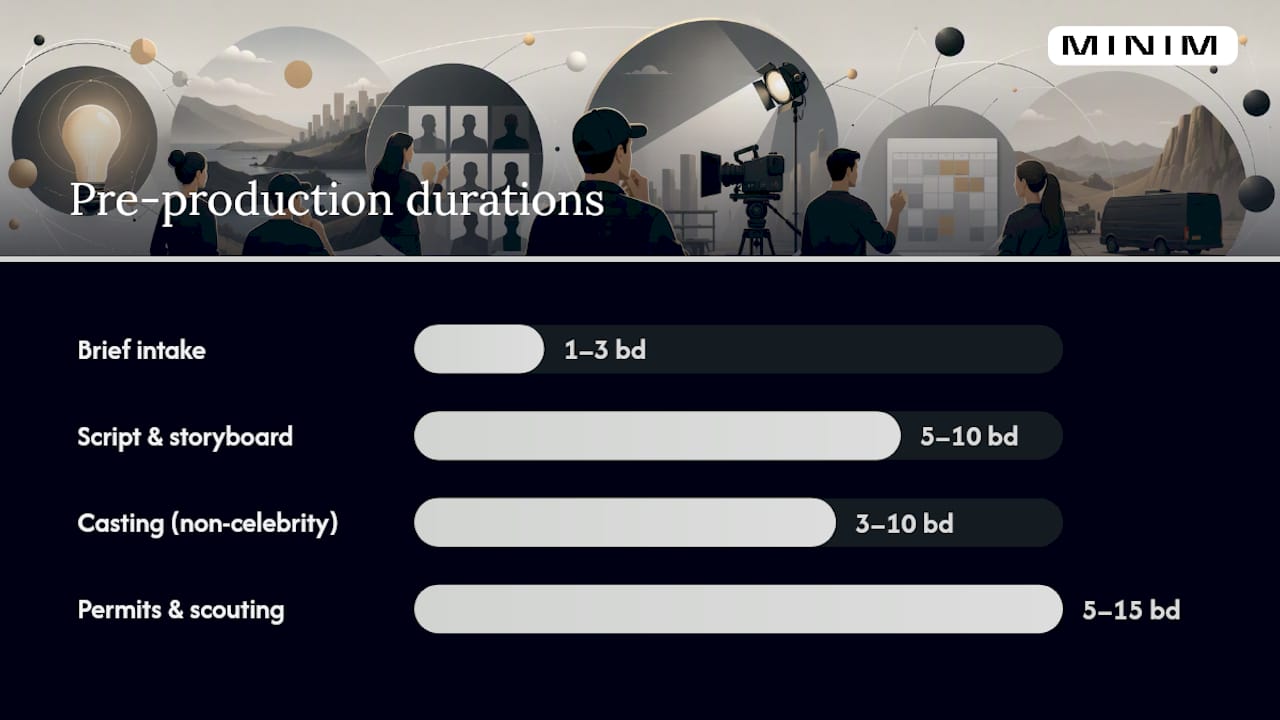
- Brief intake and creative alignment: 1 to 3 business days to capture decision-makers, KPIs, and creative direction in one document. A vague brief is the most common reason a schedule slips before it even starts. MINIM's own creative brief framework exists specifically to close this gap early.
- Concept, script, and storyboard: typically 5 to 10 business days for first drafts, plus 3 to 5 days per revision round. Timing a script aloud and building a scene-by-scene storyboard before locking the shoot date catches pacing problems that are far more expensive to fix on set.
- Casting: 3 to 10 business days for non-celebrity talent through a standard casting call. Celebrity or high-profile talent deals routinely take 2 to 6 weeks or longer once you factor in agent negotiations, usage rights, and exclusivity clauses.
- Location scouting and permitting: 1 to 3 weeks depending on jurisdiction. Municipal film permits alone can take 5 to 15 business days to process, and that's before weather contingency days get added.
- Crew and equipment booking: should happen 2 to 4 weeks ahead of the shoot date. Booking a director of photography or specialty rig with less than two weeks' notice almost always triggers rush fees, sometimes 20 to 30% above standard rates.
The gating items that block everything downstream are the script lock, the casting decision, and the permit approval. None of the shoot logistics can finalize until those three are settled, so treat them as the schedule's critical path, not just line items on a checklist.
A few practices shorten this phase without cutting corners:
- Lock the script before storyboarding starts, not in parallel with it.
- Run casting and location scouting simultaneously instead of sequentially.
- Build a shot list directly from the locked storyboard so the shoot schedule writes itself instead of getting improvised on set.
Professional producers weight their time heavily toward pre-production precisely because the costliest mistakes get decided before a single camera rolls. Reshoots cost far more, in both dollars and calendar days, than an extra storyboard revision ever would.
How Many Shoot Days Does a Commercial Need?
Most commercial shoots run far shorter than people expect. The bottleneck almost never lives in production, it lives in the phases on either side of it.
Here's what typical shoot durations actually look like:
- Single-location, simple setup: half a day to one full day.
- Single-location narrative spot: one full day, sometimes extending into a second for coverage.
- Multi-location: 2 to 3 days, plus travel and setup time between sites.
- Complex or celebrity-driven: 3 or more days, factoring in talent availability windows and larger crew coordination.
On-set discipline is what keeps these numbers from ballooning. Pre-rigging lighting and camera setups before the crew call time saves hours on day one. A dedicated media wrangler managing footage offload in real time means the editor gets usable dailies same-day instead of 48 hours later. And a shot list pulled straight from the locked storyboard, rather than improvised on set, is consistently cited as one of the most effective ways to reduce day-of overruns.
Pro Tip: Build in a weather or daylight contingency day for any outdoor shoot scheduled outside of controlled studio conditions. It's cheaper to hold the day and not need it than to reschedule a full crew and location on 24 hours' notice.
Celebrity talent changes the math in ways beyond just the shoot day itself. Availability windows often get locked months in advance, contract negotiations can add weeks to pre-production, and the shoot day frequently gets compressed to whatever window the talent's schedule allows, which means everything else has to be planned around that single fixed point rather than the other way around.
How Long Does Post-Production Take for a Commercial?
Post production is almost always the longest single phase, and it's the one agencies most consistently underestimate. Plan for 2 to 6 weeks for typical commercial post, with VFX-heavy projects running considerably longer.
Here's how the time typically breaks down for a standard 30-second spot:
- Offline edit and assembly cut: 3 to 7 business days for the first assembly, depending on footage volume.
- Fine cut and revisions: 1 to 3 weeks, driven almost entirely by how many revision rounds the client requires and how fast they turn feedback around.
- VFX: highly variable. A handful of cleanup shots might add a few days; a fully composited environment can add multiple weeks, and shot count matters more than overall runtime.
- Color grading: 1 to 3 days for a standard grade, longer for spots requiring multiple format-specific passes.
- Sound design and mix: 2 to 5 days, including music licensing coordination if a licensed track is involved.
- Versioning: budget half a day to a full day per additional cut. A social vertical, a 15-second cutdown, and a broadcast master each need their own pass, and they don't happen automatically once the 30-second master is locked.
Picture lock is the hinge point of the entire phase. Nothing in color, sound, or final versioning can proceed with real confidence until the edit stops changing, which is exactly why client indecision on the fine cut is the most expensive delay in the entire schedule.
The smartest post schedules overlap departments instead of running them in sequence. An editor can start assembling dailies while the shoot is still wrapping its last day, and sound design can begin once picture lock is close but not yet finalized, since dialogue and pacing rarely shift much in the final pass. That overlap alone routinely saves a week or more on the back end without compressing any individual task. MINIM's own post production workflow is built around exactly this kind of parallel handoff.
Sample Production Schedules by Phase and Complexity
Every production is different, but the pattern across fast, realistic, and complex timelines is consistent enough to build a starting calendar from.
| Phase | Fast | Realistic | Complex |
|---|---|---|---|
| Brief and alignment | 1 to 2 days | 3 to 5 days | 5 to 7 days |
| Pre-production | 3 to 5 days | 2 to 3 weeks | 4 to 6 weeks (celebrity clearance adds time) |
| Shoot | 1 day | 1 to 2 days | 3+ days (talent availability drives the window) |
| Post-production | 3 to 5 days | 2 to 4 weeks | 4 to 6 weeks (VFX-heavy adds further) |
| Delivery and mastering | 1 day | 2 to 3 days | 3 to 5 days (multiple broadcaster specs) |
Read this table as a starting point for your own workback calendar, not a fixed promise. The "realistic" column reflects what most standard agency-produced spots actually need when nothing goes wrong and client approvals stay on schedule. The "complex" column assumes at least one major variable, celebrity talent, multi-market versioning, or heavy VFX, is in play.
How Do You Build a Workback Schedule for a Commercial?
A workback schedule starts at the end and builds backward, which sounds obvious but almost nobody does it consistently. Most schedules get built forward from the kickoff date, which is exactly how a live date quietly slips by three weeks without anyone noticing until it's too late.
Here's the actual method:
- Set the live date first. Everything else derives from this single fixed point, not from when you'd like to start.
- List every deliverable, not just the hero 30-second cut. Include social cutdowns, verticals, and any broadcaster-specific masters.
- Assign a realistic duration to each task, using the phase benchmarks above as your starting point.
- Add buffers before you add anything else. A rushed job needs 20 to 30% more time built in than the task durations alone suggest. Client approval rounds specifically need 2 to 4 business days each, not "however long it takes."
- Work backward from the live date, stacking each phase's duration plus its buffer, until you land on the date the brief needs to be locked.
If that final date is already in the past, you don't have a schedule, you have a negotiation.
Stakeholder SLAs matter more here than almost anything else in the plan. Assign one single decision-maker per client, not a committee, and get explicit agreement on turnaround time for each approval round before the schedule gets built. A common finding across production guides is that slow client sign-off, not shoot delays or vendor issues, is the single most frequent cause of schedule overruns.
Pro Tip: Start the editor on dailies the same day the shoot wraps, not the following Monday. That single habit alone can shave three to five days off a realistic-tier post schedule.
What Templates and Tools Keep a Production Schedule on Track?
A scene-by-scene production schedule template that maps date, time, location, crew, and equipment against each scene is the right tool once you're inside pre-production and heading toward a shoot date. A high-level Gantt chart is better suited to the earlier planning conversation with a client, where the goal is showing overall phase timing rather than shot-by-shot logistics.
A few tool categories worth having in rotation:
- Spreadsheet-based schedule templates for scene-level shoot planning.
- Call sheet generators that pull directly from the locked shot list.
- Post production timeline estimators for scoping edit and VFX time before quoting a delivery date.
- Automated scheduling platforms; several agency-focused tools now handle workback calendars and stakeholder approval tracking in one place.
Before wrap, run through a short pre-wrap checklist: confirm media has been backed up and handed off properly, lock the temp sound mix, and make sure music licensing paperwork is signed, not just verbally agreed. Store final deliverables somewhere version-controlled so a rejected master from a broadcaster doesn't trigger a full re-render from scratch.
How MINIM and Steven Reina Prevent Schedule Slippage
Most schedule slippage traces back to the same three culprits: a script that wasn't locked before storyboarding began, a shot list improvised on set instead of built ahead of time, and an approval process with no enforced turnaround.
Time-locked approvals aren't a courtesy you extend to a client. They're a structural requirement of the schedule itself. A storyboard that hasn't been signed off by a fixed date isn't "almost done," it's a risk sitting on your calendar with no owner.
Steven Reina's approach to commercial production leans hard on this kind of prescriptive discipline: storyboards locked before shoot dates get booked, shot lists derived directly from those storyboards rather than improvised on set, and approval windows treated as hard deadlines rather than suggestions.
MINIM integrates directly into agency creative teams to own exactly this kind of schedule risk, taking on the production management burden so internal teams don't need to expand headcount just to keep a calendar on track.
The Timeline Advice Nobody Follows and Should
Most schedule failures don't come from bad planning. They come from good plans nobody enforced. Every producer knows to build a workback calendar. Very few actually put a hard number on how long a client gets to approve a cut before the schedule absorbs the hit.
That's the gap worth closing. The conventional wisdom obsesses over shoot logistics, crew size, camera packages, location complexity, when the shoot itself is usually the shortest phase in the entire process. The real leverage sits in pre-production discipline and approval enforcement, two things that cost nothing extra to fix and get ignored constantly because they require an uncomfortable conversation with a client about their own turnaround time.
If you take one thing from this and apply it to your next production timeline for commercials, make it this: put a number on every approval round before the schedule goes out, not after the first one runs long. A workback schedule without an enforced SLA isn't a schedule. It's a hope with a calendar attached.
— Steven Reina
How MINIM Keeps Agency Timelines On Track
MINIM exists for exactly the failure point this article keeps circling back to: the gap between a schedule that looks good on paper and one that actually survives client approvals, casting delays, and a shoot day with weather working against it. Rather than adding headcount to absorb that risk internally, agencies bring MINIM in as the production partner who owns the calendar from brief through final master.

That means creative strategy, screenwriting, casting coordination, the shoot itself, and full post production, including VFX and color, run through one integrated team instead of getting stitched together across multiple vendors with competing schedules. The workback discipline covered throughout this piece, locked storyboards, enforced approval windows, parallel post workflows, is the same discipline MINIM applies to every campaign it takes on.
If your next commercial needs a partner who treats the delivery date as fixed and builds everything else around it, explore MINIM's services and start a conversation about your timeline before the brief goes out, not after it slips.
Key Takeaways
A production timeline for commercials succeeds when the workback schedule is anchored to a fixed live date and every client approval round carries an enforced turnaround deadline.
| Point | Details |
|---|---|
| Know your band | Fast timelines run 1 to 3 weeks, realistic ones run 6 to 12 weeks, and complex or celebrity-led projects take 8 to 12+ weeks. |
| Front-load pre-production | Lock the script and storyboard before booking the shoot; reshoots cost far more than an extra revision round. |
| Budget real casting time | Non-celebrity casting takes 3 to 10 days; celebrity talent deals can take 2 to 6 weeks or longer. |
| Treat post as the longest phase | Plan 2 to 6 weeks for standard post production, more for VFX-heavy work. |
| Enforce approval SLAs | Client sign-off delays cause more schedule overruns than shoot-day problems. |
| Bring in a schedule-owning partner | MINIM integrates with agency teams to manage the full timeline from brief through delivery without adding internal headcount. |
Sources
- How Long Does It Take to Make a TV Commercial? Full Timeline Guide (2026)
- Workback schedule
- TV Commercial Production Prep — From Script to Schedule (StudioBinder)