

Scaling creative production comes down to fixing three things at once: the marginal cost of each new asset, throughput without a quality collapse, and a signal loop fast enough to tell you what to make next. Miss any one of the three and the other two stall out. Add headcount without fixing cost-per-variation, and you've just made an expensive problem move faster.
Before you touch a headcount plan or a new tool budget, audit where you actually stand:
- Cost check: Does your cost per asset go down, flat, or up as volume increases? If it's flat or rising, you don't have a scaling system, you have a treadmill.
- Throughput check: Can your team ship 12 to 25 creatives a week for an active channel without weekend crunch, per the 12-asset-per-week benchmark?
- Signal check: How many days pass between an asset going live and someone acting on its performance data?
- Brief check: Do briefs get rewritten from scratch for every channel, or reused from a master template?
These three levers interact. A cheap asset that ships slowly doesn't help you. A fast pipeline that can't tell you which hook worked just produces waste at higher velocity. Fix cost, throughput, and measurement together, or you're just relocating the bottleneck.
Key Takeaways
Scaling creative production successfully requires collapsing marginal cost per asset, redesigning workflows for throughput, and automating signal extraction so the feedback loop closes at production speed.
| Point | Details |
|---|---|
| Diagnose before you hire | Audit cost-per-asset, throughput, and signal latency separately before adding headcount. |
| Use tiered briefs | Pair one master brief with channel-specific appendices to stop brief drift. |
| Target a weekly cadence | Aim for 12 to 25 creatives per week for active channels, run on a Monday-to-Friday loop. |
| Consolidate your tool stack | Three to five well-integrated tools outperform a sprawling ten-tool setup. |
| Partner for execution capacity | MINIM integrates with in-house creative teams to add production volume without new full-time hires. |
Table of Contents
- Why Scaling Creative Production Is an Infrastructure Problem
- The Three Bottlenecks Behind Every Stalled Scaling Effort
- Building the Operational Playbook: Briefs, Tiers, and Weekly Cadence
- Which Tools Actually Help You Scale Creative Output?
- Should You Build an In-House Team or Partner With a Production Specialist?
- How Do You Turn Performance Data Into the Next Brief?
- Setting Up Roles, SLAs, and Workflow Templates That Hold Under Load
- What Does Scaled Creative Production Look Like in Practice?
- A Production Leader's Note on Adopting Systems Thinking
- Ready to Scale Without Growing Headcount?
- Frequently Asked Questions
- Sources
Why Scaling Creative Production Is an Infrastructure Problem
Most teams try to scale creative output the way they'd scale sales: hire more people. It doesn't work the same way, and the failure shows up fast. A production system has a marginal cost curve, a throughput ceiling, and an insight latency. Ignore any of the three and adding headcount just moves the jam somewhere else.
Here's the infrastructure framing in practice. If each new variation still requires a full shoot day, your marginal cost per asset never drops, no matter how many editors you hire. If your approval chain runs through five people, your throughput ceiling is set by your slowest reviewer, not your fastest producer. And if your team doesn't learn which hook or format won until three weeks after launch, you're optimizing on stale information. The three-break framework treats these as one connected system rather than three separate problems.
There's real evidence that volume itself drives quality, not just quantity. Research summarized by psychologist Keith Sawyer found that creators are statistically most likely to produce their best work during their highest-output years, not their most careful ones.
Creators don't get their best ideas by protecting a handful of "important" projects. They get them by generating enough volume that the winners have room to surface.
The common failure mode: a team hires two more editors, throughput ticks up for a month, then approval bottlenecks and stale briefs eat the gain right back.
The Three Bottlenecks Behind Every Stalled Scaling Effort
Every team that can't scale creative production is stuck on one, two, or all three of the same choke points. Diagnosing which one is actually the limiter, rather than guessing, saves months of misdirected spending.
- Marginal cost per asset stays flat or climbs. Symptom: your cost per new variation looks the same at asset 50 as it did at asset 5. That means you're still building from scratch instead of modularizing. A modular system built around one high-investment hero asset plus AI-assisted variations is what actually bends this curve down.
- Throughput collapses under its own weight. Symptom: naming conventions break down, briefs stop matching what actually ships, and your best producer becomes the approval bottleneck for everything. Hiring alone doesn't fix this. It usually adds more people to a broken handoff chain.
- Signal extraction lags behind production speed. Symptom: you're shipping fast, but nobody can say which specific hook, CTA, or visual element is driving the lift. The loop between "asset goes live" and "team learns something actionable" takes weeks instead of days.
A quick self-diagnostic. Scan these and note which ones sound familiar:
- Cost per new creative variation hasn't dropped in the last quarter.
- Your team can't name the last three winning hooks without pulling a report.
- Briefs get reinterpreted differently by every freelancer who touches them.
- One person's calendar determines when anything ships.
- Nobody knows why a top performer stopped working until it's already been live for two weeks.
If three or more of these are true, don't reach for a hiring plan yet. You're dealing with an operations design failure, and adding people to a broken workflow just distributes the dysfunction across more calendars.
Building the Operational Playbook: Briefs, Tiers, and Weekly Cadence
The teams that scale successfully run on a tiered asset architecture, not a pile of one-off requests. It works like this: one master brief captures strategy, audience, and offer. Channel-specific appendices then adapt that master brief for format constraints, whether that's a 15-second vertical cut or a static carousel. Generic briefs that try to serve every channel at once are a leading cause of brief drift, where what ships stops resembling what was requested.
Below that, modular creative blocks do the heavy lifting: pre-approved hooks, body sections, and CTAs that combine into new variations without a full rebuild each time. A useful video creative brief template gives structure to this without reinventing the format for every campaign.
A sustainable weekly cadence looks something like this:
- Monday: Strategist finalizes briefs and flags priority concepts based on last week's data.
- Tuesday to Wednesday: Producer runs the modular build, pulling from the asset library where possible instead of starting from zero.
- Thursday: First-look review, then ship to active channels.
- Friday: Analyst pulls early signal and feeds notes back into next Monday's brief.
This mirrors a proven weekly production loop, where briefing Monday and shipping Thursday cuts insight latency dramatically compared to ad hoc scheduling.
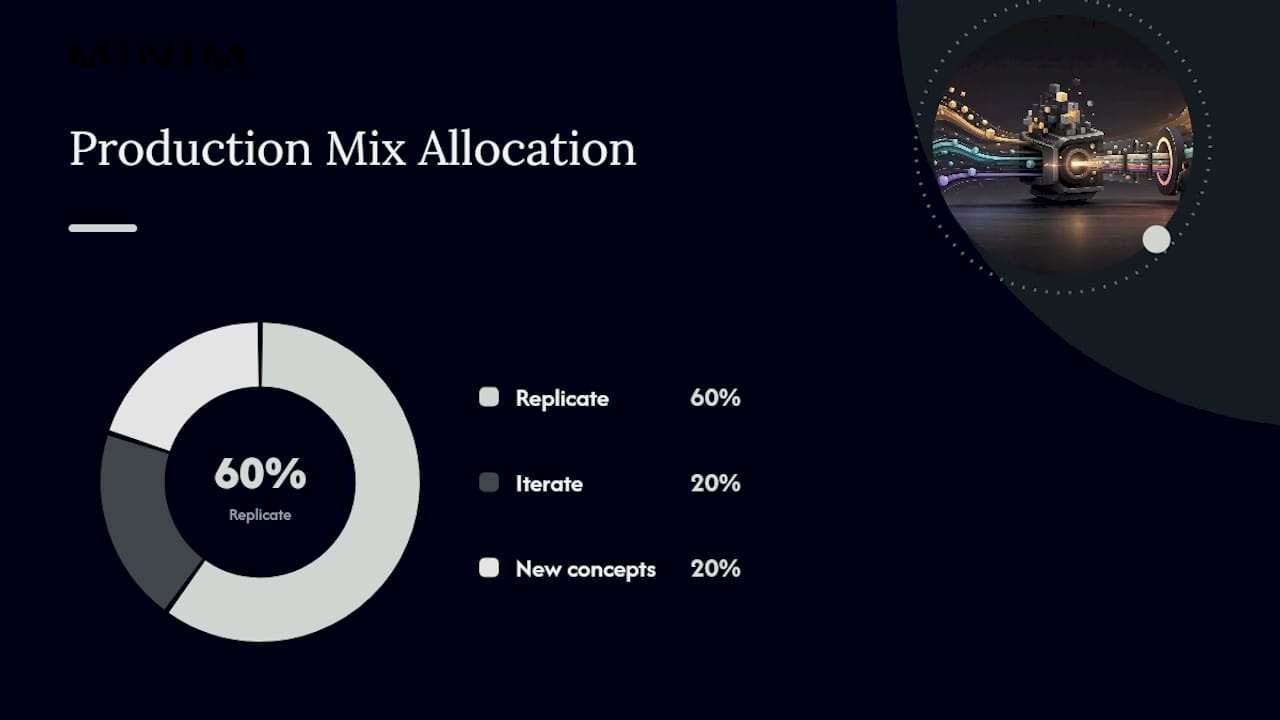
Allocate your production mix deliberately rather than chasing whatever feels urgent. A 60-20-20 split, meaning 60% replicating what already works, 20% iterating on it, and 20% genuinely new concepts, keeps velocity up without letting the whole pipeline become recycled ideas.
Protect the actual making time. 90 to 120 minute uninterrupted creative sessions produce measurably better output than creative work squeezed between meetings.
Pro Tip: Add a "first-look" checkpoint where the strategist reviews a rough cut before final polish, not after. Killing a weak concept at the rough stage costs an hour. Killing it after full production costs a day and a half of wasted work.
Which Tools Actually Help You Scale Creative Output?
Tool selection makes or breaks a scaling effort, and most teams get it backward: they add tools to fix symptoms instead of designing the workflow first and filling gaps second.
Five categories matter here. Production engines generate genuine variation (different hooks, pacing, visual treatments), not just resizing the same asset for different aspect ratios. Digital asset management systems centralize approved assets and enforce version control, so nobody ships an outdated brand asset by accident. A solid rundown of media asset management platforms is worth reviewing before you commit to one. Creative ops platforms manage the brief-to-approval workflow itself. Automated QA tools catch brand and compliance issues before human review. Analytics and element-tagging tools attach metadata to each asset so performance data ties back to specific creative choices, not just campaign-level results.
When evaluating any of these, ask whether it produces genuine variation or just a resize, whether it integrates with your existing stack through an API instead of requiring manual export and upload, and whether it can tag creative elements automatically rather than relying on someone remembering to label things correctly.
The most common mistake is tool sprawl. Research on high-output teams found that three to five well-integrated tools consistently outperform a stack of ten single-purpose ones, because every additional tool adds a handoff point where something can break. A production management platform that actually talks to your DAM and your analytics stack beats five specialized tools that don't share data.

Pro Tip: Before adding a new tool, ask what workflow step it eliminates entirely. If the answer is "it makes an existing step a little faster," you're probably adding friction, not removing it.
Should You Build an In-House Team or Partner With a Production Specialist?
The build-versus-partner decision usually comes down to four variables: how much you're spending monthly, how fast you need to move, how complex your brand guardrails are, and whether you need centralized production operations across multiple brands or business units.
Building in-house makes sense when your monthly creative spend can sustain full-time specialist salaries, when your brand voice is genuinely complex enough that outside teams need months to ramp up, and when you have someone internally capable of running the operational cadence described above. Partnering makes more sense when you need premium execution without the twelve-month runway of hiring, training, and building a management layer from scratch. A detailed look at outsourcing video production walks through this trade-off in more depth.
If you partner, the contract needs specifics, not vague promises:
- Turnaround times for first drafts and revisions, stated in business days, not "as soon as possible."
- A defined revision limit per asset, so scope doesn't creep silently.
- Delivery formats and resolutions specified upfront, matched to every channel you run.
- Metadata tagging requirements built into delivery, so assets arrive ready for your analytics stack.
Agencies handling their own production needs sometimes look at broader agency service structures to understand how pricing and scope get bundled elsewhere in the industry.
Pro Tip: Onboard a new production partner with two weeks of over-communication before you scale volume. Share three past winning assets and three that failed, with your own notes on why. Skipping this step is the single biggest cause of "vendor drift," where output slowly stops matching your brand.
How Do You Turn Performance Data Into the Next Brief?
Signal extraction only works if every asset carries metadata from the moment it's built, not bolted on after the fact. At minimum, tag the hook type, the talent or format used, the CTA variant, and the platform-specific format. Attach this at ingest time, when the asset enters your DAM, so nobody has to reconstruct it later from memory.
Watch a small set of leading indicators rather than drowning in dashboards: early engagement deltas in the first 48 hours, fatigue signals showing a previously strong asset losing steam, and cross-format lifts where an element that worked in one placement transfers to another.
| Signal Type | What It Tells You | Action Trigger |
|---|---|---|
| Early engagement delta | Whether a new asset is over or underperforming its cohort in the first 48 hours | Kill or scale within 3 days |
| Fatigue signal | A previously strong asset losing engagement week over week | Refresh creative or rotate out |
| Cross-format element lift | A hook or CTA winning in one placement and repeated elsewhere | Feed into next brief's modular blocks |
Automation does the heavy lifting here: element extraction tools tag creative components automatically, pattern detection flags which combinations are trending up or down, and fatigue alerts fire before a human notices the dip manually. Feed those signals straight into the following Monday's brief instead of waiting for a formal quarterly review. That's the difference between a team that reacts to last quarter and one that adjusts weekly.
Setting Up Roles, SLAs, and Workflow Templates That Hold Under Load
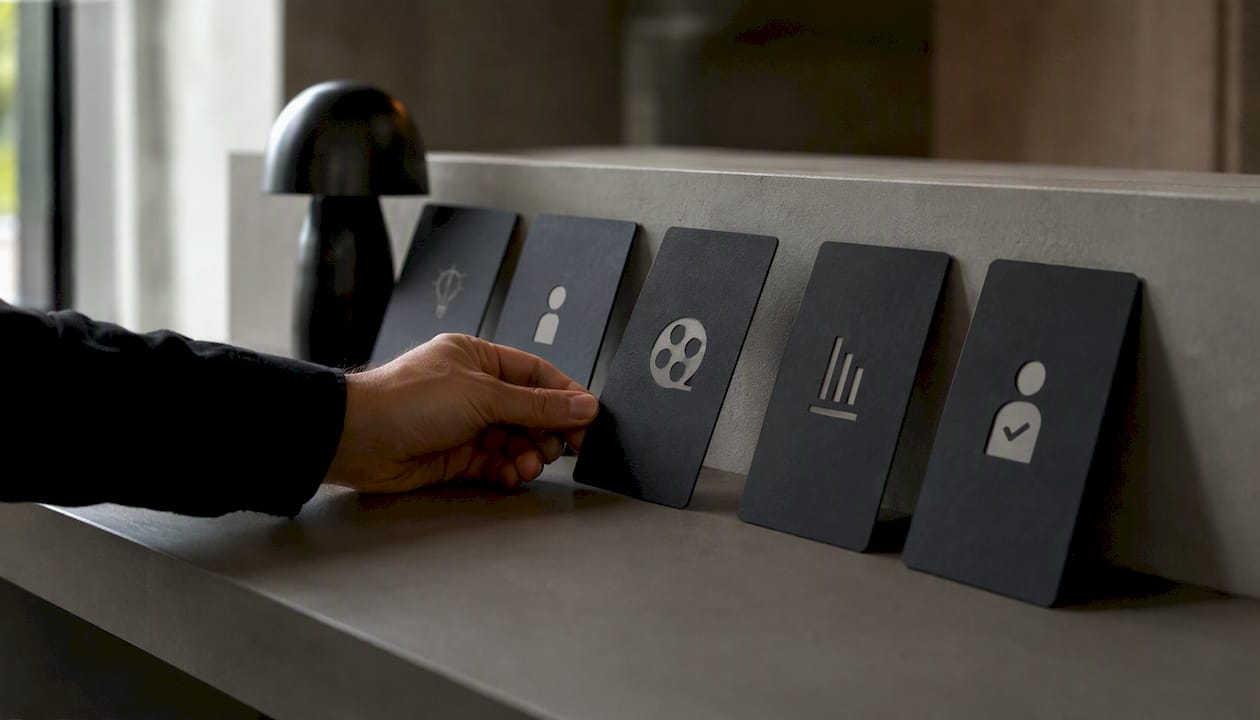
Clear roles prevent the single point of failure that kills most scaling attempts. A compact structure works better than an elaborate org chart: a strategist owns briefs and prioritization, a producer owns execution and the asset library, an analyst owns signal extraction and reporting, a QA reviewer owns brand and compliance checks, and a creator coordinator manages any external talent or freelance relationships.
Service level agreements need to be explicit, not assumed. Set a maximum turnaround for brief-to-first-draft, a firm window for approval rounds, and an upload deadline that accounts for platform review time. Build in one accepted exception category, like a rush request tied to a live performance issue, so the SLA doesn't get quietly violated every time something urgent comes up.
| Workflow Type | Typical Trigger | Cadence |
|---|---|---|
| Weekly production wave | Standing content calendar | Monday brief, Thursday ship |
| Campaign launch | New product or offer | 2 to 3 week lead time with dedicated brief |
| Emergency refresh | Fatigue alert or performance drop | 48 hour turnaround |
Document each of these as a repeatable template rather than reinventing the process every time a new campaign lands. A motion graphics commissioning guide is a useful reference for standardizing briefs on more technical asset types where handoffs tend to break down first.
What Does Scaled Creative Production Look Like in Practice?
Agencies that come to MINIM usually hit the same wall: their in-house creative team is stretched thin, but hiring more full-time producers doesn't pencil out against the campaign volume they actually need. The recurring challenge is producing premium, cinematic-quality video at a pace that matches paid media demand, without diluting brand execution to hit the number.
MINIM integrates directly into the existing creative team rather than replacing it, taking on production execution while the agency retains creative direction and client relationships. That means clear handoffs: the agency owns strategy and brand governance, MINIM owns execution from concept development through final delivery, including art direction, film, photography, and visual effects work.
The goal isn't to hand off creative control. It's to remove the production ceiling so a small internal team can say yes to more volume without saying yes to more headcount.
The outcomes that matter to agency leaders are speed to first draft, consistent asset volume week over week, and a shorter gap between a campaign going live and someone acting on what the data shows. Readers can see the range of finished work on MINIM's portfolio page.
A Production Leader's Note on Adopting Systems Thinking
Shifting a team from project thinking to systems thinking is a cultural change before it's an operational one. People who've spent years being praised for one great asset resist the idea that a repeatable process matters more than any single hero piece. The resistance is real, and it's worth naming out loud in the first team meeting rather than pretending the new workflow will sell itself.
Give the new system six to ten weeks before you start optimizing it further. Teams that tweak the cadence every week never build the muscle memory that makes throughput actually stick. Stability first, then refinement.
Ready to Scale Without Growing Headcount?
MINIM gives agencies a way to add premium production capacity without the twelve-month cost of hiring, training, and managing an in-house crew. You keep creative direction and client relationships. MINIM handles execution, from concept through final delivery, at the volume your paid media calendar actually demands.

Two things change immediately when you bring MINIM into your workflow: turnaround on premium video assets speeds up without the quality drop that usually comes with rushing production, and governance stays intact because MINIM works from your brand guardrails instead of reinventing them project by project. That combination, speed plus consistency, is what most in-house teams struggle to sustain once volume climbs past what a small internal crew can absorb.
If your team is hitting the ceiling described throughout this piece, take a look at MINIM's services and get a sense of scope and fit for your next campaign cycle.
Frequently Asked Questions
What does it actually mean to scale creative production? It means building a system where each new asset costs less to produce than the last, your team can sustain a steady weekly output without burning out, and you learn what's working fast enough to act on it. It's an operations problem, not just a hiring problem.
How many creative assets should a team produce per week? Top-performing teams typically ship 12 to 25 creatives per week for each active channel, supported by a consistent weekly cadence rather than sporadic bursts.
Is hiring more people the fastest way to scale creative production? Not usually. Headcount without fixed workflows and modular asset architecture just moves the bottleneck. Fix marginal cost and throughput design first, then add people to a system that can actually absorb them.
When should a team partner with an external production company instead of building in-house? Partnering makes sense when campaign volume outpaces what your internal team can sustain, but full-time hiring isn't justified by your monthly spend. It also helps when you need premium execution fast without a lengthy ramp-up period.
What metadata should be attached to every creative asset? At minimum, tag the hook type, talent or format, CTA variant, and platform-specific dimensions at the moment the asset enters your asset management system, not after the fact.
Sources
- How To Scale Ad Creative Production
- Performance Creative Production: The 12-Asset-Per-Week System | SEM Nexus
- Is creativity a young person's game? (Keith Sawyer summary) | Psychology Today
- Managing Creative Energy: A Research-Backed System for Creatives
- Performance Creative Strategy (2026 Playbook) | Exposure