

Talent usage rights are the license terms that spell out where, how long, and on which channels a performer's likeness, voice, or performance can run. The single most important step before signing anything: verify the exact media channels, start and end dates, territory, and exclusivity in writing. Check those four items against SAG-AFTRA rate sheets or a usage-fee framework before you approve a single deliverable.
TL;DR:
- Usage rights are separate licenses for each channel, with digital, broadcast, print, OOH, and perpetual licenses priced distinctly.
- Brands must obtain clearances for music, stock footage, location releases, and contributor releases to ensure full licensing.
- Usage fees can range from 20 to 45 percent for 90-day social media campaigns up to 150-300 percent for full perpetual buyouts.
- SAG-AFTRA requires specific pay structures, notices, and explicit consent for digital and AI-generated likeness use, especially in union-covered productions.
- Negotiate detailed, channel-specific, and date-specific license terms early, treating each extension and sublicense as a new negotiation.
Table of Contents
- What Are Talent Usage Rights, and Why Do They Vary by Channel?
- Who Owns the Content Versus Who Gets to Use It?
- What Do Talent Usage Fees Typically Cost?
- What Does SAG-AFTRA Require for Commercial Talent?
- How Should You Negotiate Usage Rights in a Contract?
- How Do Extensions, Renewals, and Sublicensing Work?
- MINIM's Production Checklist for Clearing Talent Rights
- What Do Most Negotiators Get Wrong About Usage Rights?
- How MINIM Builds Rights Clearance Into Every Production
- Sources
What Are Talent Usage Rights, and Why Do They Vary by Channel?
A usage right is not one blanket permission. It is a stack of separate licenses, each tied to a specific channel and each worth a different amount of money.
Organic social covers an unpaid post on the talent's or brand's own account, usually the cheapest tier because reach is limited to followers. Paid social and whitelisting let a brand run that same content as an ad through the talent's handle or its own, and it typically commands a real premium because paid distribution can reach millions instead of thousands. Broadcast (TV or streaming) usage carries the highest baseline value, since national rollouts multiply exposure and airtime by orders of magnitude. Print and catalog usage is priced separately because it lives outside digital measurement entirely. Out-of-home (OOH) placements, billboards and transit ads, get their own line because they're permanent and geographically fixed. Perpetual buyouts eliminate the clock altogether, granting indefinite use across some or all channels for a single upfront fee.
- A single 30-second spot can carry multiple separate usage lines for different channels and durations.
- Boosting an organic post into a paid ad after the fact, without a pre-negotiated clause, is a common source of underpayment disputes.
- Repurposing content into email marketing or retail displays requires separate usage rights rather than an extension of the original grant.
Who Owns the Content Versus Who Gets to Use It?
Creators and performers default to owning what they create. Brands don't inherit rights automatically just because they paid for a shoot. They license specific, scoped usage, and anything outside that scope requires a new agreement.
Assignment, where the talent transfers full ownership, is rare and expensive. Most commercial deals run on licensing instead: the talent retains ownership, the brand gets defined permission to use the work. Before you can grant broad usage rights, though, you need every underlying piece cleared separately. That means:
- Music licensing for any score or needle drop, cleared for the specific channels and duration in play.
- Stock footage or imagery with its own usage terms that may not match your talent agreement's scope.
- Location releases for any filmed setting that isn't fully owned or controlled by the production.
- Contributor releases from anyone identifiable in the frame, including background talent.
Miss one of these and the whole deliverable becomes unlicenseable, regardless of what the lead talent contract says.
What Do Talent Usage Fees Typically Cost?
Pricing runs on three layers: a session fee (payment for the shoot itself), a usage fee (payment for where and how long the content runs), and an exclusivity premium (extra payment if the brand wants to lock out competitors). Most disputes happen because someone conflates the session fee with the full value of the deal.
Published benchmarks give negotiators a defensible starting point. Paid social usage for a 90-day window commonly adds 20 to 45 percent on top of the base content fee. A 12-month term can run 70 to 100 percent or more, since the brand is buying a full year of flexibility instead of a season. Full buyouts, unlimited use with no expiration, often command 150 to 300 percent of the base fee, reflecting the fact that the talent gives up all future negotiating leverage on that piece of content.
| Usage tier | Typical premium over base fee | Best fit |
|---|---|---|
| Paid social, 90 days | 20-45% | Short campaign tests, seasonal pushes |
| Extended term, 12 months | 70-100%+ | Ongoing brand campaigns |
| Full buyout, perpetual | 150-300% | Evergreen assets, no renewal admin |
Pro Tip: Default to a term license, not a buyout, whenever a campaign's future scale is uncertain. Buyouts look cheaper upfront but strip out any renegotiation once a video unexpectedly goes national.
What Does SAG-AFTRA Require for Commercial Talent?
SAG-AFTRA's commercial contracts cover any performer working under a signatory producer, which includes most agencies handling national or regional broadcast campaigns. The rules govern far more than the paycheck.
- Covered performers earn a session fee plus separate use fees tied to how the spot airs, and renewals trigger additional payment rather than a one-time cost.
- Audio Flex structures bundle session and use fees for digital-only voice work, with published rate examples for four-week and 13-week runs.
- Producers must issue proper notice, file the correct forms, and stay ready for a union audit if usage extends beyond what the contract authorized.
- The 2025 Commercials Contract added specific limits on digital replica use, meaning AI-generated likeness or voice work now requires separate, explicit consent, highlighting critical considerations explored in the AI Profile | Chrome Cactus Studio.
Every producer working with covered talent should keep the official SAG-AFTRA rate sheet open during budgeting, not just during contract drafting. Our own breakdown of SAG commercial rules walks through what to line-item for 2026 productions.
How Should You Negotiate Usage Rights in a Contract?
Strong usage language reads like a spreadsheet, not a mission statement. Vague terms cost someone money later, usually the talent.
- List every media channel explicitly. "Marketing purposes" is not a channel. Name organic social, paid social, broadcast, print, and OOH separately if any of them apply.
- Lock the territory and exact dates. "Worldwide" and "in perpetuity" without a corresponding fee are the two biggest red flags in any usage clause.
- Define permitted edits. Can the brand cut a 30-second spot into a 6-second bumper? Say so, or don't.
- Set sublicensing terms. If a retailer or media partner needs access to the asset, the contract should say who approves that and what it costs.
- Attach payment triggers to renewal and extension events, not just to the original air date.
Term length, channel granularity, and audit rights are your real negotiating levers. Favor usage-based pricing over flat buyouts whenever a campaign might scale, since a flat rate signed before a spot goes viral almost always underpays the talent relative to what the brand ultimately gets from it.
How Do Extensions, Renewals, and Sublicensing Work?
Treat every extension as a fresh negotiation, not a rubber stamp. Performance data from the first run often justifies a different price than what was agreed at signing.
- Ask what channels the extension covers before agreeing to a rate, since scope creep is common when a campaign performs well.
- Price renewals against current performance, not the original session fee, especially for retroactive buys after a piece has already run in paid media.
- Require separate consent and a defined fee before any third party, a retailer, media partner, or franchisee, gets sublicense access to the asset.
MINIM's Production Checklist for Clearing Talent Rights
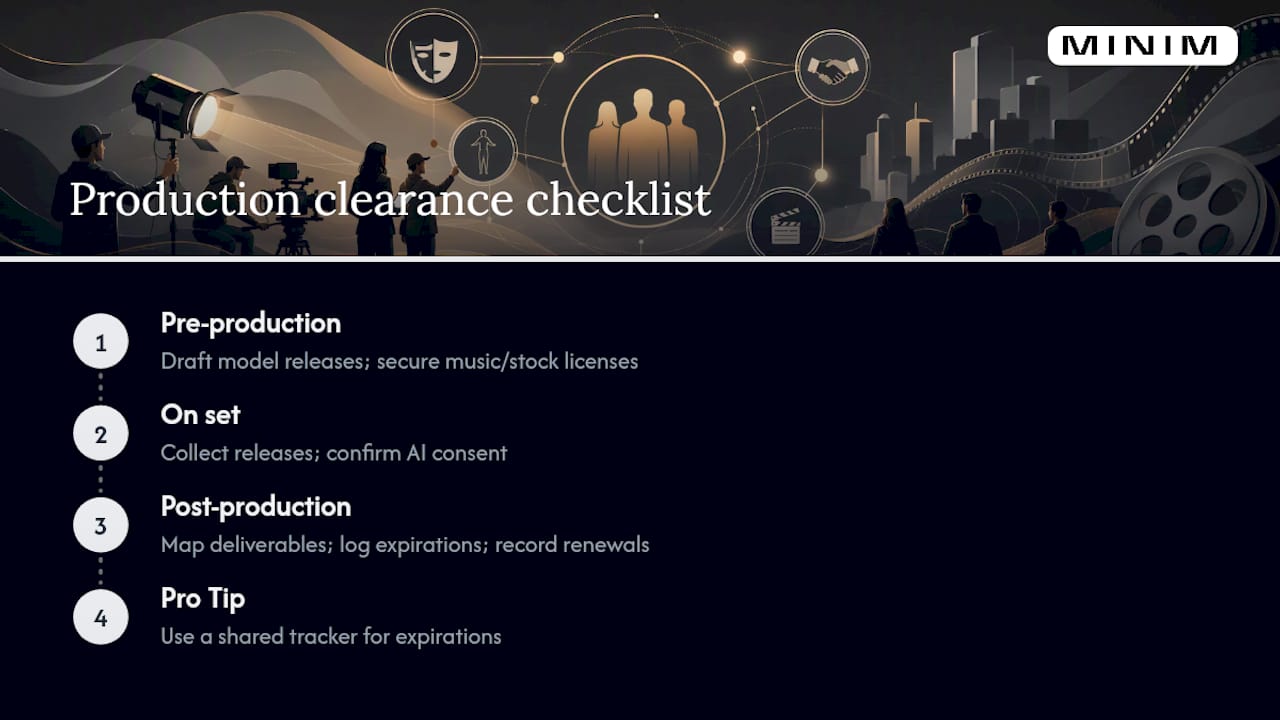
Rights problems usually start on set, not in the contract. MINIM builds clearance into every stage of production rather than treating it as a legal afterthought.
Pre-production: confirm model releases are drafted, line up contributor clearances for anyone appearing on camera, and secure music and stock licensing before the shoot date, not after.
On set: collect signed releases before anyone leaves for the day, and confirm explicit consent for name, voice, or digital replica use if any AI-assisted post-production is planned.
Post-production: map every licensed deliverable against the actual media plan, log expiration dates in your asset management system, and record renewal options and audit trails so nothing lapses quietly.
Pro Tip: Build a single shared tracker for expiration dates across every talent contract on a campaign. Losing track of one renewal date is how agencies end up airing a spot on expired rights without realizing it.
For a deeper walkthrough of release documents and clearance workflows, see our rights management guide for video, and for how to build audit trails into ongoing productions, our production risk management playbook covers the operational side in detail.
What Do Most Negotiators Get Wrong About Usage Rights?
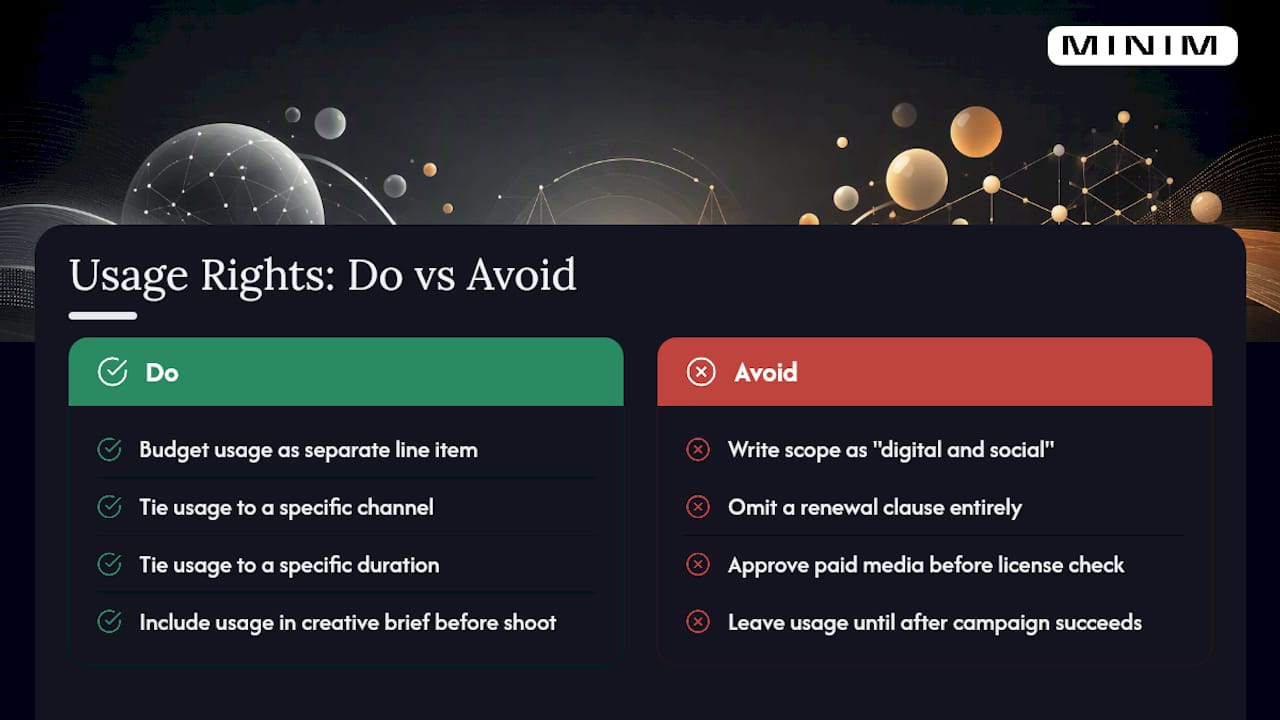
The mistake I see most often isn't a bad rate. It's a vague one. Scope written as "digital and social" instead of naming actual channels. A renewal clause that doesn't exist at all. A paid media budget that gets approved before anyone checks whether the usage license even covers it.
My rule of thumb: budget usage as its own line item, tied to a specific channel and a specific duration, the same way you'd budget for talent's session fee or a location rental. If usage isn't in the creative brief before the shoot, it becomes a fire drill after the campaign already works. Put it in early, and the rest of the negotiation gets easier.
— Steven Reina
How MINIM Builds Rights Clearance Into Every Production
A production partner can run end-to-end commercial production with rights clearance built into the workflow instead of bolted on afterward, enabling agencies to get cinematic campaigns without the internal legal scramble that usually follows a scope change. Bring MINIM in at the brief stage, or the moment a campaign is about to scale into paid media, and clearance tracking, renewal dates, and channel-specific licensing get handled alongside the creative work itself, not after the fact.
That matters most the moment a client wants to take an organic post and boost it nationally: the usage terms need to already account for that, not get renegotiated in a panic two weeks before launch. MINIM's production services integrate directly with your creative team, so the same partner shooting your campaign is tracking what happens to it after it airs. If you're scoping a production that will likely expand beyond its original media plan, start a brief with MINIM before the shoot date, not after the first renewal request lands.
Sources
- SAG-AFTRA 2025 Commercials Contracts summary
- Influencer usage rights pricing: content repurposing and licensing costs
- What Is SAG Scale Pay for a Commercial? - CLIMB