

Rights management for video means three things working together: licensing agreements, signed releases, and chain-of-title documentation that proves you can legally use what you shot. The immediate action for any agency briefing a production partner is simple: start clearance in preproduction, not after the edit locks, and demand a single audit-ready clearance package before final delivery. That package is what an Errors & Omissions (E&O) insurer wants to see, and it's what protects a campaign from a takedown notice six weeks into a media buy.
MINIM builds this into its production workflow rather than treating it as legal paperwork bolted on at the end. Before you sign off on a partner, require:
- Signed talent and location releases collected during the shoot, not chased afterward
- Music sync and master licenses matched to the exact edit, territory, and platforms in the media plan
- A chain-of-title memo tying every asset back to its source and license
Key Takeaways
Rights management for video succeeds when clearance starts in preproduction and ends with one audit-ready package covering releases, licenses, and chain-of-title documentation.
| Point | Details |
|---|---|
| Start clearance early | Begin collecting releases and music intake data during scripting, not after the shoot wraps. |
| Two licenses for music | Every recorded song needs a separate sync license and master use license from different rights holders. |
| Ownership isn't usage | Negotiate territory, duration, platforms, and exclusivity separately from who holds the copyright. |
| Document every stock asset | Keep source, license type, purchase date, and restrictions on file, not a vendor's homepage screenshot. |
| Rights work is built into production | MINIM stages clearance checkpoints through every production phase and delivers a complete rights package at final handoff. |
Table of Contents
- What Goes in a Video Rights Clearance Package?
- Ownership vs. Usage Rights: What Should You Actually Negotiate?
- Why Two Licenses for One Song? The Music Clearance Rule
- How Should Rights Clearance Fit Into the Production Timeline?
- What Are the Real Risks of Skipping Rights Clearance?
- How Do You Verify Stock Assets and Vendor Warranties?
- What DRM Tools Actually Protect Licensed Video Content?
- How Do Territory and Distribution Rights Work Internationally?
- What Should You Do When Someone Uses Your Video Without Permission?
- How Does Rights Management Affect Monetization?
- An Operational Take on Rights Clearance
- How MINIM Handles Rights Clearance for Your Next Campaign
- Where to Find Templates and Deeper Legal Guidance
- Sources
What Goes in a Video Rights Clearance Package?
An insurer, distributor, or platform reviewing your campaign wants proof, not assurances. The clearance package is that proof, and missing even one document type is the most common reason E&O underwriting stalls or a distributor kicks a spot back for revisions.
Seven items belong in every package:
- Talent and model releases for every recognizable person on camera, signed before or during the shoot, not requested weeks later when someone has gone quiet.
- Location and property releases covering private property, distinctive architecture, and any interior where the owner could claim a right of publicity or trademark interest.
- Music sync licenses covering the composition itself, issued by the publisher or rights holder of the underlying song.
- Master use licenses covering the specific recording, issued separately by whoever owns that recording.
- Stock license certificates documenting source, license type, purchase date, and any restrictions still attached to the asset.
- Cue sheets listing every piece of music used, its duration, and how it's used (background, featured, theme), which distributors and performance rights organizations both require.
- A chain-of-title memo that walks through every rights-bearing element and states, in plain terms, how the production secured the right to use it.
Insurers reviewing an E&O application typically want a title search, releases for every recognizable person, and proof of music rights from both the publisher and the recording owner before they'll issue a policy at all, according to LegalClarity's breakdown of film and media clearances. Skipping the shot-by-shot clearance report that maps intellectual property and personality rights across a production tends to surface the same gaps later, when they're far more expensive to fix, per WIPO's clearance guide for filmmakers.
The cleanest way to track all of this is a single exportable spreadsheet, often called a rights matrix, with columns for asset ID, source, license type, licensor contact, term, territory, platform, and a link to the actual proof file, an approach detailed in Art & Media Law's rights clearance navigator. Whoever runs production should own that matrix and update it at every milestone, not just at final delivery.
Pro Tip: Ask your production partner to share the rights matrix as a live document during the shoot, not as a PDF attached to the final invoice. If they can't show it to you mid-project, they're probably reconstructing it after the fact.
Ownership vs. Usage Rights: What Should You Actually Negotiate?
Ownership and usage rights get conflated constantly, and that confusion costs agencies money later. Ownership means who holds the copyright to the footage. Usage rights mean what you're actually allowed to do with it, and for how long, and where.
Production companies commonly keep raw footage while the brand owns the finished deliverable, a split that works fine until someone wants to recut the spot for a new market. What matters far more than who "owns" the file is how precisely the license spells out:
- Territory: national, regional, or worldwide
- Duration: a fixed term, or in perpetuity
- Platforms: broadcast, social, paid media, out-of-home, or all of the above
- Exclusivity: whether a competitor could license the same footage
- Sublicensing and derivative rights: whether you can hand assets to a media partner or cut new versions
Narrow, cheap licenses look attractive at signing but tend to force expensive renegotiation the moment a campaign expands into new channels, per Entertainment Law Miami's analysis of usage rights pricing. A step-deal structure solves this directly: pay for limited initial use, with expansion fees pre-negotiated at signing, so scaling a winning campaign doesn't mean starting a new legal negotiation from scratch.
Why Two Licenses for One Song? The Music Clearance Rule
Music trips up more commercial productions than any other rights category, mostly because a single recorded song carries two separate copyrights. You need a sync license from the publisher for the composition, and a separate master use license from whoever owns the actual recording, according to Montague Law's music clearance checklist. Clear only one and you're still exposed.
Before anyone contacts a publisher or label, collect this intake data:
- The exact recording (artist, title, and version, since remixes and covers count as different works)
- Precise edit length and which portion of the song plays
- Territory where the ad will run
- Every media type and platform, including paid social and broadcast
- Whether the placement involves paid media (this changes the fee structure)
- Any remix, sample, or cover flags
- Budget ceiling, deadline, and an approved fallback track if negotiations stall
Licensing timelines for a single popular song can run past eight weeks once you factor in publisher approvals and master negotiations, per WIPO's guide to rights clearance. That timeline alone is why music intake belongs in the creative brief, not the week before air date.
Three tactics keep music costs and timelines under control: commission original music outright, so there's no third-party clearance at all; use a production music library with pre-cleared commercial and advertising rights; or negotiate a step-deal on a needle-drop track that lets you expand usage later at a pre-agreed rate.
How Should Rights Clearance Fit Into the Production Timeline?
Clearance isn't a legal chore you hand off at the end. It's a project-management function that runs parallel to creative development, and the handoffs matter as much as the documents themselves.
- Concept and scripting: creative flags every asset that will need clearance, from a needle-drop song to a recognizable brand logo appearing in a background shot.
- Storyboard and preproduction: production begins collecting talent releases, location agreements, and initial music intake before a single frame is shot, an approach laid out in most solid pre-production checklists.
- Shoot: releases get signed on set, in real time, rather than tracked down afterward when a talent agent stops responding.
- Post-production: legal reviews any high-risk items, unresolved music, unclear stock sourcing, or minors on camera, and the rights matrix gets updated to match the final cut.
- Delivery: the partner compiles the complete rights package alongside the final assets, not a week later.
Each milestone should produce a deliverable: a preproduction clearance report, midproduction updates as the edit changes, and a final rights package with the completed matrix at delivery.
Pro Tip: Build a clearance checkpoint into your existing creative brief template rather than treating it as a separate document. If clearance lives outside the brief, it gets forgotten outside the brief too.
What Are the Real Risks of Skipping Rights Clearance?
E&O insurers won't write a policy without documented proof of clearance, and that documentation requirement exists because the financial exposure is real. Underwriters typically require a title search, signed releases for every recognizable person, and proof of music rights from both the publisher and recording owner, and any fair-use claim usually needs a written legal opinion before they'll accept it, according to LegalClarity.
The scenarios that create the most exposure:
- A minor appears on camera without a parent or guardian's signed release
- A trademarked logo or product shows up prominently in paid media without permission
- Music clearance covers sync but not the master recording, or vice versa
- Stock footage carries restrictions the vendor's site-wide license language didn't disclose
The mitigations aren't complicated, they're just often skipped under deadline pressure: get a written legal opinion for any fair-use claim rather than assuming it holds, keep a substitution or fallback track ready for any music placement that stalls, document every stock warranty with source and license date rather than a screenshot of the vendor's homepage, and write replacement obligations into vendor contracts so a supplier is on the hook if an asset turns out to be improperly licensed.
How Do You Verify Stock Assets and Vendor Warranties?
Stock footage and vendor-supplied assets are where "commercial license" gets misread most often. A site-wide license badge is not proof; it's marketing copy. What you need on file for every stock asset is the source, license type, purchase date, and any restrictions that survive the sale.
Require this in vendor contracts:
- A stock warranty clause stating the vendor guarantees clean rights for the specific use
- A replacement obligation if an asset turns out to carry undisclosed restrictions
- Disclosure of sources for every third-party asset, including subcontracted work
- Prior written approval before any subcontractor touches licensed material
User-generated content and AI-generated assets need the same rigor, plus proof of uploader rights and a documented provenance trail, since neither carries the built-in paper trail that a licensed stock library does.
What DRM Tools Actually Protect Licensed Video Content?
Once footage is cleared and licensed, protecting the finished asset from unauthorized redistribution is a separate, practical concern for agencies distributing across multiple platforms.
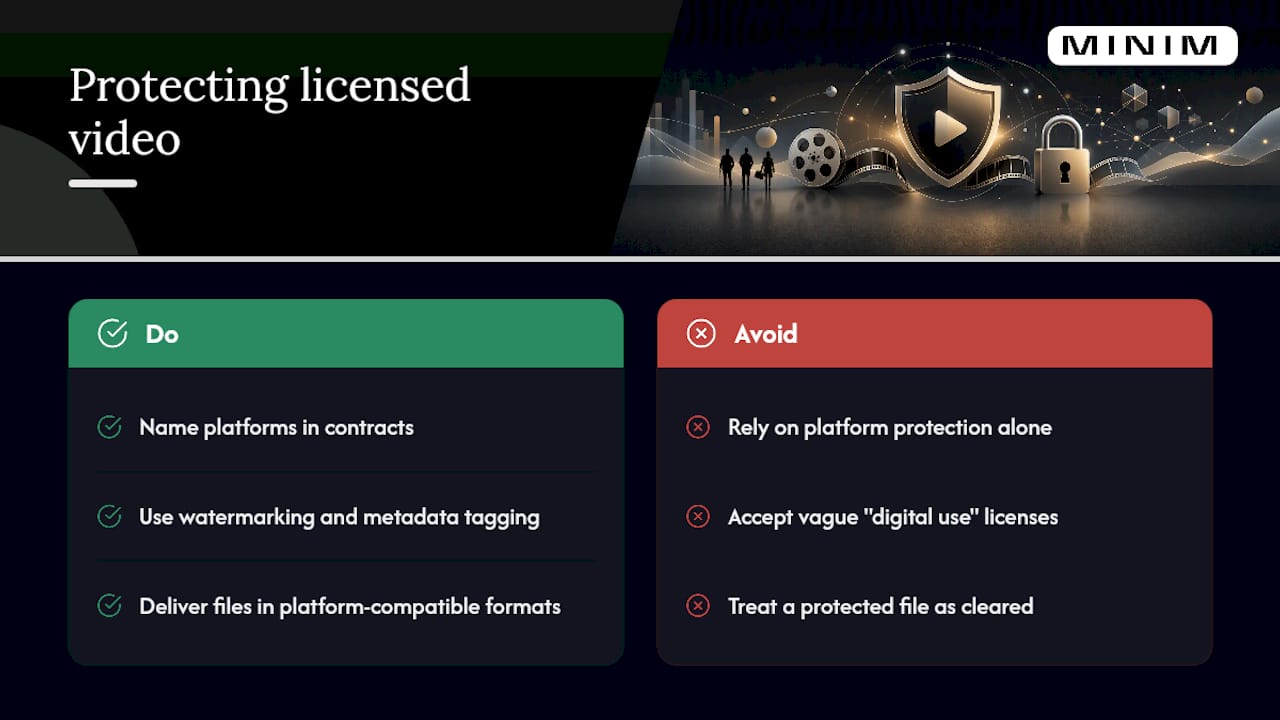
Most commercial video today relies on platform-level protections rather than a standalone system the agency manages directly. Streaming and ad platforms encrypt video during transmission and restrict downloading by default, YouTube's Content ID and Meta's Rights Manager both scan uploads against a reference library and flag matches automatically, and broadcast and OTT distributors typically require delivery in formats compatible with their own protection layers before they'll accept a file at all.
For agencies, the practical takeaway isn't which encryption standard a platform uses. It's making sure the licensing terms in your contracts explicitly name the platforms where the video will run, since a license that covers "digital use" without naming specific platforms can create disputes when a distributor's protection system flags content as improperly sourced. Watermarking and metadata tagging, embedding ownership and license information directly into the file, give you a second layer of proof if a dispute arises, separate from whatever protection the distribution platform applies on its end. Neither replaces the underlying license. A protected file that was never properly cleared is still an infringing file; it's just harder to copy.
How Do Territory and Distribution Rights Work Internationally?
A license cleared for domestic use doesn't automatically extend to a global campaign, and this is where agencies with ambitious media plans get burned. Music, talent, and stock licenses are almost always territory-specific, and "worldwide" needs to appear explicitly in the contract language, not be assumed from context.
Talent right-of-publicity laws vary significantly by country and even by US state, which matters when a campaign features recognizable people and runs across multiple markets simultaneously. Music licensing bodies differ by territory too. A sync license cleared through a US publisher doesn't necessarily cover performance in the European Union, where separate collecting societies handle those rights.
The practical fix is specificity at the negotiation stage, not damage control after a campaign launches. Before signing any license, confirm exactly which territories are covered, whether "territory" means countries, regions, or a global grant, and whether the license needs updating if the media plan expands mid-campaign. Broad, worldwide grants cost more upfront but eliminate the renegotiation scramble that narrow, region-specific licenses tend to create once a campaign performs well and the client wants to run it somewhere new.
What Should You Do When Someone Uses Your Video Without Permission?
Unauthorized use of a cleared, licensed commercial video is more common than most agencies expect, whether that's a competitor lifting footage for a comparison ad or a platform user reposting a campaign spot without credit.
The first step is always documentation: a timestamped screenshot or archived copy of the infringing use, before it disappears. From there, platform-level tools like YouTube's Content ID or a formal DMCA takedown notice handle the bulk of straightforward cases, since most platforms are legally required to respond to a properly filed notice. For a copyrighted asset that a competitor is using in paid media, a cease-and-desist letter from counsel often resolves the situation faster than a takedown request, since the exposure to statutory damages tends to motivate a quick response.
Your chain-of-title memo and rights matrix are the evidence that makes enforcement possible in the first place. Without proof that you hold the rights you're claiming were infringed, there's no enforcement action to take. This is the practical payoff of maintaining clean documentation throughout production rather than only when a dispute forces you to reconstruct it.
How Does Rights Management Affect Monetization?
Clean rights management isn't only a defensive measure. It's what makes a campaign asset monetizable beyond its original placement.
A commercial spot with a properly negotiated, broad usage license can be repurposed into paid social ads, licensed to a retail partner for co-branded use, or extended into a longer-form content series, all without renegotiating from zero. A spot cleared only for a narrow original use sits idle the moment someone wants to extend it, because every new use requires going back to talent, music rights holders, and stock vendors individually.
Licensing deals built around branded content work the same way. A brand that wants to license footage to a retail partner, or monetize a campaign asset through a platform's revenue-sharing program, needs usage rights specific enough to cover that exact arrangement. Ad revenue-sharing programs on platforms like YouTube also require the uploader to hold clear rights to every element in the video, since a claim from a third-party rights holder can redirect or freeze that revenue entirely.
The agencies that get the most mileage out of a single production budget are the ones that negotiate for flexibility upfront, even at a higher initial cost, rather than treating the first use as the only use.
An Operational Take on Rights Clearance
Most agencies treat rights clearance as a legal afterthought that gets handled once the creative is locked. That's backward, and it's the single biggest reason clearance problems surface at the worst possible moment: during media buying, right before a launch date.
MINIM integrates clearance checkpoints directly into production stages rather than treating them as a separate legal workstream. That means talent releases get signed on set, music intake happens during scripting instead of during panic, and the rights matrix updates continuously so the final handoff includes a complete, audit-ready package rather than a scramble to reconstruct one. This isn't about adding process for its own sake. It's about making sure creative decisions and rights decisions get made by the same team, at the same time, so nobody discovers a licensing gap after the campaign is already live.
— Steven Reina
How MINIM Handles Rights Clearance for Your Next Campaign
MINIM operates as an extension of your creative team, and that includes the paperwork that protects your campaign, not just the footage. Full-service production means clearance checkpoints are built into every project stage, from talent releases signed on set to a completed rights matrix delivered alongside your final assets. You get cinematic execution without adding headcount, and without discovering a licensing gap the week your media buy goes live.

When you brief a production partner, ask for specifics up front: a rights matrix covering every asset, a documented stock source list, signed releases for every recognizable person, exact music license terms matched to your media plan, and proof that the partner's process supports E&O readiness. If a partner can't answer those questions before the shoot starts, that's worth knowing before you sign a contract, not after.
Review MINIM's production capabilities and services to see how clearance workflows fit into a full campaign build, or get in touch to discuss what a rights-ready deliverable looks like for your next brief.
Where to Find Templates and Deeper Legal Guidance
- WIPO's rights clearance guide: full clearance process and required documentation.
- Montague Law's music clearance checklist: sync versus master licensing details.
- Music licensing guide for film and TV: practical licensing primer.
- MINIM's music licensing resource: vendor options for production libraries.
Sources
- Rights clearance: From idea to distribution — WIPO
- What are rights and clearances in film & media? — LegalClarity
- Music clearance checklist for video, apps, podcasts, and branded content — Montague Law
- Usage rights pricing and structuring — Entertainment Law Miami