

Under the 2025 SAG-AFTRA Commercials Contracts, producers must budget for phased rate increases, a 24-month maximum period of use, and explicit consent-plus-pay rules for AI and digital replicas. Miss any one of the three and you either overpay a talent renewal you didn't need to trigger, or you undercount a spot's true cost until a Commercials department audit tells you otherwise.
The three non-negotiables, in order of how often they trip up production budgets:
- Phased wage and use increases. Year 1 added 5% starting April 1, 2025, Year 2 adds 4% on April 1, 2026, and Year 3 adds 3% on April 1, 2027, though several use categories are excluded from each round.
- The 24-month MPU clock. It starts 10 business days after principal photography begins, not on air date, which changes how you calculate renewal windows.
- AI and digital replica consent. Any use of a performer's Digital Replica now requires informed, reasonably specific consent and a minimum pay trigger of 1.5 session fees.
Beyond those three, the line items that actually move a budget are session fees, holding fees, use fees by platform and duration, the digital replica pay multiplier, and the newer paid-edit and addressable-edit fees under revised Section 37 language. Get the current rate sheets, confirm your signatory status before you cast a single SAG-AFTRA performer, and build MPU tracking into your production calendar on day one.
The contract rewards producers who treat compliance as a budgeting input, not a legal afterthought. The ones who get burned are almost always the ones who didn't know their MPU clock started on the shoot date, not the launch date.
Key Takeaways
The 2025 SAG-AFTRA Commercials Contracts require producers to plan around phased rate increases, a 24-month MPU tied to production start date, and mandatory consent-plus-pay rules for any AI or digital replica use.
| Point | Details |
|---|---|
| Verify signatory status early | Confirm in writing before casting, since both agencies and advertisers can qualify as Producer under the contract. |
| Track Day 1 for MPU | Log the exact start of principal photography, since the 24-month MPU clock starts 10 business days later, not on air date. |
| Budget the AI premium | Any Digital Replica that generates a performance triggers a minimum 1.5x session fee plus applicable holding and use fees. |
| Treat edits as payable events | Paid edits owe payment within 15 business days of first use; unpermitted edits create a new commercial entirely. |
| Use official rate sheets and a production partner | Cross-check the JPC rate sheets against your budget, and consider a partner like MINIM to manage compliance end to end. |
Table of Contents
- Where Do You Find the Official SAG Commercial Rules?
- What Rate Increases Take Effect Under the 2025 Contract?
- How Do the New AI and Digital Replica Rules Work?
- What Counts as an Unpermitted Edit Under the New Rules?
- Who Qualifies as a Producer and When Do You Need Signatory Status?
- How Do You Budget for SAG Rates Across a Full Campaign?
- What Do the New Rules Actually Change for Creative Decisions?
- How Can MINIM Help You Stay SAG Compliant?
- Where Can You Find the Official SAG-AFTRA Commercial Documents?
- Sources
Where Do You Find the Official SAG Commercial Rules?
Start with SAG-AFTRA's own production center page for the Commercials Contract, which aggregates the base agreement, rate digests, forms, and contact information in one place. That's the front door. From there, the documents branch into distinct purposes, and knowing which one answers your specific question saves you from reading 40 pages to find a single number.
- The 2016 base contract plus the 2019, 2022, and 2025 MOAs together form the actual legal text. SAG-AFTRA's own contracts and industry resources page warns against relying on the 2016 e-book alone, since it won't reflect the MPU extension, the rate schedule, or the AI provisions layered on in later MOAs.
- The 2025 Ratification Booklet is the readable summary: term dates, wage increases, MPU changes, and AI protections explained in plain English rather than contract prose.
- The Contract Summary covers negotiated gains and financial impact, including the deal's projected significant new earnings and benefit contributions.
- The JPC Year-1 rate sheets carry the actual dollar figures you need for a line-item budget.
- The SAG-AFTRA Commercial Payment Calculator gives a fast ballpark for principal performer costs, though it's not a substitute for the rate sheets.
For urgent questions, the Commercials department can be reached at (323) 549-6858 or (212) 827-1454. If you're a signatory dealing with a JPC-negotiated question specifically, the Joint Policy Committee is the body that negotiated the contract on behalf of advertisers and agencies, and it's worth having their contact on file before preproduction, not during a dispute.
What Rate Increases Take Effect Under the 2025 Contract?
The 2025 Commercials Contract runs a three-year term starting April 1, 2025, with rate increases layered in each year rather than all at once. Producers who budget off last year's rate card without checking the current effective date are the most common source of underpaid talent claims.
- Year 1: 5% increase, effective April 1, 2025. This applies broadly across session, use, and holding fees for new commercials produced after that date.
- Year 2: 4% increase, effective April 1, 2026. According to the JPC's Year 2 bulletin, this rate applies to new commercials, commercials recreated through an unpermitted edit, and renewals following MPU expiration between April 1, 2026, and March 31, 2027.
- Year 3: 3% increase, effective April 1, 2027. Model this now if you're planning a campaign with a renewal cycle that crosses that date.
Not every use category rides the escalator at the same pace. Streaming uses, Traditional Digital with paid YouTube placement, Class A network buys, and the full range of cable categories are excluded from some or all of these increases, which means two commercials shot the same week can carry different rate obligations depending purely on where they'll run. Check the exclusion language in the current JPC rate sheet before you assume a flat percentage applies across your whole media plan.
The other major structural change is the Maximum Period of Use, now extended to 24 months. The clock starts 10 business days after the start of on-camera principal photography for live-action work, with separate timing rules for animation and off-camera voice or motion capture sessions. That start date matters enormously for animation productions, where recording often happens months before final delivery.
Here's a simplified example using generic Year-1 figures for a principal performer appearing on camera in a Traditional Digital use:
| Cost Component | What It Covers | Rough Basis |
|---|---|---|
| Session fee | Payment for the day of filming | Set by role/category on the Year-1 rate sheet |
| Holding fee | Payment to retain exclusivity rights during the option period | Weekly or monthly, per rate sheet |
| 4-week use fee | Payment for a defined block of digital use | Flat rate per the current rate sheet |
| AI/digital replica premium (if applicable) | Minimum 1.5x session fee when a replica generates the performance | Added on top of session, not instead of it |
A single 30-second spot with one on-camera principal, no digital replica, and a 4-week digital use commitment adds session plus holding plus that use fee. Add a second and third performer, a 13-week renewal, and a digital replica for one background character, and the total moves fast. Run every campaign through the payment calculator early, then reconcile against the actual rate sheet line items before you lock a budget.
How Do the New AI and Digital Replica Rules Work?
Creating or using a Digital Replica of a SAG-AFTRA performer triggers a mandatory consent requirement and a minimum pay obligation, full stop. If your campaign touches synthetic voice, face replacement, de-aging, or any AI-generated version of a real performer's likeness, this section governs your budget and your legal exposure equally.
The contract defines a Digital Replica as a computer-generated or synthetic representation of a performer's voice or likeness, distinct from a live performance. A Synthetic Performer is an entirely AI-generated character not modeled on a specific real person, which sits outside most of these protections but still carries disclosure obligations in some contexts. The Contract Summary is explicit that performers must give informed consent before a replica is created or used, and that consent has to be reasonably specific rather than a blanket sign-away.
- Consent must describe the intended use with enough detail that the performer understands what the replica will do and where it will appear.
- Producers face notice-timing rules, generally structured around 48 and 24-hour windows tied to when services are rendered relative to when the replica use begins.
- When a Digital Replica generates a performance, the minimum pay trigger is 1.5 times the applicable session fee, unless the performer's overscale deal explicitly already covers replica use.
- Holding fees and use fees still apply on top of that premium; the 1.5x multiplier does not replace them.
- Digital replicas cannot be used as a substitute for hiring a performer purely to cut costs. The contract's language is aimed squarely at that scenario.
According to the ratification booklet, the timing of consent matters as much as the content. Get it locked before principal photography, not during post when someone in the edit bay decides a face swap would fix a continuity problem. Legal advisories following the contract's rollout, including one from Davis+Gilbert, recommend building consent capture directly into casting paperwork and creative approvals rather than treating it as a separate legal step tacked on later.
Pro Tip: Build a standard consent clause into your talent deal memo template now, even for campaigns that don't currently plan AI use. Creative briefs change mid-production more often than legal paperwork does, and retrofitting consent after a shoot is far harder than getting it signed alongside the original booking.
If a commercial containing a digital replica later transfers to a new advertiser or gets licensed for a different campaign, the consent and pay obligations travel with it. Document the original consent scope carefully, because a vague description won't cover a use the performer never actually agreed to.
What Counts as an Unpermitted Edit Under the New Rules?
Most routine edits still don't trigger new fees, but the contract's revised Section 37 draws a firmer line around what counts as an Unpermitted Edit, meaning a change substantial enough to create a new commercial for both session and use-fee purposes.
Common unpermitted edit triggers include:
- Swapping in a different performer's footage or replacing a principal's performance entirely.
- Materially changing the product being advertised, rather than updating copy within the same product line.
- Adding a new performer's likeness or voice without matching consent and payment.
- Using AI to alter a performance beyond the scope of the original consent.
Section 37 also formalizes two categories producers use constantly but rarely think through contractually: paid edits and addressable edits. A paid edit, like a shortened cutdown or a new tagline using existing footage, requires payment, and that fee is due within 15 business days of first use. Addressable edits, meaning versioned creative served to different audience segments, are allowed in unlimited number once payment is made, provided every version uses only original footage and doesn't introduce new performances.
Here's how that plays out in practice:
- Localized copy swap on an existing shot: allowed as a paid edit, no new session required, use fee timing applies.
- New voiceover recorded to replace an actor's line: likely an unpermitted edit if it involves a different performer or materially new dialogue.
- Shortening a 30-second spot to 15 seconds using the same footage: a paid edit under the shorter-version rules, not a new commercial.
- Swapping a background actor for a digital replica: triggers both the unpermitted edit analysis and the AI consent/pay rules simultaneously.
Keep a clean invoicing trail for every edit that changes the cut. The 15-business-day payment window means disputes tend to surface fast, and the producer who can point to a dated approval email and a matching invoice resolves them in an afternoon instead of a month.
Who Qualifies as a Producer and When Do You Need Signatory Status?
Advertisers and advertising agencies can both qualify as a "Producer" under the Commercials Contract, which means signatory obligations don't stop at the production company you hired. If your agency is booking SAG-AFTRA talent directly or through a producer that isn't currently in good standing, you're exposed to retroactive liability the moment that talent starts working.
- Confirm signatory status before casting begins. Ask the production company directly and request documentation, or check with SAG-AFTRA's Commercials department if you have any doubt.
- Understand the JPC's role. The Joint Policy Committee negotiates the Commercials Contract on behalf of advertisers and agencies collectively; it isn't a substitute for your own signatory paperwork, but it's the right contact for interpretation questions on rate application.
- Request proof of good standing in writing, not a verbal assurance, especially on a new vendor relationship or a smaller regional production house.
- Watch for retroactive payment triggers. If a company loses signatory status mid-production or was never properly signed, the retroactive wage exposure can land on whichever party the contract defines as Producer, which may be you.
- Signatory verification takes one phone call or email and costs nothing; a retroactive payment dispute costs weeks and real money.
- Renewal windows following MPU expiration are a common point where signatory status gets overlooked because everyone assumes the original paperwork still covers the extension.
- Agencies commissioning through multiple production vendors on the same account should keep a running signatory log rather than re-verifying from memory each time.
How Do You Budget for SAG Rates Across a Full Campaign?
The SAG-AFTRA Commercial Payment Calculator gives you a fast estimate for principal performer costs, but it explicitly does not include payroll burden, employer taxes, or withholdings, and it's not a binding figure you can hand to a client as final. Treat it as a starting number, then build outward.
- Identify performer categories for the spot: principals, group principals, extras, voiceover, and note where any AI or digital replica use might apply.
- Pull session, holding, and use rates from the current JPC rate sheet for each category and the specific use type (streaming, Traditional Digital, cable, Class A).
- Add fringe and payroll burden. This typically runs as a percentage on top of gross talent fees and covers pension, health, and employer-side payroll taxes.
- Layer in AI/digital replica premiums wherever a replica generates any part of a performance, using the 1.5x session fee minimum as your floor.
- Total per spot, then multiply against the full MPU term, factoring in whether the campaign is likely to renew past 24 months and at what rate year that renewal falls.
A practical production management checklist for every commercial:
- Confirm the base contract plus every applicable MOA is on file, not just the 2016 e-book.
- Verify signatory status in writing before the first casting call.
- Capture AI/digital replica consent in the same paperwork batch as the talent deal memo, using creative brief language that's reasonably specific about intended use.
- Log the exact date principal photography starts, since that's your MPU clock trigger, not the air date.
- Route every post-production edit through an approval workflow that flags anything resembling an unpermitted edit before it airs.
- Set a recurring reminder tied to rate-year boundaries (April 1 each year) to check whether a renewal falls into a new pricing tier.
Pro Tip: The single change that prevents the most expensive MPU miscalculations is boring: log the exact date of Day 1 principal photography in your production tracker the moment it happens, not after wrap. Teams that reconstruct this date from memory months later routinely get it wrong by a week or more, and that week can shift an entire renewal into a different rate year.
What Do the New Rules Actually Change for Creative Decisions?
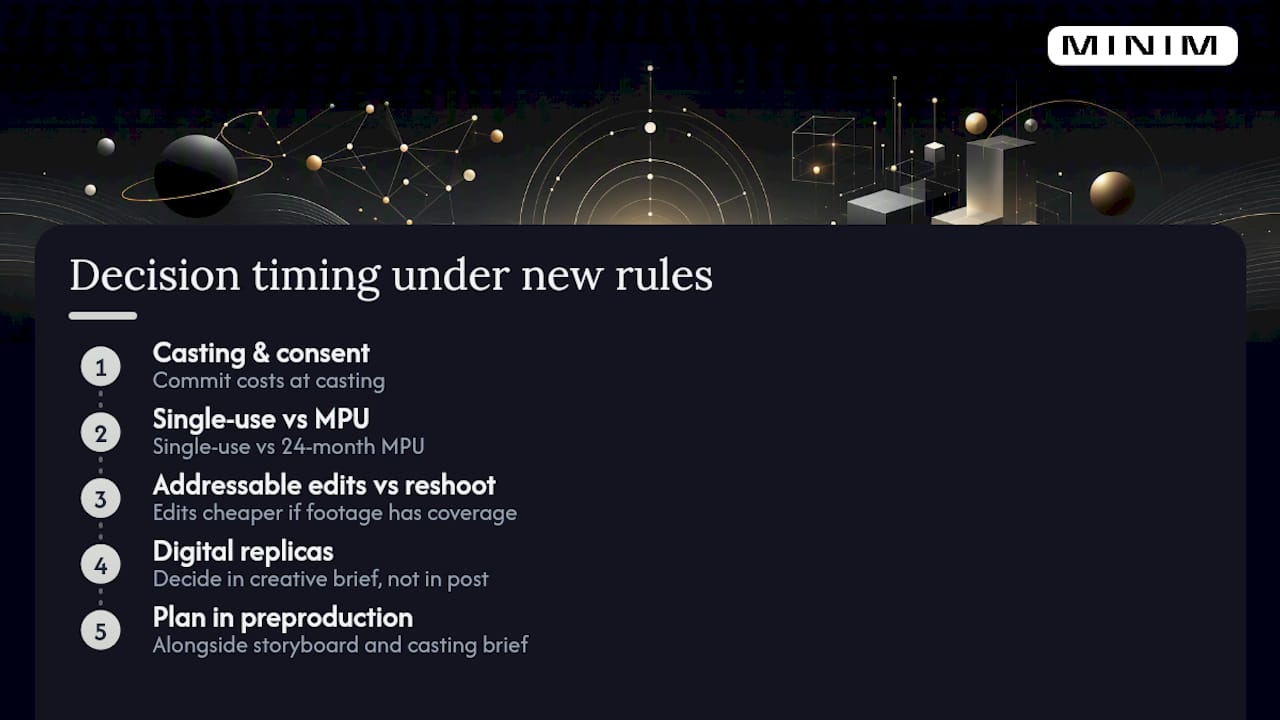
The practical effect of these rules is that cost shifts earlier in the process. A longer MPU and stricter AI consent requirements mean producers now make more of their financial commitment upfront, at the casting and consent stage, rather than deferring it to a renewal negotiation 12 months down the line.
That changes how you should think about single-use buys versus broader MPU commitments. A campaign with real staying power benefits from locking in the 24-month window now, since it defers renewal cost further out. A campaign built for a short seasonal push might be better served by a narrower use category and a shorter commitment, even if the per-unit rate looks slightly less efficient.
The addressable edit versus reshoot tradeoff deserves more attention than most budgets give it. Paying for unlimited addressable edits on existing footage is almost always cheaper than a reshoot, but only if your original footage was shot with enough coverage to support the versioning you'll eventually need. That's a creative decision made on set, long before anyone touches the edit timeline, and it's the kind of thing that gets missed when a shoot day is already running behind.
Digital replicas carry a similar tension. They offer real convenience, letting you extend a campaign's life or localize a performance without rebooking a performer's schedule. On projects MINIM has helped shepherd through production, the teams that came out ahead were the ones that decided on digital replica use during the creative brief stage, not during a budget crunch in post. Deciding late almost always costs more, in both dollars and rework.
None of this argues against using the new tools the contract makes available. It argues for sequencing decisions correctly: consent and use planning belong in preproduction, right alongside your storyboard and your casting brief, not bolted onto the back end when the deadline is already tight.
How Can MINIM Help You Stay SAG Compliant?
Coordinating SAG-AFTRA compliance across casting, consent paperwork, and post-production edit approvals eats time your creative team doesn't have, especially on a campaign with multiple performers and a real chance of AI or digital replica use. MINIM works as a production partner integrated directly with your agency's creative team, handling the planning and delivery work that keeps a union commercial on schedule and on budget without adding headcount to your roster.

That includes production planning built around MPU timing, budgeting that accounts for phased rate increases and digital replica premiums before they surprise you mid-campaign, coordination of talent paperwork and consent capture, and a post-production process structured to avoid the kind of unpermitted edits that trigger new use fees. Whether you're commissioning your first SAG-AFTRA commercial or scaling a campaign across markets and platforms, having a partner who already knows where the compliance risk hides means your team spends its energy on the creative work instead of the paperwork.
If you're weighing whether to build this expertise in-house or bring in a production partner for your next SAG-covered campaign, start by reviewing what MINIM handles end to end on our services page, then reach out to talk through your specific talent and platform mix before you lock a budget.
Where Can You Find the Official SAG-AFTRA Commercial Documents?
- Commercials — Production Center: the aggregator page for the base agreement, forms, and current rate digests.
- 2025 Commercials Contracts Ratification Booklet: plain-language summary of term dates, MPU changes, and AI provisions.
- 2025 Commercials Contract Summary: negotiated gains and financial impact detail, including digital replica pay triggers.
- JPC Year-1 Rate Sheets: the dollar figures for session, use, and holding fees effective from April 1, 2025.
- JPC Year-2 Bulletin: rate timing and exclusions for the increase effective April 1, 2026.
- Contracts & Industry Resources Page: reminds producers to read the 2019, 2022, and 2025 MOAs alongside the 2016 base contract.
- SAG-AFTRA Commercial Payment Calculator: a non-binding estimate tool for principal performer costs, excluding payroll burden and taxes.
For anything the documents don't answer clearly, call the Commercials department directly at (323) 549-6858 or (212) 827-1454 before you lock a budget on assumptions.
Sources
- Commercial Payment Calculator | SAG-AFTRA
- 2025 Commercials Contracts Ratification Booklet | SAG-AFTRA
- 2025 Commercials Contract rate sheets — Year 1 | JPC
- 2025 SAG-AFTRA Commercials Contract Summary | SAG-AFTRA
- Commercials — Production center | SAG-AFTRA