
Casting for commercials is the production service that sources, auditions, clears, and books on-camera talent for TV and digital ad campaigns. A production partner or dedicated casting director should run it, with SAG-AFTRA compliance, signed releases, avail checks, and usage buyouts all handled before shoot day. The agency's job is to own the creative brief and character references. The casting partner's job is to deliver a curated shortlist, talent releases, booking paperwork, and a contingency tier so nothing stalls production.
Here is what that split looks like in practice:
- Agency owns: character descriptions, visual references, usage specs (media, territory, duration), and final talent approval
- Casting partner delivers: breakdown distribution, self-tape collection, shortlist reels, avail checks, signed releases, and offer coordination
- Legal must confirm: union status, usage windows, residuals eligibility, and name/likeness clearances before any offer goes out
Industry voices like casting director Terry Berland have long emphasized that the brief is the foundation. Without precise usage specs from the agency, Business Affairs cannot estimate buyouts, and the casting director cannot write an accurate breakdown.
Key Takeaways
Casting for commercials requires a production partner who can manage sourcing, auditions, legal clearances, and booking coordination while the agency retains creative approval at every stage.
| Point | Details |
|---|---|
| Brief drives everything | Supply precise character descriptions and usage specs before breakdown is issued. |
| Up to eight stakeholders sign off | Build client presentation time into the casting timeline from day one. |
| Hold three talent tiers | Prepare a third backup tier beyond hero and immediate alternates to protect the shoot date. |
| Usage specs determine buyout cost | Media type, territory, and campaign duration are the primary drivers of talent buyout pricing. |
| MINIM handles end-to-end casting | MINIM integrates casting, Business Affairs paperwork, and shoot logistics into one production engagement. |
Table of Contents
- How does casting for commercials actually work?
- Who signs off on casting choices?
- What goes into a casting brief?
- What audition formats should agencies expect?
- What does casting cost, and how long does it take?
- SAG-AFTRA basics every agency team must know
- How do you choose the right casting partner?
- How should you plan for contingencies?
- What should casting hand over at booking and wrap?
- How MINIM integrates casting into full commercial production
- MINIM runs casting end-to-end so your team stays focused on creative
- Sources
How does casting for commercials actually work?
The commercial casting process starts the moment the agency finalizes its creative brief and production brings on a casting director. From there, the flow is predictable:
- Brief intake: Agency delivers character descriptions, usage specs, and visual references to production.
- Breakdown issued: Casting director writes and distributes a breakdown to agents, managers, and submission platforms.
- Self-tapes collected: Talent submits self-tapes, headshots, and resumes. Casting narrows thousands of submissions to a working shortlist.
- Internal review: Casting director screens submissions and brings roughly 15–25 options per role to the creative team.
- Callbacks: Director, writer, and art director attend in-person or remote sessions to test performance and chemistry.
- Client sign-off: Shortlist is presented to the client, typically at a production meeting.
- Offers and paperwork: Business Affairs negotiates fees, usage, and buyouts. Releases are signed before booking is confirmed.
- Shoot integration: Booked talent is handed off to production with full paperwork, wardrobe notes, and avail calendars.
Casting milestones need to be locked into the production schedule from day one. A brief that lands late pushes every downstream milestone, and a delayed client sign-off can cost a confirmed talent hold.
Who signs off on casting choices?
Booking decisions for commercials involve multiple stakeholders across agency and production: writer, art director, producer, creative supervisor, creative director, account supervisor, director, and client. That is a consensus process, not a single approval chain.
- Agency creative team (art director, writer, creative director): evaluates look, performance, and brand fit at the shortlist stage
- Director: assesses chemistry, performance range, and how talent fits the visual concept
- Production: manages scheduling, avail holds, and logistics coordination
- Casting director: runs auditions, negotiates deals, and manages contracts throughout the process
- Business Affairs / legal: owns fee negotiation, usage terms, and clearance sign-off
- Client: gives final green light, typically at a formal shortlist presentation
The client and agency creative team usually stay out of day-to-day casting until the shortlist is ready. Final approval happens at the production meeting. Budget negotiation sits with Business Affairs; talent fee negotiation sits with the casting director working alongside Business Affairs.
What goes into a casting brief?
A complete brief is the single biggest lever agencies have over casting quality; for agency insights on briefing and client-agency alignment, see the Marketing Insights & Blog at TBE Agency. Vague briefs produce vague shortlists. Here is the minimum:
- Character description: age range, gender, ethnicity guidance, personality traits, and any physical requirements
- Visual references: mood boards, reference spots, wardrobe direction
- Usage specs: media (broadcast, digital, OOH), territory (national, regional, global), and campaign duration
- Scene context: script sides or a scene description the talent will perform
- Special skills or requirements: physical stunts, language fluency, product-specific skills
- Union status preference: SAG-AFTRA or non-union, flagged at brief stage
For submission materials, require at minimum: a slate, full self-tape performance, headshot, resume, availability window, union status, and any stunt or skill clips relevant to the role. A well-structured video creative brief circulated to casting before breakdown distribution prevents the back-and-forth that eats days.
Pro Tip: Casting director Melissa O'Neil recommends preparing a third tier of backup talent beyond your hero choices and immediate backups. For clients with strong opinions or tight schedules, that third tier is what keeps the shoot date intact.
What audition formats should agencies expect?
Self-tapes are now the default first round for most commercial casting. In-person callbacks follow for the shortlist. Chemistry reads happen when the spot requires two or more performers to feel natural together.
That insight matters operationally. Production partners who enforce submission standards and give talent technical guidance get better raw material to work with.
When evaluating submissions, agency teams should score on six dimensions:
- Look: does the talent match the character brief and visual references?
- Performance: is the delivery natural, on-brand, and repeatable?
- Brand fit: does the talent's energy match the campaign tone?
- Chemistry: for ensemble spots, do the performers feel connected?
- Technical quality: is the self-tape well-lit, clearly audible, and properly slated?
- Availability: is the talent confirmed clear for shoot dates and any hold periods?
What does casting cost, and how long does it take?
Timeline and budget are the two variables agencies most often underestimate. The table below shows typical milestone durations for a standard commercial casting process.
Total from brief to booking: roughly 10–20 business days for a standard campaign. Rush timelines compress this, but avail holds and Business Affairs review cannot be skipped.
Budget buckets to plan for:
- Casting director fee: covers search, shortlist creation, and audition facilitation. Studio fees and materials are typically included in this fee; talent fees and buyouts are separate.
- Talent fees: day rates for shoot day, fitting fees, and any rehearsal days
- Usage buyouts: the largest variable. Media type, territory, and campaign duration drive buyout pricing more than any other factor.
- Residuals: applicable on SAG-AFTRA union jobs for broadcast use
- Travel and wardrobe: out-of-state talent travel, hotel, and fitting costs
- Casting materials: headshots, self-tape storage, and session recordings
SAG-AFTRA basics every agency team must know
Union status must be flagged at the brief stage, not after callbacks. Mixing union and non-union talent on a SAG-AFTRA signatory production creates compliance exposure.
Legal checklist before shoot day:
- Confirm union or non-union status for every booked talent
- Verify usage windows, media types, and territories match the signed agreement
- Confirm residuals obligations for broadcast use on union jobs
- Collect signed talent releases covering image, video, name, and likeness
- Confirm no exclusivity conflicts with competing brands
- Verify any minors have proper work permits and guardian sign-off
Pro Tip: Loop Business Affairs into the casting conversation at the shortlist stage, not after the client falls in love with a specific talent. Clearance issues discovered post-approval create expensive delays and occasionally force a full recast.
How do you choose the right casting partner?
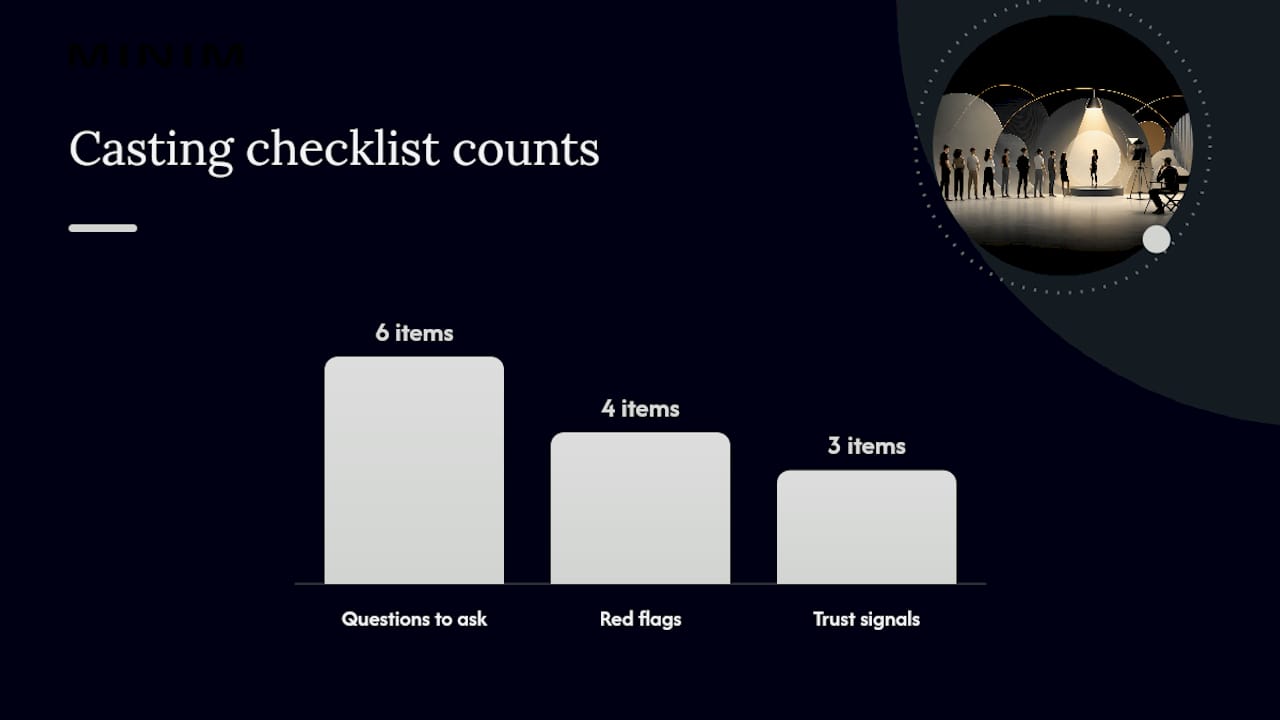
The right partner has a documented process, not just a portfolio. Ask these questions before signing anything:
- Can you provide sample booking packets and release templates?
- What is your typical turnaround from breakdown to shortlist?
- How do you handle avail checks and hold fees?
- What is your backup cast protocol when primary talent drops?
- How do you manage Business Affairs coordination and SAG-AFTRA paperwork?
- Who is the escalation contact if a talent issue surfaces on shoot day?
Red flags to watch for: no sample contracts on request, opaque buyout estimates with no usage breakdown, inability to confirm avail status within 24 hours, and no documented process for handling talent conflicts. A production partner that cannot produce a sample booking packet before you sign is not ready to run your casting.
Trust signals worth requiring: production management workflows that track casting milestones, documented NDA practices for unreleased campaign work, and references from agency-side producers, not just talent agents.
How should you plan for contingencies?
Hold three tiers of talent, not two. The hero choice, one backup, and a third tier for situations where the client rejects the first two or a confirmed talent becomes unavailable. Melissa O'Neil's recommendation to pre-clear alternates is the difference between a one-day delay and a full reschedule.
Day-of logistics checklist:
- Transport and hotel confirmed for out-of-state talent
- Wardrobe fits scheduled before shoot day
- Stand-ins identified for lighting setup
- On-set release capture assigned to a specific crew member
- Emergency contacts collected for every booked talent
- Medical disclosures reviewed for any physical requirements
For fast-turnaround shoots, the distinction between a hold fee and a confirmed booking matters. A hold keeps talent available; a booking creates a contractual obligation. Never assume a hold is a booking.
What should casting hand over at booking and wrap?
At booking, the agency and production team should receive:
- Shortlist reels and final selection self-tapes
- Signed talent releases (image, video, name, likeness)
- Avail calendars and confirmed shoot dates
- Talent contact details and agent or manager information
- Usage paperwork matching the agreed media, territory, and duration
- Wardrobe notes and any special requirements flagged by talent
At wrap, the handoff packet should add: stunt or skills proof documentation, emergency contact records, any accommodations requested and confirmed, and a named archive of all tapes with consistent file naming for future reference. Casting directors who maintain a talent archive can rebook strong performers on future campaigns without restarting the search from zero.
How MINIM integrates casting into full commercial production
The friction in most commercial casting comes from handoff gaps: the brief arrives incomplete, Business Affairs is looped in too late, or the shortlist presentation happens without the right stakeholders in the room. MINIM is built to close those gaps from the inside.
When MINIM runs casting as part of a production engagement, the flow looks like this: brief intake with the agency creative team, breakdown distribution and self-tape collection, shortlist presentation with structured review materials, client sign-off coordination, offer and release management with Business Affairs, and full shoot integration with archived booking packets. The agency keeps creative control at every approval stage. MINIM handles the logistics, compliance, and documentation that typically fall between chairs.
For agencies that want to see what that looks like in practice, MINIM's production portfolio shows how casting integrates into campaign-level commercial work. Sample booking packets, NDA templates, and timeline documents are available on request.

MINIM runs casting end-to-end so your team stays focused on creative
When casting coordination pulls agency producers into avail checks, release chasing, and Business Affairs back-and-forth, the creative work suffers. MINIM handles the full casting workflow as part of a commercial production engagement: brief intake, breakdown, self-tape review, shortlist delivery, offer coordination, and Business Affairs-ready paperwork, all without adding headcount to your team.

The result is a casting process your creative director can trust and your legal team can sign off on, delivered as part of a single production engagement. See MINIM's commercial production services and request a sample casting packet or production quote to get started.
Sources
The following sources informed this guide. Each supports a specific practical point covered above.
- Who Are the Commercial Booking Decision-Makers?
- Commercial Casting Fundamentals Every Actor Should Know
- What is a Casting Director — Job Description, Duties & Salary
This list is not exhaustive. For contract templates, SAG-AFTRA guidance, and Business Affairs support specific to your campaign, contact MINIM directly.
This article is general information, not a substitute for advice from a qualified lawyer. Consult a qualified legal professional about your own circumstances before acting on anything here.