
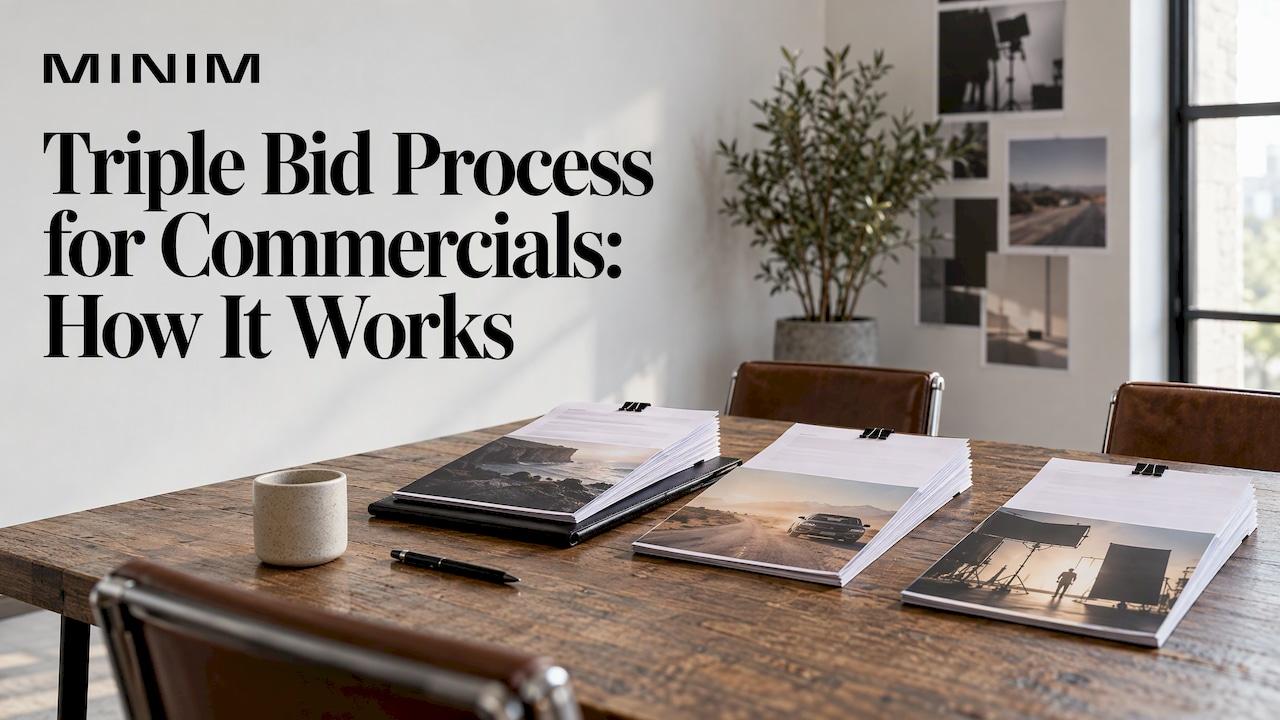
A triple bid is the standard way U.S. agencies price and cast a commercial: you send the same boards and brief to three production companies, each returns a director's treatment and a budget, and you pick one. It works when all three bidders get identical information, the field is honest, and you score the bids on more than the bottom line. This guide covers the steps, the bid request, the comparison and the traps.
TL;DR
- A triple bid sends one brief to three production companies, each answering with a treatment (the creative approach) and a priced budget.
- Give all three bidders the same scope, the same budget information and the same deadline, and tell them who they are bidding against.
- Never invite a "cover" bid just to satisfy a requirement. AICP flags legal risk in that practice.
- Score bids on creative fit, execution, scope, schedule and cost together. The lowest number rarely buys the best spot.
- Lower budgets are often single- or double-bid, so match the process to the job.
Table of Contents
- What a triple bid is and why agencies run one
- The triple bid process, step by step
- What to put in the bid request
- How to compare three bids
- Keep the process honest
- When a triple bid is the wrong tool
- Perspective
- Where MINIM fits
- FAQ
- Sources
What a triple bid is and why agencies run one
In a triple bid, the agency invites three production companies to answer one creative problem. Each returns two things: a treatment, which is the director's written vision for the spot (look, casting, tone, how each scene plays), and a budget priced against that vision. The agency and often the brand then compare three real answers side by side.
AICP, the trade association for commercial production companies, describes the typical triggers in its 2017 bidding best practices. An agency seeks several bids, typically three, when the advertiser requires it, when the creative team wants different stylistic approaches, or when production costs are hard to pin down and the advertiser wants to compare competitive options.
That is the real value for a creative or marketing director. You are buying a creative idea and an execution plan, not a commodity. Three directors will solve the same script differently, and seeing that range often sharpens your own view of what the spot should be.
The cost is real too. Writing a treatment and building a bid takes time and money for every company that does not win. A May 2025 LBB report notes that most production pitches involve a three-way bid and that the pitch phase often eats into pre-production time. A well-run process respects that, which is also how you get the best work from bidders.

The triple bid process, step by step
The sequence below combines the HSM University commercial production course with a commercial bidding guide that lays out the timing.
1. Lock the creative brief and approvals
The agency develops the brief, then boards or a script. The client approves the script and a budget range. Bidding before this point produces bids built on guesses, which cannot be compared.
Where it goes wrong: a vague script or a budget range nobody has confirmed. Every bidder fills the gap differently and you end up comparing assumptions instead of ideas.
2. Build the shortlist
If you are also choosing a director, the agency requests treatments and narrows to two or three directors. Then it picks the three production companies that can deliver them. Look at who has made work like yours, at your scale, and who can actually take the dates. Our guide to how agencies choose a production company covers the shortlisting criteria in more detail.
Where it goes wrong: inviting a company you would never hire to fill the third slot. That is the start of a cover bid, covered below.
3. Send the bid package
The agency sends boards or script, the brief, deliverables, usage and media plans, the shoot window and the budget guidance to all three. The same package goes to all three, at the same time.
4. Bidders write treatments and cost the job
The bidding guide puts the turnaround at typically two to four days to submit a full AICP budget. Bidders may ask questions during this window. Answer them for everyone, not just the one who asked.
5. Review the top sheets and treatments
The agency producer, and sometimes the brand, reviews each budget's summary page (the top sheet) next to its treatment. Calls with each director, where they walk through the treatment, are common before an award, according to the HSM course.
6. Award and cost review
You select one company. The agency's cost consultant then goes through the winning budget line by line, and pre-production starts once the budget is approved and the purchase order is issued.
7. Pre-production and the pre-production meeting
The winner moves into department heads, locations, casting, equipment, sets and the shot list. The pre-production meeting (PPM) is where agency, client and production company review every element, and the approvals become the shoot plan. After that come the shoot, often one to three days, and post-production.
What to put in the bid request
Fair comparison starts with a fair package. AICP's best practices say agencies should give all bidders the same job-scope information and the same opportunity to bid, and should keep each company's creative ideas and bid details, including costs and prices, confidential.
A bid request that holds up includes:
- Script or boards, plus the creative brief and any reference.
- Every deliverable: lengths, cutdowns, aspect ratios, versions.
- Usage: media, territory and term, because they drive talent costs.
- Shoot window, delivery date and approval milestones.
- Budget range, given identically to all three.
- Whether the contract is firm-bid or cost-plus.
- Who the other bidders are.
That last point matters. AICP's Universal Principles of Engagement say a maximum of three production companies should be invited to bid on a commercial, that bidders should be told who they are bidding against, and that if more than three are asked, all participants should be notified in advance so they can decide whether to take part.
Bidders also ask their own questions. AICP's best practices suggest they ask whether the job is cleared by the client, whether it is single- or multi-bid, whether bidding is fully transparent, whether it is firm-bid or cost-plus, and who the peer bidders are. Answer these before they ask and you will get sharper, more candid bids.
AICP updated its guidance in March 2026, releasing new Suggested Best Practices for bidding and a Bidding Reference Guide. Check the current versions before you write your next package.
How to compare three bids
A triple bid only helps if you compare like with like. Three columns, five questions.
| Question | What to look for |
|---|---|
| Creative fit | Does the treatment solve the brief, or does it show off a reel? Look at casting approach, tone and how key scenes play. |
| Execution | Does the crew, location and schedule plan support the look the treatment promises? |
| Scope | Does each bid cover the same deliverables, versions and usage? |
| Schedule | Are prep, shoot and post dates realistic for your delivery date? |
| Cost | Is the budget built on the same assumptions, and what is excluded? |
Read the budget structure
AICP's National Live Action Guidelines explain that the AICP bid form organizes common live-action cost items into groups A through K. A negotiated mark-up percentage is applied to produce the production fee, which covers administrative and sales costs plus a fee for services from prep through wrap. A separate creative fee may be added for services outside traditional production scope, and for low-budget or complex work a lump-sum, all-inclusive production fee may be considered.
So two bids with the same bottom line can differ a great deal underneath. Put the three top sheets next to each other and ask where each one carries its risk: contingency, overtime, weather, talent, post.

Check scope, not just price
For digital work, AICP's digital production guidelines describe the bid proposal or statement of work as the roadmap for the job. It names deliverables, intellectual property ownership and other job-specific terms, and it should record the firm-bid approach and the creative and technical expectations agreed during pitch and award. If one bidder has skipped these items, the low price may just be a smaller job. Our piece on scope gaps in agency RFPs shows how these gaps tend to surface.
Firm-bid or cost-plus
This choice changes your rights after the award. Under AICP's Standard Commercial Production Agreement, the contracting client may audit cost-plus productions, no later than one year after the contract date, and has no audit right on firm-bid work. On cost-plus, the producer estimates all element costs and adds a fixed fee to form the contract price, and overages should be communicated and approved in advance whenever possible. Know which structure each bidder assumed before you compare totals.
Make the comparison faster
A scoring sheet that every reviewer fills in beats a long meeting. Agencies are also testing AI tools for agencies to take admin off their teams, which leaves more time for the judgment calls a bid review needs.
Keep the process honest
No cover bids
Asking a company to submit a "cover" bid just to satisfy a multiple-bid rule is a legal and reputational problem. AICP's 2017 guidance notes that the U.S. Department of Justice has warned about complementary bidding, and cites Rattoballi v. United States, a Second Circuit conviction for submitting exaggerated cover bids to create the illusion of competition. If you already know who you want, say so and run a single bid.
Protect confidentiality and ideas
Do not share one bidder's proposal or pricing with another. AICP's 2020 guidelines treat unrequested creative contributions in a bid as the production company's intellectual property, usable by the client only upon award and full payment. If you liked an idea from a company you did not hire, the clean path is to talk to that company, not to lift it.
Disclose affiliated bidders
When a bidder is owned by or tied to the agency or its network, say so up front. The Artist Management Association published guidance on competitive bidding that raises exactly the questions independent companies ask: is there an internal or affiliated bidder, was its proposal presented first, were all bidders briefed at the same time with the same budget information, and who will see the pricing. A Decideware paper on the production competitive bidding process cites ISBA research finding that 43% of agencies are required to disclose in-house or affiliated bidders and 24% are not. That research is UK-based, but the fairness question is the same in the U.S.
When a triple bid is the wrong tool
Not every job needs three bids. In the LBB report, production executives say lower-budget jobs can be single- or double-bid, and that the once-unstated budget minimums that warranted a three-way director pitch "seem to be slipping lower and lower." A small social campaign with a known creative approach does not need three treatments.
A single bid or a two-way bid makes sense when:
- The budget is modest and the cost of three bids would eat into it.
- You already know the director or company you need, and the aim is a fair price.
- The timeline cannot absorb a bid round.
- The creative is already set and only execution is open.
If your client requires three bids, run three honest ones. If it does not, choose the process that fits the work. Our guide to picking production partners can help you judge fit before you bid at all.
Perspective
Most bid problems start before anyone writes a treatment. The brief is thin, the budget range is a guess, and three companies each fill the gaps with their own assumptions. Then the agency compares three different jobs and wonders why the numbers are far apart.
We work as a production partner that integrates with an agency's creative team, from concept through final delivery. That shapes how we see a bid: it is the first deliverable of the production, not a sales document. A clear treatment, a budget that matches it and a schedule that holds are what the agency will live with for months.
Our approach is that every project is managed as a high-end production, regardless of budget. For a creative or marketing director, the useful question at bid stage is not who is cheapest, but who will still be making the work well in post. Score the bids on that, and give the bidders what they need to answer it.
Steven Reina
Where MINIM fits
MINIM is a strategic production partner for agencies that need premium commercial execution without expanding internal headcount. We integrate with your creative team to take a campaign from concept through final delivery, with services spanning creative strategy, campaign development, screenwriting, photography and film, 2D/3D visual effects and an in-house photo studio. If you are preparing a bid package, or want a partner involved before the brief is final, see our full list of services or get to know the company.
For the creative side of a bid, our guide to the six-part director treatment shows what a strong treatment contains, which is also a useful yardstick when you read the three you receive.
FAQ
What is a triple bid in commercial production?
It is a process where an agency sends the same brief and boards to three production companies. Each returns a director's treatment and a budget, and the agency selects one. It lets the agency and client compare three creative approaches and three prices for the same spot.
How long do bidders get?
A commercial bidding guide puts the typical window at two to four days to submit a full AICP budget. Complex jobs, or those with several directors, can need more. Give every bidder the same deadline and the same answers to their questions.
Do I need three bids for every commercial?
No. Many clients require three, but production executives quoted by LBB say lower budgets can be single- or double-bid. Match the process to the size of the job and the cost of asking companies to pitch.
What is a cover bid, and why avoid it?
A cover bid is a bid submitted by a company that does not expect to win, just to make a field look competitive. AICP's guidance flags it as a legal issue, pointing to Department of Justice warnings on complementary bidding. Run fewer bids instead.
What happens after I pick a winner?
The agency's cost consultant reviews the winning budget line by line. Pre-production starts once the budget is approved and the purchase order is issued, followed by a pre-production meeting where every element is confirmed before the shoot.
Sources
- AICP Suggested Best Practices: Bidding (June 2017)
- AICP Universal Principles of Engagement (2013)
- AICP updated bidding guidance (March 2026)
- AICP National Live Action Guidelines (April 2020)
- AICP National Guidelines for Digital Production
- AICP Standard Commercial Production Agreement
- LBB: The toll of pitching as a production company (May 2025)
- Commercial Bidding Guide
- Decideware: The Production Competitive Bidding Process (November 2017)
- Artist Management Association: Competitive Bidding Guidance