
Commercial VFX generally runs from under $1,000 for a simple stock-driven effect to $50,000 or more per finished minute for cinematic CG work, with mid-tier commercial polish landing between $10,000 and $50,000 per minute. Shot count and per-shot complexity, not total runtime, drive that spread. Skip to the sample budgets below for line-item figures you can drop straight into an approval deck.
TL;DR:
- Shot count and shot complexity primarily determine VFX costs, with complex CG shots reaching five figures each, regardless of ad length.
- Mid-tier commercial VFX costs typically range from $10,000 to $50,000 per minute, with actual expenses heavily influenced by shot complexity and artist staffing.
- Spending more on pre-production planning and locking VFX scope early can significantly reduce revisions, scope creep, and unexpected post-shoot expenses.
- Licensing costs for stock assets and custom CG elements can add to the budget, especially if usage rights or ownership transfer are not clarified beforehand.
- Using a production partner during pre-production helps align VFX scope with actual needs, avoiding overruns caused by on-set issues or unanticipated complexity.
Table of Contents
- How Much Does VFX Cost for Commercials, by Tier?
- What Actually Drives VFX Cost Up?
- Sample 30-Second Commercial Budgets by VFX Tier
- How Do You Cut VFX Costs Without Cutting Impact?
- MINIM's Rules of Thumb for Agency Briefs
- What Do VFX Licensing Costs Actually Cover?
- What Hidden Costs Show Up After the Bid Is Approved?
- An Honest Read on Where Agencies Overspend and Underspend
- Get Agency-Grade VFX Without the Overhead
- Sources
How Much Does VFX Cost for Commercials, by Tier?
Pricing VFX by the minute only works once you know which tier you're buying. Studios and vendors generally sort commercial work into three bands, and knowing which one your concept lives in determines whether your line item is a rounding error or the biggest number on the budget.
- Simple/social tier: Basic screen replacements, logo cleanups, or minor color correction using stock or template assets often come in under $1,000 total, according to ActionVFX's industry pricing breakdown. Small promotional pieces with light CGI frequently land between $1,500 and $2,500 when they need even modest custom work, per LegalClarity's cost survey.
- Commercial-quality tier: This is where most national and regional ads sit, typically $10,000 to $50,000 per finished minute, according to Pixune's VFX cost guide. Think particle simulations, tracked product integrations, or a photoreal CG hero asset.
- Cinematic tier: Full CG environments, complex fluid or destruction sims, and detailed character work push well past $50,000 per minute and can climb into the hundreds of thousands for a 30-second spot loaded with hero shots.
Per-second framing helps when your spot only needs VFX in short bursts. Lumpfish Studio's pricing model puts low-budget work at $500 to $2,000 per second, mid-tier at $2,000 to $10,000 per second, and high-end work at $10,000 or more per second.
Run the math before you pitch a concept internally. Five seconds of mid-tier VFX at $4,000 per second puts you at $20,000 just for that segment, before you add sound design, color, or delivery formatting. A single hero shot with a photoreal CG product spin can eat that same $20,000 on its own if it requires custom modeling and lighting rather than a tracked insert. Knowing which math applies to your concept, before the agency locks the creative, is the difference between a bid that survives client review and one that gets renegotiated in week three.
What Actually Drives VFX Cost Up?
Runtime is almost irrelevant. A 30-second spot with three simple comps can cost less than a 15-second spot with one complex CG creature. Vendors bid per shot, and every shot carries its own complexity score, so the real question is never "how long is the ad" but "how many hard shots does it contain."
- Shot count and per-shot complexity. A screen replacement or basic rotoscope might run a few hundred dollars per shot. A photoreal CG asset interacting with practical lighting can run into five figures for that shot alone.
- Artist staffing. Rotoscope artists and junior compositors sit at the lower end of day rates; 3D generalists, technical directors, and VFX supervisors sit at the top. A shot that needs all four adds cost fast.
- Simulations and rendering. Fluid dynamics, destruction, hair, and cloth sims are compute-heavy and iteration-heavy. Expect these to add roughly 30% to 100% on top of a comparable static shot, depending on how many render passes the look requires.
- Matchmove and tracking. Camera data that has to be reconstructed from scratch, because none was captured on set, adds hours no client wants to pay for after the fact.
- Footage quality. Poor plate photography, missing tracking markers, or inconsistent lighting on set can add 30% to 50% to the VFX bill through remedial roto and cleanup, according to MKTR Production's cost guide.
- Schedule compression. Rush turnarounds and extra revision rounds carry premiums that vendors bake into rush fees, not always itemized upfront.
Pro Tip: Ask your vendor for a per-shot complexity score, not just a total quote. It turns "why does shot 4 cost so much" into a conversation you can actually have with the client.
Sample 30-Second Commercial Budgets by VFX Tier
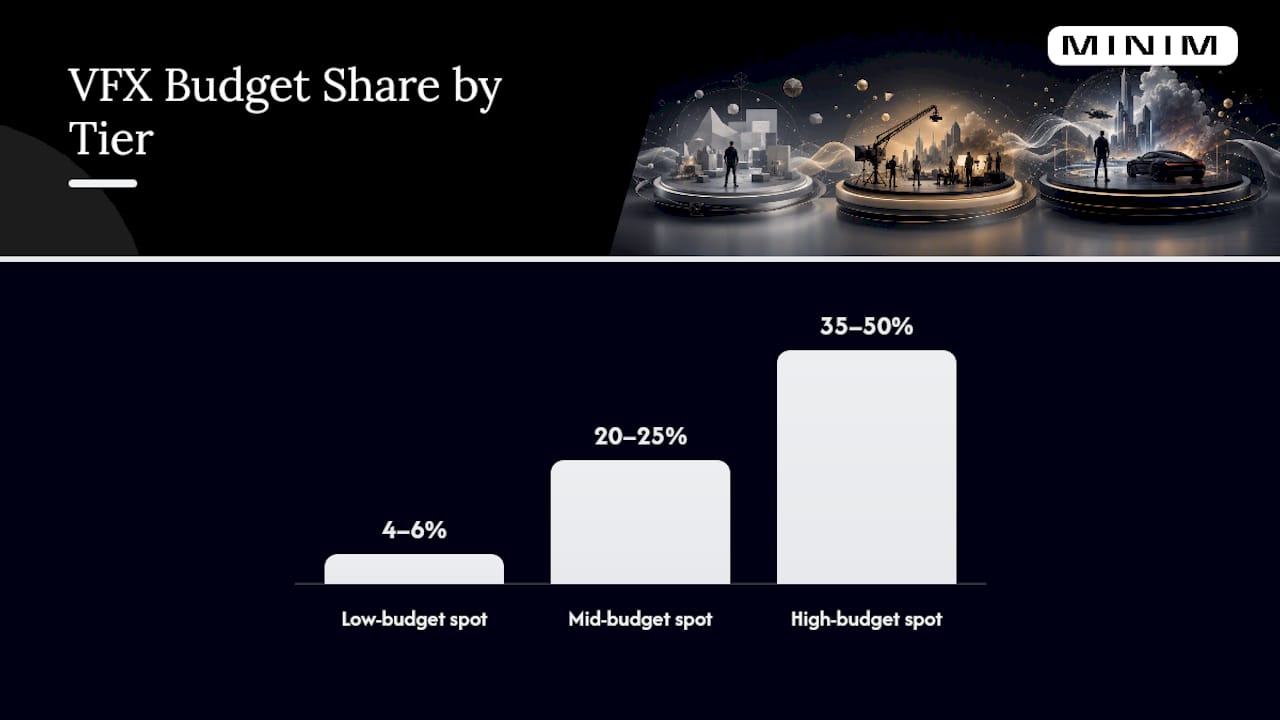
Three annotated examples show how VFX scales against a full spot budget, based on typical ad production ranges from Simulmedia's ad-cost analysis.
Low-budget spot ($50,000 to $75,000 total production):
- 3 VFX shots: two basic comps and one motion graphics title card
- VFX line item: roughly $2,500 to $4,000
- VFX share of budget: 4% to 6%
Mid-budget spot ($150,000 to $250,000 total production):
- 8 to 12 VFX shots: product tracking, a CG element or two, moderate on-set supervision
- VFX line item: roughly $30,000 to $60,000
- VFX share of budget: 20% to 25%
High-budget spot ($400,000-plus total production):
- 20-plus complex shots, heavy simulation work, one or more photoreal CG hero assets
- VFX line item: often $150,000 to $300,000, sometimes more if sims dominate
- VFX share of budget: 35% to 50%, occasionally higher when VFX is the entire creative concept
National TV ad production commonly ranges from $50,000 to $500,000, with CGI-heavy concepts pushing toward the top of that range. Note that these figures cover creation, not usage. Licensing terms for stock assets or third-party software can add separate line items depending on where and how long the spot runs. Our breakdown of commercial video costs covers how VFX slots into the rest of a US production budget in more detail.
How Do You Cut VFX Costs Without Cutting Impact?
The cheapest VFX fix is the one you make before anyone picks up a camera. A VFX supervisor brought in during pre-production catches problems that would otherwise turn into remedial roto charges after the shoot.
- Lock your VFX plan before the shoot, not during editorial, so the crew captures clean plates and tracking data the first time.
- Prioritize spend on hero shots the audience actually notices; let background or transitional shots use lighter, cheaper techniques.
- Reuse CG assets across a campaign's multiple cuts instead of building new ones for every version.
- Lean on high-quality stock elements for smoke, fire, or particle effects instead of commissioning custom simulations.
- Blend practical effects with VFX cleanup rather than building everything in CG; a stylized look often costs less than a photoreal one and can read as more distinctive.
- Batch multiple spots with one vendor to negotiate a package rate instead of bidding each one separately.
Pro Tip: If budget is tight, ask your vendor which shots are "hero" versus "supporting" in their own bid. Vendors already rank complexity internally. They just don't volunteer that ranking unless you ask.
MINIM's Rules of Thumb for Agency Briefs
Years of running VFX-heavy commercial work alongside agency creative teams point to one consistent pattern: the projects that come in on budget are the ones where VFX gets scoped before the shoot, not during it. Virtual production tends to pay off when a spot needs multiple environments or lighting setups in a single day. Animation usually wins on cost-to-impact when the concept doesn't need to look photoreal, since it sidesteps the plate-quality and matchmove issues that inflate live-action VFX bids. Our comparison of when virtual production makes sense and this guide to animation for commercials both walk through that trade-off in more depth.
Before sending an RFP, put these items in the brief:
- Exact shot count and a one-line complexity note per shot
- Plate specs: format, frame rate, and whether raw camera files (R3D, BRAW, ProRes 4444) will be delivered
- Number of included revision rounds and the cost of additional rounds
- Usage and licensing terms for the final cut and any stock or third-party assets
- Delivery deadline and whether it includes buffer for client review cycles
Reviewing how VFX scheduling fits into the broader post-production pipeline before you finalize the brief tends to surface scope gaps early, when they're still cheap to fix.
What Do VFX Licensing Costs Actually Cover?
Licensing sits separately from the creation fee, and it's the line item agencies most often forget to ask about. Two categories matter here. First, stock VFX elements, things like smoke, fire, or particle libraries, usually carry a license tied to usage: broadcast, digital, or unlimited. A royalty-free element bought once might be fine for a single digital spot but require an upgraded license for national broadcast.
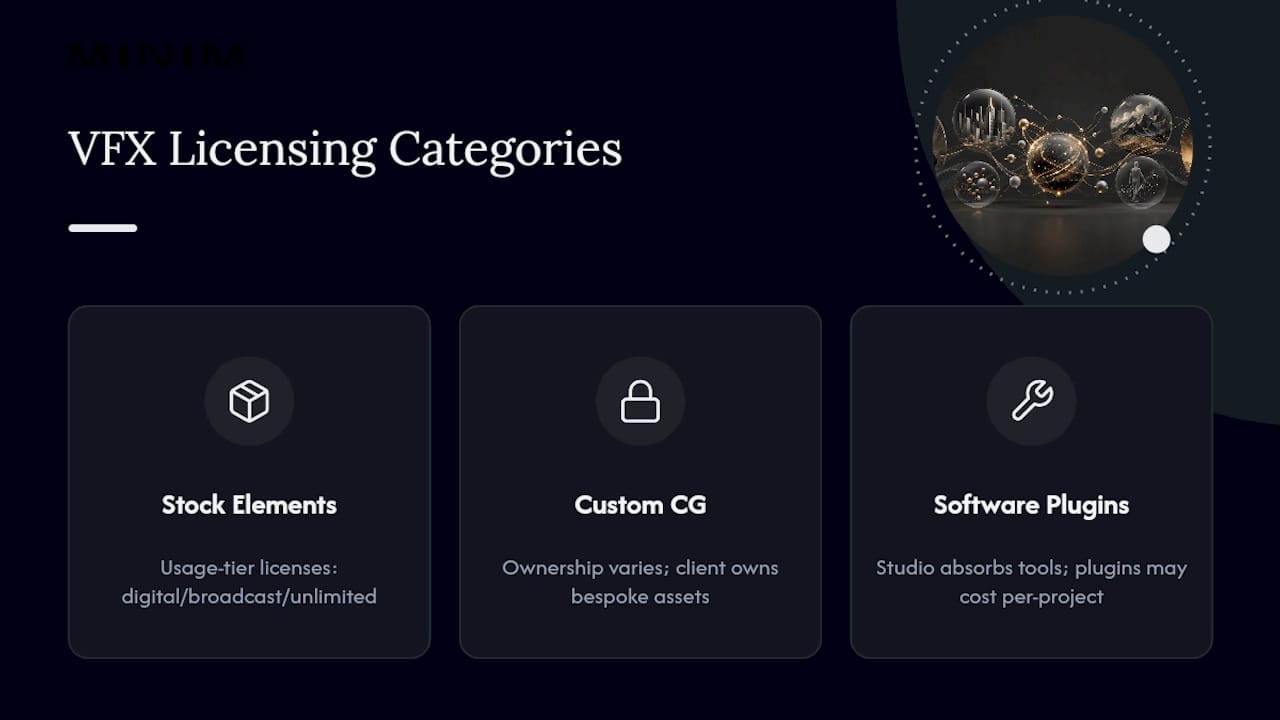
Second, any custom CG asset built for the campaign, a product model, a character, an environment, comes with an ownership question. Some vendors retain rights to reuse generic elements (a stock explosion, a generic cityscape) across other clients, while the client owns anything built specifically to spec. Get this in writing before production starts, not after the campaign wraps and someone wants to reuse the CG asset for a follow-up spot.
Software licensing rarely hits the client's invoice directly, since most VFX studios absorb tool costs like Nuke or Houdini into their day rates. Where it does surface is with proprietary plugins or specialized simulation tools that carry per-project licensing fees; ask your vendor to flag these upfront if the concept calls for anything unusual, like advanced crowd simulation or photogrammetry-based asset creation. A five-minute conversation about licensing scope during the bid stage avoids a five-figure surprise during usage renewal.
What Hidden Costs Show Up After the Bid Is Approved?
The bid you approve rarely matches the invoice you pay, and the gap is almost always revisions. Most vendor quotes include two or three rounds of client feedback baked into the price. Round four, the one where the client wants the CG product to "feel more premium," usually costs extra, and vendors are within reason to charge for it since it often means re-rendering, not just re-tweaking.
Scope creep is the second surprise. A client asking to extend a 15-second cutdown into a 30-second version, or wanting the same VFX shot reformatted for vertical social delivery, sounds minor but often means re-compositing at a different aspect ratio or re-timing a simulation that wasn't built to stretch.
Approval delays cost money too, just less visibly. If a client sits on a review for two weeks, the VFX team's calendar doesn't stay open waiting. Getting reslotted into a vendor's schedule can trigger a rush fee even though nothing about the creative changed. Build a firm approval timeline into the production schedule from day one, and see how a compressed schedule affects total delivery time before you promise a client a launch date the VFX vendor hasn't confirmed.
An Honest Read on Where Agencies Overspend and Underspend
The conventional advice tells creative directors to "get quotes early and compare." That's fine advice, but it misses the actual failure point: most agencies lose money not on the bid itself, but on what happens between the bid and the shoot. A VFX supervisor left out of pre-production meetings can't flag a lighting setup that will need $8,000 in remedial roto. By the time anyone notices, the shoot is over and the fix is mandatory, not optional.
The bigger mistake, though, is treating VFX as a single number instead of a portfolio of shots with wildly different costs. Push back on the expensive shots specifically. Don't negotiate the whole bid across the board and risk cutting quality from shots that were already lean.
Prioritize plate quality and supervisor involvement before you prioritize the vendor's day rate. A cheaper vendor working from bad footage will cost more in the end than a pricier one working from clean plates.
— Steven Reina
Get Agency-Grade VFX Without the Overhead
A strategic production partner can work as an extension of your creative team, not a separate vendor you have to manage from scratch on every campaign. When a concept calls for heavy VFX, a production team can scope shot complexity before the shoot, bring supervision on set, and deliver cinematic results without you needing to build out an in-house VFX department or juggle multiple freelancers per project.

That structure matters most on the exact problems this article covers: shots that need remedial fixes because nobody supervised the plate photography, or budgets that blow up because scope wasn't locked before production. Bringing a production partner in during pre-production can help ensure your VFX line item reflects what the campaign actually needs, not what got missed on set. If you're scoping a VFX-heavy commercial and want a partner who can carry it from concept through final delivery, take a look at MINIM's production services and start a conversation about your next campaign.
Sources
- Visual Effects Cost: The Numbers You Need to Know
- VFX Cost Per Second: What You Need to Know - Lumpfish Studio
- How much do TV ads cost? — Simulmedia