
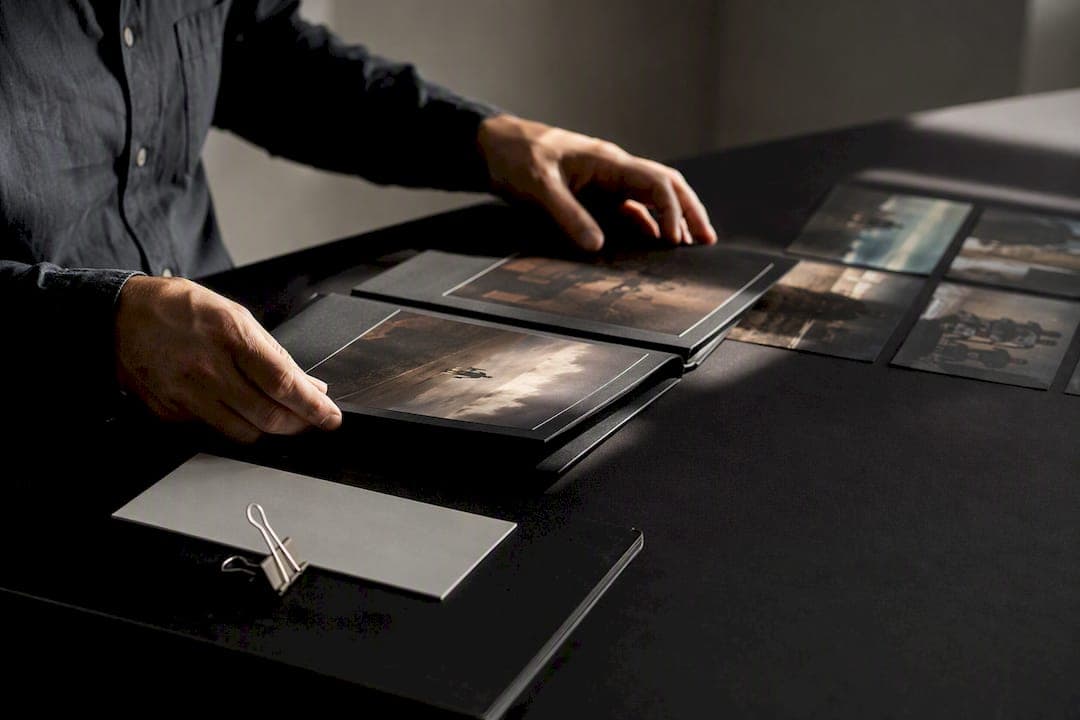
A director treatment is a persuasion document, built around images, that commits to one distinct take on a brief and makes the client trust it enough to hire you. Its only job is to win the bid. A treatment that succeeds usually shares three signals: a sharp director's statement up front, a small set of curated visual references, and a designed, image-heavy PDF that reads like the film it promises.
TL;DR:
- A director's treatment should focus on a clear, confident statement that directly addresses the brief's core tension and showcases a unique point of view.
- Organize the treatment sequentially with the vision first, followed by how it looks and moves, then proof of feasibility, and finally credibility of the director.
- Visual references must be curated, captioned accurately, and serve a specific purpose, avoiding overuse or generic images that erode originality.
- Design quality signals professionalism; use white space, full-bleed images, and consistent typography to build trust before revealing the conceptual content.
- The treatment must stay concise, specific, and tailored to the format, emphasizing understanding of the client’s needs and realistic execution over sheer polish.
Table of Contents
- What Is a Director's Treatment, and What It Isn't
- The Ordered Anatomy of a Winning Treatment
- Writing the Director's Statement That Wins the Room
- Describing the Through-Line So the Client Can Watch It
- Tone, Pacing, Cinematography, and Sound: The Emotional Mechanics
- Designing and Delivering the Treatment: PDF Tips That Build Trust
- Pitching the Treatment: How to Present and Close
- How a Production Partner Turns the Treatment Into a Shoot
- Casting, Wardrobe, and Production Design: Showing Who Lives in This World
- Why a Director Treatment Exists at All
- Tailoring the Treatment to Commercials, Films, and Music Videos
- What Effective Treatments Get Right, With Specifics
- The Mistakes That Quietly Sink Good Treatments
- Turning Feedback Into a Stronger Second Draft
- Where the Treatment Fits in the Bigger Production Timeline
- Where the Standard Advice on Treatments Falls Short
- How MINIM Helps Take a Winning Treatment to Delivery
- Sources
What Is a Director's Treatment, and What It Isn't
A director's treatment is a sales document, not a technical shooting plan. It exists to convince a client, an executive creative director, or a brand team that your take on the brief is the right one and that you can deliver it. That's a different job than a shot list or a script, and confusing the two is one of the fastest ways to lose a bid: producers want confidence in the vision before they want proof of logistics.
Full treatments for competitive commercial or music video pitches typically run several designed pages. For repeat clients or lower-stakes jobs, a shorter mini-treatment often does the job just as well, keeping everyone aligned without the overhead of a full deck. Readers on the other side, agency creatives, brand marketers, executive producers, are judging taste, clarity, and whether you understood the brief better than the other directors in the running.
The Ordered Anatomy of a Winning Treatment
The strongest treatments follow a deliberate sequence: vision first, then craft, then proof, then credibility. Open with the idea, back it up with how it looks and moves, and close with why you're the person to execute it. Jumping straight to camera specs before the client has bought into the concept is a common way to lose the room early.
A dependable page order looks like this:
- Cover page — title, project name, your name, a single striking image.
- Director's statement — your first-person take on the brief.
- Concept or narrative through-line — what happens on screen, beat by beat.
- Visual references — curated, captioned styleframes and motion clips.
- Craft pages — tone, cinematography, casting, sound.
- Credits or bio — past work, key crew, contact information.
Scale this up or down with the project. A national campaign might expand the craft section into three or four separate pages covering wardrobe, lighting, and casting separately. A quick social spot might compress the whole thing into six pages total, with the statement and references doing almost all the persuasive work.
Writing the Director's Statement That Wins the Room
The director's statement is the first thing anyone reads and the part they remember longest. Get it wrong and the rest of the treatment, however beautiful, is fighting an uphill battle. Storyflow's breakdown of the process places the statement first for exactly that reason: it sets the frame through which every image and reference that follows gets read.
Write it in first person. Speak directly to what the brief asked for, not to filmmaking in general.
- Keep it concise; confidence reads as brevity, not volume.
- Name the specific tension or feeling in the brief and state plainly how your film resolves it.
- Avoid hedging language. "I want to" is weaker than "This film will."
- Reference the brand or artist by name, not by category.
Don't finalize the statement first. Draft it early to clarify your own thinking, then rebuild it after you've pulled your visual references, because the images almost always sharpen the language and surface a sharper version of the idea than your first pass did.
Pro Tip: Read your statement out loud before you lock it. If it sounds like something you'd say to a friend about the coolest project you've ever gotten to make, it's working. If it sounds like a proposal, rewrite it.
Describing the Through-Line So the Client Can Watch It
The concept section is where you show what actually happens on screen, not a shot list, a story the reader can watch unfold in their head. Structure it the way you'd structure the film itself: a set-up that establishes the world, a turn that introduces tension or surprise, and a payoff that lands the brand or artist's role inside that arc.
Write it as a sequence of moments, not a technical breakdown:
- Describe what the viewer sees and feels in each beat, in the order they'd experience it.
- Place the product or artist naturally inside the story rather than bolting it on at the end.
- For music videos, tie your beats to the song's actual structure, verse, chorus, bridge, so pacing decisions feel inevitable rather than arbitrary.
- For 30 or 60 second commercials, respect the runtime; a through-line that needs two minutes to land won't survive the edit.
This section is where a lot of directors default to jargon, calling out lens choices or camera moves before establishing why the audience should care. Save the technical language for the craft pages that follow.
Tone, Pacing, Cinematography, and Sound: The Emotional Mechanics
Name the specific feeling you want the viewer to leave with, then work backward into the craft choices that deliver it. That's the real function of this section: not a technical spec sheet, but a sensory case for how tone gets built.
- State the emotional target directly: warmth, tension, awe, whatever the brief calls for, and connect it to edit rhythm (quick cuts for urgency, long holds for intimacy).
- Cover cinematography in sensory language, not a full lighting plot: describe lens choices, movement, and light quality the way an audience would experience them.
- Select two or three reference tracks for sound and music, and explain what each one is doing (driving energy, creating contrast, signaling a genre) rather than just naming a genre.
- Keep this section image-supported. A described lighting approach lands harder next to a still that shows it.
Designing and Delivering the Treatment: PDF Tips That Build Trust
The design of the document itself functions as a credibility signal. A cluttered, inconsistent layout undercuts even a strong concept, while a considered one builds confidence before the client reads a word.
- Include, at minimum: a cover, a short contents structure, the statement, references, craft pages, and credits.
- Use generous white space and a consistent type system; cramped pages read as rushed thinking.
- Let images breathe at full bleed where the reference genuinely earns it, rather than shrinking everything into uniform grids.
- Tools like Adobe InDesign handle complex, image-heavy layouts well for directors who want full control; Canva works for faster turnarounds when timelines are tight.
- Hire a designer for high-stakes pitches if layout isn't your strength; a treatment is one of the few documents where the packaging genuinely affects the verdict.
Pitching the Treatment: How to Present and Close
The pitch call itself functions as something close to a vibe check between director and client, and the treatment is your commitment to what you heard in that conversation.
- Open with the vision and statement before anything else; let the client buy into the idea first.
- Move quickly into your strongest two or three references; don't work through the deck sequentially if the best material sits on page nine.
- Land craft credibility fast, enough lighting and camera detail to signal feasibility without turning the pitch into a technical review.
- Prepare short, direct answers for budget and feasibility questions before the call, not during it.
- Decide in advance which pages go to which audience. An executive creative director may only need the front half; a producer will want the craft pages in full.
Pro Tip: Send a short follow-up note within 24 hours restating your one-line concept. Committees deliberate; a clear, memorable line outlasts a forty-page deck in that room.
How a Production Partner Turns the Treatment Into a Shoot
Winning the bid is only half the job. A production partner takes the approved treatment and translates it directly into storyboards and shot lists, turning the persuasive language of the statement into a workable production schedule. MINIM does exactly this work daily with agency teams, bringing in-house departments to bear once the vision is locked so nothing gets lost between the pitch deck and the call sheet. The right time to loop a partner in is right after the treatment gets approved, not after preproduction has already stalled.
Casting, Wardrobe, and Production Design: Showing Who Lives in This World
A treatment that nails tone but skips who's actually in the frame leaves a credibility gap. Casting, wardrobe, and production design cues answer the question every good client is silently asking: does this director know exactly who populates their world?
Casting references don't need to be literal lookalikes. Pull two or three faces or body types that capture an energy, awkward, magnetic, weathered, and say what quality each one represents rather than presenting them as a casting call. For commercials built around a specific demographic, this section reassures a brand team that the film will actually look like their customer.
Wardrobe cues work the same way: a few frames showing texture, color palette, and era rather than a full costume plot. If the brief calls for aspirational but grounded, show one reference that's clearly too polished and explain why you're pulling back from it, that contrast teaches the client your taste faster than a paragraph of description would.

Production design deserves the same restraint. Show the world's material reality, worn wood, fluorescent light, a specific decade of furniture, rather than a generic mood board. One well-chosen location still, captioned with why it fits the story, does more work than five loosely related interiors. The goal across all three is specificity: prove you've already pictured the people and places, not just the concept.
Why a Director Treatment Exists at All
Strip away the design polish and a treatment has exactly one purpose: to win the job by proving you understand the brief better, or at least more distinctively, than every other director being considered. Everything else, the references, the statement, the craft pages, exists in service of that single goal.
That framing matters because it changes what "good" means in this context. A treatment isn't judged on how thorough it is or how many ideas it contains. It's judged on whether it makes a specific, memorable case that sticks in a decision-maker's head after they've reviewed four other decks that day. Seasoned directors treat concision itself as a signal of experience, including only what proves the idea rather than every possible direction they could take it.
The secondary goal, easy to underweight but genuinely important, is alignment. Even after you win the job, the treatment becomes the reference document the whole team returns to during production when memory of the pitch call starts to fade. A treatment that's vague in the excitement of the pitch creates real problems three weeks later when the DP asks what "gritty but hopeful" actually means on set. Precision in the treatment is an investment in a smoother shoot, not just a sharper pitch.
Tailoring the Treatment to Commercials, Films, and Music Videos
The core anatomy of a treatment stays constant across formats, but the weighting shifts hard depending on what you're pitching.
Commercial treatments lean heavily on brand fit and feasibility. Clients want to see the product or service handled with intention, not bolted onto a cool concept, so the concept section should show explicitly where the brand sits inside the story. Craft pages matter more here too, since agencies are often comparing budgets across multiple directors and want early signals that your vision fits the number on the table.
Music video treatments can afford more visual ambition and less feasibility hand holding, since artists and labels are usually buying into a bold idea first. The through-line section should track the song's structure directly, verse, hook, bridge, and the references can lean more experimental since the format rewards distinctiveness over polish.
Feature or branded-film treatments need the strongest director's statement of the three, since there's no thirty-second brief doing narrative heavy lifting for you. Expect a longer concept section that reads closer to a short synopsis, and expect the visual references to carry more of the tonal argument since there's more film to imagine.
Across all three, the mistake is treating one template as universal. A commercial treatment padded with music-video-style visual abstraction will read as unfocused to a brand team; a music video treatment weighed down with feasibility notes will read as timid to an artist's team.
What Effective Treatments Get Right, With Specifics
The treatments that consistently win share a pattern worth naming directly: they commit early and stay specific. A statement that says "I want to explore themes of connection" loses to one that says "This film opens on a hand missing a train door by half a second, and spends the next thirty seconds showing everyone that hand reaches for afterward." The second version gives the reader something to picture immediately.
Strong reference sections show the same discipline. Instead of eight frames that all say "moody lighting," an effective treatment might use one frame to establish the color temperature, one to show how shadow falls across a specific kind of face, and one motion clip to demonstrate the camera move that makes the whole sequence feel unstable. Each reference earns a distinct job instead of repeating the same point three times.
The strongest craft pages resist the urge to over-explain. A single sentence about lens choice, paired with a still that shows the resulting depth of field, communicates more than a paragraph of technical justification. Pairing vivid language with purpose-built styleframes rather than generic mood boards is what separates a treatment that feels custom from one that feels recycled from a previous pitch.
The Mistakes That Quietly Sink Good Treatments
Most losing treatments don't fail because the idea was weak. They fail because of execution problems that are entirely avoidable once you know to watch for them.
Overloading the deck is the most common one. Twenty-five pages of references, craft notes, and alternate concepts signals indecision, not thoroughness. Clients read volume as a lack of a clear point of view, since a director with one strong idea doesn't need six alternates as a hedge.
Leading with technical detail before the client has bought into the vision is a close second. Opening a treatment with lens specs and lighting diagrams before establishing why the film matters emotionally loses the room in the first sixty seconds.
Generic references cause quiet damage too. Pulling the same widely circulated commercial or music video stills that every other director in the running is also likely to pull makes your taste indistinguishable from theirs, even if your concept is genuinely different.
Skipping captions on visual references is an easy fix that gets missed constantly. An uncaptioned image asks the reader to guess why it's there; a captioned one tells them exactly what to notice.
Finally, treatments that ignore feasibility entirely put producers in an uncomfortable position. A gorgeous concept that clearly can't be shot on the stated budget forces the client to either pass or negotiate scope down after they've already fallen for the idea, which erodes trust fast.
Turning Feedback Into a Stronger Second Draft
Feedback on a treatment rarely arrives as a clean note. It usually shows up as hesitation on a call, a vague "can we see more options for the opening," or silence after you send the deck. Reading what's underneath the comment matters more than reacting to its literal wording.
When a client asks for "more options," they're often signaling that the current concept didn't fully land, not that they genuinely want five alternate directions. Responding with one sharper version of the original idea frequently works better than diluting your point of view across multiple half-formed alternates.
Revise the statement last, even during a second pass. If the concept or references shifted based on feedback, the opening statement needs to reflect that new shape rather than describing a version of the film you've already moved away from.
Protect the core idea while staying genuinely flexible on execution. If a client pushes back on a specific reference or craft choice, that's usually a solvable detail. If they push back on the emotional core of the concept itself, that's worth a real conversation rather than a quick fix, since chasing every note risks producing a treatment that pleases no one because it no longer commits to anything.
Send revisions with a short note explaining what changed and why, not just a new attachment. Committees are often reviewing multiple treatments across days; a clear changelog helps your revision actually register as improved rather than just different.
Where the Treatment Fits in the Bigger Production Timeline
The treatment sits at a specific, narrow point in the process: after the creative brief and pitch call, before any production planning begins in earnest. Understanding that placement changes how you should think about its content.
Everything upstream, the creative brief, the pitch call conversation, client goals that never made it into a written document, needs to get synthesized into the treatment rather than repeated from it. A treatment that just restates the brief back to the client in prettier language hasn't done its job; it needs to add a point of view the brief didn't already contain.
Everything downstream depends on what the treatment locks in. Once approved, it becomes the reference document for storyboarding, scheduling, casting calls, and location scouting. That's why vague language in a treatment causes real cost later: a producer building a budget off an underspecified concept is essentially guessing, and guesses get expensive once cameras are rented.
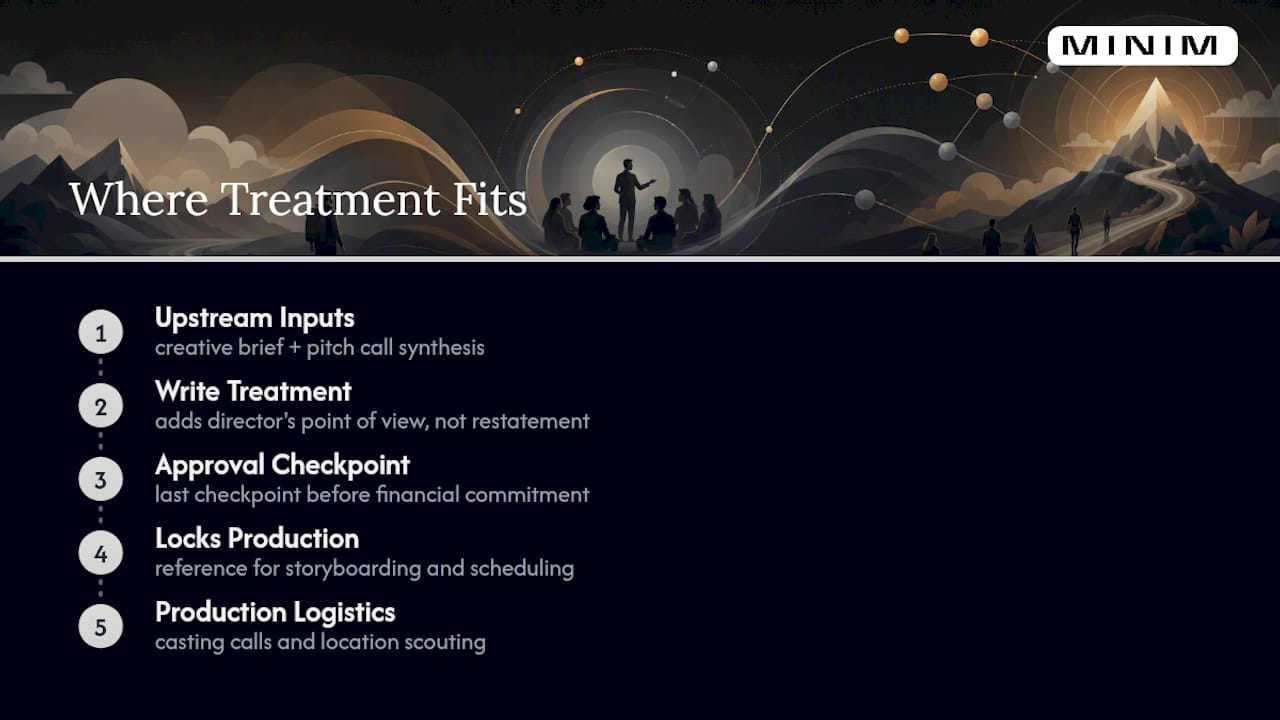
The treatment also functions as the last checkpoint before financial commitment. Agencies and brands are effectively buying a promise at this stage, since the film doesn't exist yet. That's precisely why persuasion and specificity matter more here than at any other point in development: it's the moment where trust in the director has to substitute for the finished product.
Where the Standard Advice on Treatments Falls Short
Most guidance on treatments obsesses over polish, better typography, more references, tighter design, while underweighting the actual decision-making that happens once a client opens the deck. Clients aren't grading production values. They're asking a much blunter question: does this person understand what we actually need, and do I trust them to deliver it without surprises.
That's where a lot of talented directors lose winnable pitches. They build a gorgeous, image-heavy document and skip the one paragraph that would have closed the deal, a direct, first-person statement that commits to a specific point of view rather than showcasing range. Range is what you sell in a demo reel. Conviction is what you sell in a treatment, and those are different pitches entirely.
The other blind spot is treating feasibility as an afterthought. A director who addresses budget and shootability briefly, without turning the whole document into a shot list, reads as someone who's actually run a set before. Skipping that signal, even in a visually stunning treatment, leaves producers guessing about risk at exactly the moment they're deciding whether to bet on you.
Prioritize the statement and a believable production plan before you touch layout. The polish matters, but it's the second thing a good treatment gets right, never the first.
— Steven Reina
How MINIM Helps Take a Winning Treatment to Delivery
Winning the pitch is the start of the real work, not the end of it. Once a treatment gets approved, someone has to turn that director's statement and reference deck into storyboards, a shot list, and a crew that can actually execute the vision on the day. MINIM works directly with agency creative teams as that execution partner, handling everything from storyboarding through final delivery without adding headcount to your team.
That means your treatment doesn't sit in a drawer between the pitch and the shoot; it becomes the working document our production team references at every stage, from casting through final cut. If you've got an approved concept and need a partner who can carry it through production reliably, take a look at our services page or browse past work to see how that translation from treatment to finished film actually plays out.
Sources
References carry as much weight as the writing, sometimes more. A Flim makes the case plainly: precise, well-chosen frames do argumentative work that paragraphs of description can't match on their own.
Resist the urge to pad the deck with a dozen loosely related images. Pick fewer, sharper ones.
Pro Tip: If you can picture two other directors in the running pulling the exact same reference from the exact same music video, cut it. Overused frames read as a lack of original thinking, even when the film behind them was great.