
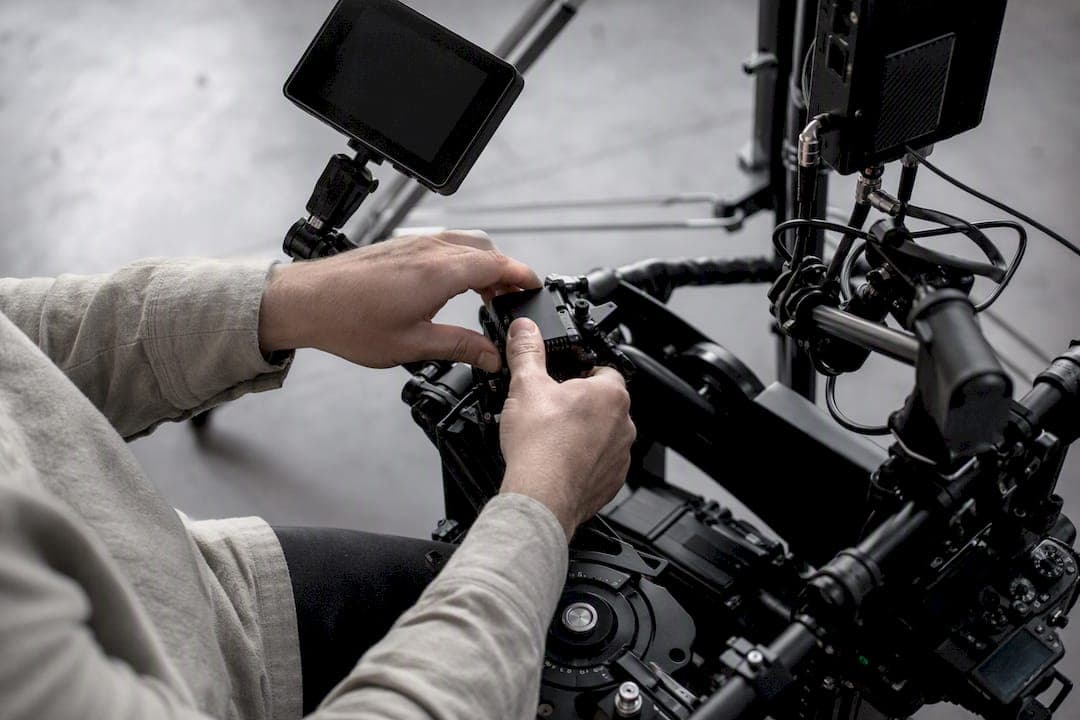
Use virtual production for commercials that need multiple photoreal locations, precise in-camera lighting, or a tightly compressed talent schedule. Automotive spots, multi-location sequences, talent-limited shoots, and stylized branded worlds all benefit most. Most working productions land on a hybrid approach: physical set pieces for what actors touch, LED-driven environments for everything behind them. That trade requires more pre-production discipline and specialist crew than a traditional shoot, not less.
This guide covers:
- What virtual production actually means, in plain terms
- When it beats green screen and when it doesn't
- What it costs, who staffs it, and how to plan around it
- A decision checklist you can hand to a studio during a bid
Key Takeaways
Virtual production works best for commercials when pre-production discipline, specialist crew, and locked assets replace the flexibility that traditional location shoots and green screen normally provide.
| Point | Details |
|---|---|
| Best-fit use cases | Choose virtual production for multi-location car spots, talent-limited shoots, and stylized branded worlds. |
| Hybrid is standard practice | Combine physical foreground builds with LED backgrounds to keep tactile realism at scale. |
| Pre-production carries the risk | Lock 3D assets, lighting maps, and lens data before the studio day, not during it. |
| Staffing is specialized | Book real-time artists and tracking technicians distinct from traditional VFX crew. |
| MINIM integrates VP into agency briefs | MINIM handles storyboards, tech-vis planning, and studio coordination directly with agency creative teams. |
Table of Contents
- What Is Virtual Production for Commercials?
- Virtual Production vs. Green Screen: Which Wins for Your Spot?
- What Are the Real Benefits of Virtual Production for Ads?
- What Are the Biggest Challenges of Virtual Production?
- How Do You Plan a Virtual Production Shoot?
- The Core Technology Behind Virtual Production Commercials
- What Do Real Virtual Production Commercials Look Like?
- How MINIM Integrates Virtual Production Into Agency Briefs
- What Questions Should You Ask Before Booking a VP Studio?
- What the Industry Gets Wrong About Virtual Production
- Ready to Plan Your Virtual Production Commercial?
- Sources
What Is Virtual Production for Commercials?
Virtual production for commercials refers to shooting against real-time digital environments instead of building sets or traveling to locations. The umbrella term is OSVP, on-set virtual production, which uses LED panels and a real-time engine to display a photoreal background directly behind actors and product, captured live by the camera.
A few terms come up constantly once you're scoping a job:
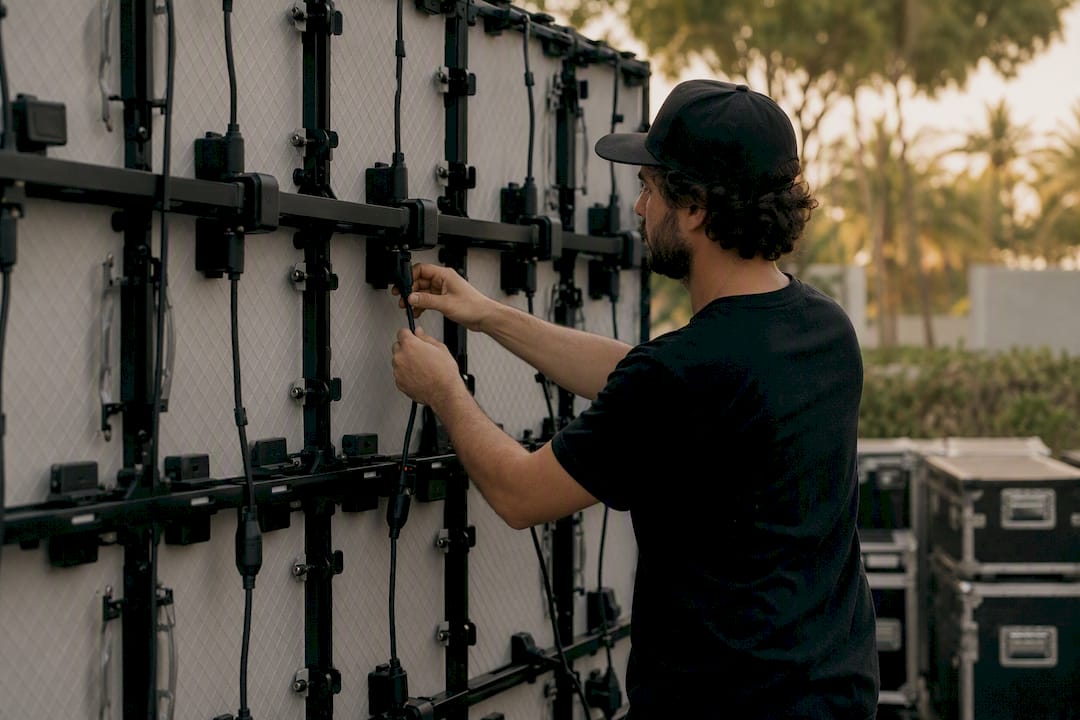
- LED volume: the physical stage, a curved or flat wall (sometimes a full ceiling) of LED panels displaying the virtual environment.
- In-camera VFX: the practice of capturing the final background live, in-camera, rather than compositing it later. Wikipedia's overview of virtual production describes how this setup delivers interactive lighting and reduces reliance on green-screen keying.
- Previz: rough 3D visualization used early to block shots and test ideas before anything is built.
- Tech-vis: a more technical pass after previz, mapping exact camera positions, lens choices, and LED content placement so the studio day runs on rails.
The engine doing the heavy lifting is usually Unreal Engine, which renders the background in real time and syncs it to the physical camera's position through tracking data, so the parallax shifts correctly as the camera moves. The technology went mainstream fast: Epic Games estimated roughly 300 LED stages worldwide by late 2022, just a few years after The Mandalorian popularized the approach.
Virtual Production vs. Green Screen: Which Wins for Your Spot?
Green screen and virtual production solve different problems, and confusing them is where budgets go sideways.
Green screen gives you maximum flexibility in post. You can change a background at the eleventh hour, swap a location because a client changed their mind, and composite multiple plates together. What it doesn't give you is anything in-camera. Actors squint at nothing, reflections on a car hood or a product's glass have to be painted in by hand, and the director is judging a performance against a green wall, guessing how the final composite will read.
Virtual production flips that. The LED volume displays the actual environment during the take, so lighting on skin, reflections in a watch face or windshield, and the actor's eyeline all read correctly on set. Directors and DPs see something close to the final frame while shooting, which changes how creative sign-off happens: approvals happen faster because nobody's imagining the finished shot, they're looking at it.
Where does green screen still win? Straightforward product shots against a single clean background, low-budget social cutdowns, and any job where the final environment isn't locked yet. If your client is still deciding between three concepts the week before the shoot, don't book a volume. Traditional location shooting still wins when the story depends on a real, specific place. A beach at golden hour, a historic street, a genuine landmark. Nobody's faked a convincing Santorini yet.
- Green screen: cheaper crew, flexible in post, weak in-camera realism.
- Virtual production: strong in-camera realism, faster sign-off, higher pre-production cost.
- Location shooting: unmatched authenticity, but subject to weather, travel, and permits.
What Are the Real Benefits of Virtual Production for Ads?
The pitch to a client isn't "it's cool technology." It's speed, control, and image quality that survives scrutiny in a 4K cutdown.
- Faster creative sign-off. Because the background is final in-camera, the director, DP, and client are approving something close to the finished frame instead of a green screen placeholder. That collapses review cycles that used to stretch across weeks of post.
- Multiple environments, one studio day. A car spot that once required three location moves across two states can shoot dawn desert, wet city street, and mountain switchback in the same LED volume, on the same day. Case reporting on Isuzu's "Own It" campaign shows exactly this kind of schedule compression, including a location swap solved entirely inside the volume after a last-minute change.
- Better talent economics. When a celebrity's availability is two days, not two weeks, capturing five setups on a single volume day protects the budget more than any location savings could.
- Cleaner reflections, less retouching. Glossy surfaces, cars, bottles, jewelry, pick up real, interactive light from the LED wall instead of a flat green bounce that needs a compositor to fake later.
Pro Tip: Ask the studio for reference stills from a prior automotive or product shoot on their specific volume. Reflections and highlight behavior vary a lot between LED panel brands and pixel pitches.
Sustainability pitches come up often, too. Fewer flights, fewer trucks, fewer location permits, a real reduction when a script calls for multiple geographies. Just don't oversell it: the LED stage day rate and the pre-production hours needed to build those environments can offset travel savings on a smaller job. The math works best when the alternative was genuinely multi-location.
What Are the Biggest Challenges of Virtual Production?
Virtual production shifts risk earlier in the schedule instead of removing it. That's the trade nobody puts in the pitch deck.
- Pre-production becomes the real production. Assets need to be finalized, lit, and camera-ready well before the studio day, because there's no "we'll fix it in post" safety net for a background that's already baked into the plate. Coverage of Mercedes' virtual production spots makes clear that locked 3D assets and calibrated lens data were the difference between a smooth shoot and a scramble.
- You need specialist crew, not just VFX crew. Real-time artists who manage the live engine scene during the shoot are a distinct role from traditional post-production VFX artists, and tracking technicians who calibrate camera-to-engine sync are their own specialty.
- Data and infrastructure get underestimated. High-speed file transfer, render node capacity, and asset version control are frequently the quiet failure point on a studio day, not the glamorous stuff.
- Budget crossover point matters. A single-location, single-day shoot rarely justifies a volume booking; three-plus locations or heavy talent constraints usually do.
- Foreground interaction and parallax can break the illusion if an actor gets too close to a background element or moves at the wrong depth. This is exactly why hybrid setups, physical foreground pieces against an LED background, remain the dominant approach for commercials.
Pro Tip: Build a "must-have, nice-to-have, if time" priority list for every asset going on the LED wall before the studio day. It keeps scope creep from eating your schedule when something inevitably runs long.
How Do You Plan a Virtual Production Shoot?
The planning sequence for a VP commercial looks different from a standard shoot, mostly because more of the creative decisions have to happen before anyone books a stage.
- Previz first. Rough 3D blocking establishes composition, camera moves, and story beats without committing to final assets.
- Tech-vis next. This locks camera positions, lens choices, and exact LED content placement so the studio day has a blueprint instead of a guess.
- Asset lock and a pre-shoot day. Environments, lighting maps, and lens data need to be finalized and tested, ideally with a dry run on the actual volume, before the real shoot.
- Studio day execution, sequenced to shoot the most complex or highest-risk setups first, while the crew and talent are freshest.
Staffing needs to include a real-time artist managing the live engine scene, a tracking technician calibrating camera-to-engine sync, and someone owning storyboards and shot lists that editorial and VFX can reference after the shoot wraps.
- Version-control every asset by shot number, not by generic scene name.
- Share a locked shot list with editorial before the studio day, not after.
- Build in redundancy time for at least one setup that runs long. One always does.
The Core Technology Behind Virtual Production Commercials
Three systems have to work together for a volume day to go well: the render engine, the physical stage, and the tracking system that ties the camera to both.
Unreal Engine provides the real-time rendering and, on larger stages, nDisplay for driving multiple synced LED walls or ceiling panels as one continuous environment. This is what lets a background respond instantly when a camera moves, rather than rendering overnight like traditional CG.
LED stage specs aren't a footnote, they determine image quality. Pixel pitch, brightness output, color calibration, and panel uniformity all directly affect how reflections read on glossy surfaces like a car hood or a glass bottle. Clarify these specs with the studio during booking, not on shoot day.
Camera tracking and lens data sync the physical camera's position, focal length, and focus to the virtual camera inside the engine, so parallax and depth read correctly in every frame.
- Render nodes and GPU capacity determine how complex an environment the stage can display without frame drops.
- High-speed data transfer and asset management keep editorial and VFX teams working from the same locked files.
- Animation and previsualization workflows often feed directly into the tech-vis stage, especially for stylized or non-photoreal branded worlds.
What Do Real Virtual Production Commercials Look Like?
A few precedents are worth pulling into any internal pitch.
Automotive brands have leaned on virtual production to simulate multiple driving environments, desert, city, mountain road, with consistent lighting across a single studio day, avoiding the location moves that traditionally eat a car spot's schedule. Talent-limited shoots have used LED volumes to capture five or six setups with a celebrity whose availability was measured in hours, not days. Hybrid campaigns, meanwhile, keep a physical set piece (a car body, a countertop, a doorway) in the foreground for tactile authenticity while the LED wall extends the world behind it.
Practitioners behind one such hybrid shoot describe the workflow as splitting the day between volume work for scale and practical builds for anything the talent actually touches, calling that mix the difference between a spot that reads as real and one that reads as a green-screen composite. That approach is documented in coverage of the Warburtons 150th anniversary campaign.
The lesson across all three: the planning and staffing behind the shoot mattered more than the technology itself.
How MINIM Integrates Virtual Production Into Agency Briefs
MINIM operates as a strategic production partner, integrating directly with agency creative teams rather than replacing them, which matters for VP work because the technical planning has to sit next to the creative brief from day one, not get bolted on afterward.
That integration covers the pieces a VP brief actually needs:
- Storyboards and shot lists that double as tech-vis references, so the volume day has a blueprint.
- Animation and previsualization support for stylized or branded-world environments.
- Studio coordination and asset management across editorial, VFX, and real-time teams.
- Full 2D/3D visual effects and art direction, in-house, so foreground and background match tonally.
Agencies that want to see how this plays out on delivered work can review MINIM's project portfolio or ask about specific service capabilities before scoping a brief.
What Questions Should You Ask Before Booking a VP Studio?
Score your project honestly before you shop a studio. Add a point for each: multiple environments needed, high photorealism required, limited talent availability, restrictive shooting locations, and a budget that supports pre-production depth. Three or more points, virtual production is worth pricing out.
Then bring these questions to any studio bid:
- What's the LED panel pixel pitch and brightness, and how does it perform on reflective surfaces?
- What tracking system do you use, and how is lens data calibrated and validated?
- What's the realistic turnaround between asset lock and a shoot-ready studio day?
- How is data transferred and versioned between your team, editorial, and VFX?
Pro Tip: Insist on a full tech-vis pass any time the spot has more than two environments or any product with reflective surfaces. A single studio day without one is realistic only for simple, single-environment setups with assets that are already locked.
What the Industry Gets Wrong About Virtual Production
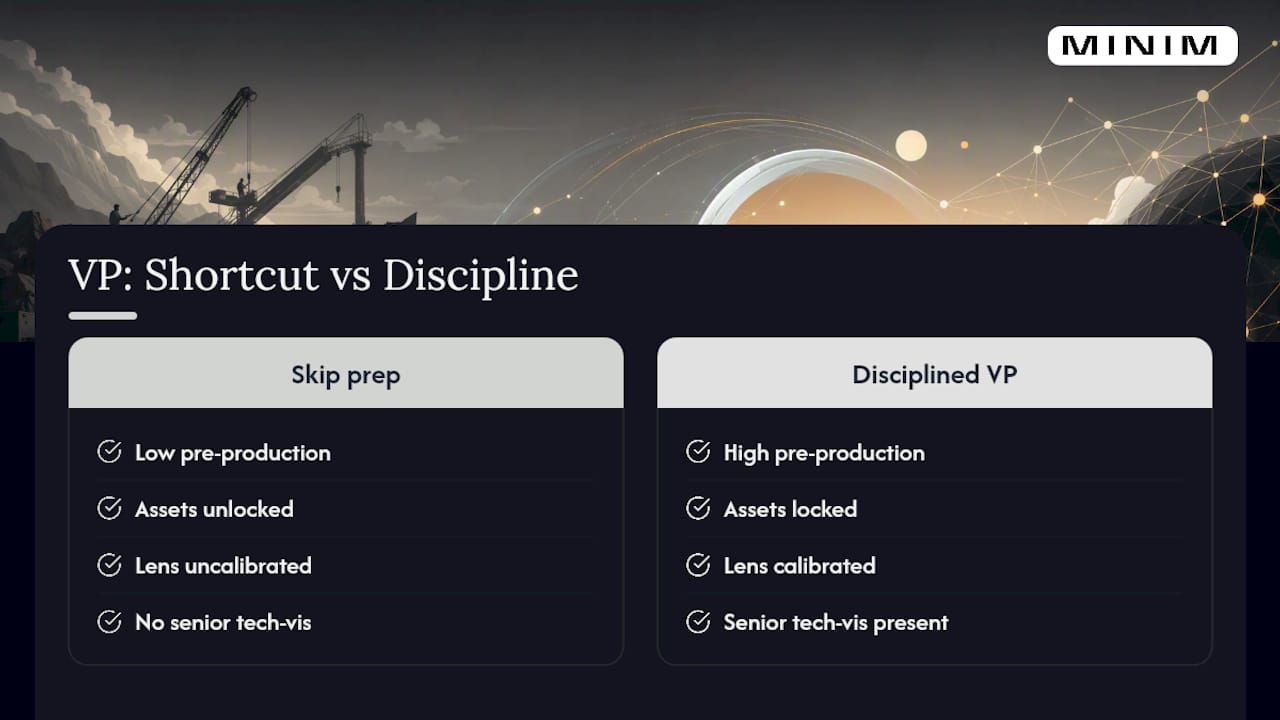
Most coverage of virtual production sells it as a shortcut. It isn't one. It's a different allocation of the same risk, moved earlier in the schedule where it's cheaper to fix but easier to underestimate.
The conventional advice, "get an LED volume and skip the location shoot," skips the part that actually determines whether the spot works: whether the assets were locked, the lens data was calibrated, and someone senior enough understood the tech-vis before the studio day started. Agencies that treat virtual production like a green-screen swap end up with the exact plastic, uncanny look they were trying to avoid. Agencies that treat it like a hybrid discipline, physical foreground, digital scale, disciplined pre-production, get the schedule and cost benefits without the tell.
The real judgment call isn't "should we use virtual production." It's "does this brief have enough pre-production runway to do it properly, or are we better off with a smart hybrid and a shorter volume day." Most commercials fall into the second category, and there's nothing wrong with that.
Ready to Plan Your Virtual Production Commercial?
If you've read this far, you already know virtual production isn't a plug-and-play upgrade, it's a discipline that lives or dies on pre-production, staffing, and asset lock. That's exactly the gap MINIM closes for agencies. Instead of building an internal VP team from scratch, agencies bring MINIM in to handle storyboards, tech-vis planning, studio coordination, and in-house 2D/3D visual effects on a per-campaign basis, with no added headcount and no long-term commitment.
MINIM's team has coordinated production across creative strategy, art direction, and final delivery on real campaign work, viewable on the MINIM project portfolio. If your next brief involves multiple locations, a limited talent window, or a stylized branded world, get in touch through MINIM's services page to scope what a virtual production or hybrid approach would actually cost and require for your specific spot.
Sources
- What is virtual production? — Unreal Engine
- Using virtual production for Warburtons 150 Years in the Baking — postPerspective
- A last-minute location switch and cutting-edge virtual production: Behind the scenes on Isuzu’s ‘Own It’ — LBBOnline