

The strongest agency production workflow runs on eight named phases (intake, scope, resource booking, production, internal review, client approval, delivery, retro), each with a single owner and a template attached. This guide breaks down that structure phase by phase, with copyable checklists, tool categories, and a six-week pilot plan producers can run without stalling live client work.
TL;DR:
- Skipping the scope and estimate step often causes scope creep by allowing production to start before pricing is confirmed.
- Clear phase naming and role ownership are crucial to prevent invisible workflow stalls and diagnose project delays effectively.
- A hybrid workflow with internal Kanban and external gates suits agencies with mixed project sizes and multiple concurrent deliverables.
- Automating file handling and approvals improves efficiency, but creative judgment must remain manual to maintain quality control.
Table of Contents
- What Is an Agency Production Workflow?
- Which Workflow Pattern Fits Your Agency?
- The Phase-by-Phase Production Playbook
- Which Tools Actually Support This Workflow?
- How to Design, Pilot, and Roll Out the Workflow
- Where Agency Workflows Break, and How to Fix It
- Producer Playbook: Templates Worth Copying Today
- The Producer's Role in Holding the Rhythm Together
- A Production Partner That Fits Inside Your Existing Workflow
- Sources
- FAQ
What Is an Agency Production Workflow?
An agency production workflow is the repeatable sequence of steps, roles, and handoffs that turns a client brief into a delivered asset. It differs from general workflow management because it's built around creative deliverables with subjective review cycles, not fixed manufacturing steps. A generic project management framework assumes tasks are objectively "done." Creative work isn't. A logo either matches brand specs or it doesn't, but "does this feel right" is a judgment call, and that judgment call is exactly where most agency timelines fall apart.
Most agency workflows follow the same underlying skeleton no matter the discipline, according to a workflow scaling guide from ClickUp: intake, planning, production, review, approval, and retro. Naming each phase matters because unnamed phases get skipped. If "scope & estimate" isn't a discrete step with its own owner, someone starts production before pricing is confirmed, and that's how scope creep gets baked into a project before the kickoff call even happens.
Here's the canonical phase map worth adopting:
- Intake/brief: Account or strategy lead captures the request; output is a signed brief.
- Scope & estimate: Producer or ops lead sizes the work; output is a scope document with hours and price.
- Resource booking: Producer books crew, freelancers, and equipment; output is a locked schedule.
- Production kickoff: Creative lead aligns the team on deliverables; output is a shared reference deck.
- Production: The creative team executes; output is a working draft or raw footage.
- Internal QA: Senior creative reviews against the brief; output is an internally approved cut.
- Client review & approval: Account lead manages feedback; output is a signed approval.
- Delivery & billing: Producer packages final files and triggers the invoice.
- Retro: The team logs what worked and what didn't for the next cycle.
Skipping the naming step is the single most common failure point in agency production process management. Teams that run informally usually have all these steps happening. They just happen invisibly, which means nobody can diagnose where a project actually stalled.
Which Workflow Pattern Fits Your Agency?
Pick your pattern based on team size and how many projects run at once, not on what sounds more sophisticated.
Sequential (waterfall) works when a project has hard dependencies. You can't edit a video before the footage exists, so production has to follow shooting. Waterfall's safeguard is a formal sign-off at each gate. Nobody moves to the next phase without an approval on record, which slows things down but prevents rework.
Parallel production fits agencies running multiple deliverables from one asset pool. A photo shoot generating stills for six social formats at once is parallel by nature. The risk is drift. One workstream changes a headline and four other workstreams don't know. The fix is a shared source-of-truth file and a single person who owns version control.
Hybrid (Kanban internally, gated externally) is the most common answer for agencies with a mixed workload. Internal teams move fluidly through a Kanban board, but client-facing deliverables still require formal gates.
Decision signals:
- Small team, one project at a time → sequential
- Multiple concurrent deliverables from shared assets → parallel with strict version control
- Mixed project types and sizes → hybrid, gated only where a client signs off
The Phase-by-Phase Production Playbook
This is the operational core: what each phase needs as input, what it produces, who owns it, and how long it should realistically take. Production-focused playbooks for agency video and commercial work typically follow a five-stage model, according to Minifridge Media's agency guide: script interpretation and pre-production, planning, production execution, post-production, and delivery, each with its own approval gate. The structure below adapts that model into eight operational phases for broader agency use.
-
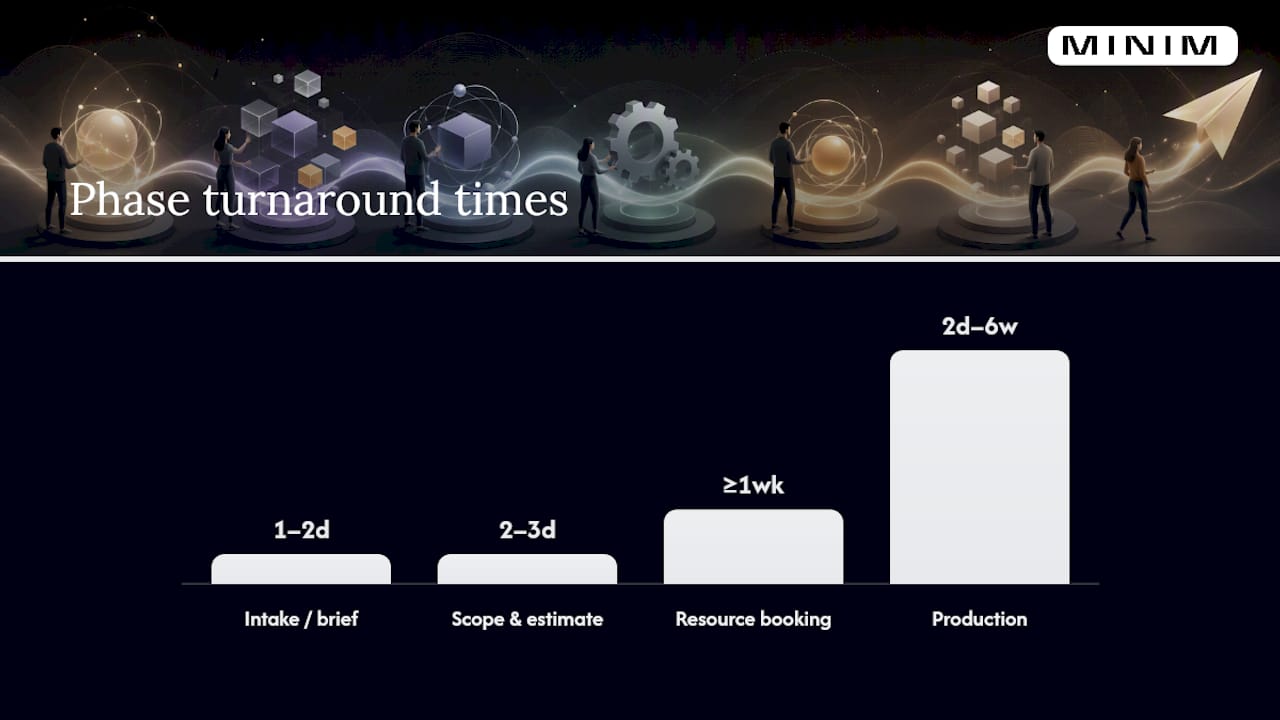
Intake/brief. Input: client request, budget range, deadline. Output: a completed brief document. Owner: account lead. Turnaround: 1 to 2 business days. Attach a brief template that forces fields for audience, success metric, and hard constraints, not just "what they want."
-
Scope & estimate. Input: the brief. Output: a scoped estimate with hours by role. Owner: producer. Turnaround: 2 to 3 business days for standard work, longer for anything requiring a location scout or specialty crew.
-
Resource booking. Input: approved scope. Output: a locked crew and equipment schedule. Owner: producer. Turnaround: varies by crew availability, but should be locked at least a week before kickoff for anything requiring outside talent.
-
Production kickoff. Input: locked schedule, creative references. Output: a kickoff deck the whole team has seen. Owner: creative lead. Turnaround: same day as the first production session.
-
Production. Input: kickoff alignment. Output: raw or draft assets. Owner: creative team. Turnaround: this is the widest range in the whole workflow. A single social cutdown might take two days; a full commercial shoot and edit can run four to six weeks.
-
Internal QA. Input: draft asset. Output: an internally cleared cut. Owner: senior creative or creative director. Turnaround: 1 business day. This step exists specifically to catch errors before a client ever sees them, and skipping it is the fastest way to burn client trust on avoidable mistakes.
-
Client review & approval. Input: internally approved cut. Output: signed approval or a consolidated feedback list. Owner: account lead. Turnaround: 48 to 72 hours is the standard window recommended in Workzone's agency workflow guide, and it should be enforced, not suggested.
-
Delivery & billing. Input: signed approval. Output: final packaged files and an invoice trigger. Owner: producer. Turnaround: same day as approval for standard formats.
The review discipline in phases 6 and 7 deserves its own emphasis. One approval owner per side, client and agency, prevents the classic problem of five stakeholders sending five conflicting rounds of notes. Consolidate feedback into a single list before it reaches the creative team. A short social asset might move through this entire eight-phase sequence in under a week. A full commercial campaign, per the timelines outlined in MINIM's commercial production process playbook, typically runs four to eight weeks, and that's where buffer time in scope & estimate saves a project from a missed launch date.
Pro Tip: Build a 10 percent time buffer into any phase involving outside talent or locations. Weather, availability, and last-minute creative changes hit those phases hardest, and a buffer there is cheaper than a rushed reshoot.
Which Tools Actually Support This Workflow?
Your tool stack should mirror the phases, not the other way around. Five categories cover almost everything an agency needs: a PM platform for spaces and boards, a frame-accurate review and approval tool, a media asset management or proxy workflow for video-heavy work, time tracking, and a transfer/backup system.
Creative teams commonly adopt PM platforms that offer guest access, built-in time tracking, and separate spaces per client, according to Capterra's listing for Wrike, which reflects a broader pattern across agency tooling. Client isolation matters more than most teams realize early on. Mixing two clients' assets in one shared workspace is how confidential creative leaks or gets referenced in the wrong pitch.
Architecture rules worth following:
- Give each client their own project space, not a shared folder buried in a bigger workspace.
- Build a template project you duplicate for every new engagement, so the phase structure is baked in from day one.
- Set up guest reviewer permissions once, as a template, rather than configuring access from scratch every project.
A well-built stack for creative workflow solutions automates the boring connective tissue between tools. Two patterns worth building first: a transfer webhook that triggers proxy generation and posts a review link automatically, and an approval webhook that triggers the final export and delivery package the moment a client signs off. Skip automating anything involving creative judgment. That's the anti-pattern. Automation belongs in file handling and notifications, not in decisions about whether a cut is ready.
Dashboards that answer three questions, who has capacity, which projects are on track, and which clients are profitable, function as the operational nervous system of the whole setup, per ClickUp's agency workflow research. Without that visibility, resource conflicts get discovered the hard way, usually the week a deadline is due.
How to Design, Pilot, and Roll Out the Workflow
Don't design a workflow from a whiteboard session. Map what your team actually does first.
-
Interview 3 to 5 people across roles (a producer, a creative, an account lead) about how a recent project actually moved, not how it was supposed to move. The gaps between the two are where your real bottlenecks live.
-
Build the minimum viable workflow. Name the phases, attach one template per phase, and set one review cycle. Resist adding more structure than the team can absorb in week one. Overbuilding a workflow before anyone has used it is a documented failure pattern, per ClickUp's guidance on scaling agency workflows.
-
Run a six-week pilot. Weeks 1 to 2: map and build templates. Weeks 3 to 4: run two live projects through the new structure. Weeks 5 to 6: measure and adjust. This staged approach mirrors the pilot structure described in Kreatli's producer playbook, which treats a six-week runway as the minimum needed to see real adoption patterns.
-
Track the metrics that matter to producers, not vanity metrics: time-to-first-comment, average review rounds per deliverable, and utilization by role, all flagged as core pilot signals in Kreatli's playbook.
-
Roll out with a one-page guide, a single training session, and a standing dashboard check. Iterate based on what actually breaks, not what you assumed would break.
Pro Tip: Name your phases using the vocabulary your team already uses informally. If creatives already call the ideation phase "concepting," call it that in the workflow instead of inventing a more formal-sounding label. Adoption improves fast when the workflow speaks the team's own language.
Where Agency Workflows Break, and How to Fix It
Four bottlenecks account for most agency production process management failures, and each has a fix that costs nothing but discipline to implement.
- Intake failures: A brief missing a hard deadline or a named approver derails a project before it starts. Fix: a structured brief template with a mandatory approver field, no blanks allowed.
- Feedback chaos: Five people sending notes through four channels. Fix: one review link, timecode-specific comments, one consolidated feedback list delivered to the creative team.
- Resource conflicts: Two projects claiming the same editor the same week. Fix: a weekly utilization check against a live capacity dashboard, reviewed every Monday.
- Scope creep: "Just one more version" turning into six unpaid revision rounds. Fix: an explicit change-order process with a defined number of included revisions, everything past that billed separately.
Standardized templates for briefs and deliverables, paired with clear revision limits, correlate directly with faster approvals and fewer rework cycles, according to Smartsheet's research on creative agency workflows.
Producer Playbook: Templates Worth Copying Today
Four artifacts cover most of what a producer needs on day one of a new engagement.
- Brief template fields: target audience, success metric, hard constraints (budget, deadline, brand rules), named final approver, and a list of required source assets.
- Internal review checklist: brand accuracy, technical spec compliance, message clarity. Client review checklist: does it answer the brief, does it meet the approved scope, is feedback timecoded and specific.
- Delivery checklist: correct export formats, a consistent file naming convention, a specs sheet attached, and an invoice trigger fired the moment approval lands.
- Retro template: estimated hours vs. actual hours, number of revision rounds, and exactly one process change to test on the next project.
The Producer's Role in Holding the Rhythm Together
A workflow document doesn't run itself. The producer is the one who actually enforces cadence, chases approvals, and keeps templates from going stale. A production partner can slot into that structure at the execution layer, taking on delivery without disrupting the agency's own review gates. The real skill is holding discipline on process while staying loose on the creative itself.
— Steven Reina
A Production Partner That Fits Inside Your Existing Workflow
MINIM integrates directly into the phases already covered here, sitting inside your production and internal QA steps rather than replacing your account and creative leadership. Agencies that need cinematic execution without adding permanent headcount typically plug in a production partner at the production kickoff phase and hand back a delivery-ready asset at the other end.
That's the practical value: your team keeps ownership of intake, client relationships, and creative direction, while MINIM absorbs the full-service production load, from photography and film to 2D/3D visual effects, on a project basis. There's no retainer commitment and no bench to manage between projects. If your current bottleneck is execution capacity rather than strategy, the fastest next step is reviewing MINIM's service capabilities and scoping a single project to see how it slots into your next production cycle.
Sources
- How to Build an Agency Workflow That Scales (ClickUp)
- The Producer’s Playbook - Running Creative Production (Kreatli)
- Agency Workflow Process (Workzone)
- Creative agency process & workflows (Smartsheet)
FAQ
What Is an Agency Workflow?
An agency workflow is the defined sequence of steps, from client intake through final delivery, that a creative team follows to produce and approve deliverables. It typically includes intake, scoping, production, internal and client review, approval, delivery, and a retro, according to ClickUp's breakdown of agency workflow phases.
Who Are the Big Four in Advertising?
The term commonly refers to the four largest global advertising holding companies by revenue and reach, a distinct concept from an individual agency's production workflow. This guide focuses on the operational process any agency, regardless of size, uses to move a project from brief to delivery.
Can You Give an Example of a Workflow Process?
A typical example: a client submits a brief, a producer scopes and estimates the work, the creative team produces a draft, an internal reviewer checks it against the brief, the client reviews within a set window (usually 48 to 72 hours, per Workzone's guidance), and the final asset ships with an invoice trigger attached.
What Is a Good Workflow for Creative Teams?
A good creative workflow names every phase, assigns one owner per phase, and attaches a template to each step so nothing depends on memory. Hybrid models, Kanban internally with gated client approvals, tend to fit agencies running a mixed load of small and large projects at once.
How Long Should a Client Review Window Be?
A 48 to 72 hour review window is the standard recommendation for agency client feedback, and enforcing it, rather than leaving it open-ended, reduces revision rounds and timeline drift according to Workzone's agency workflow research. Pairing that window with a single consolidated feedback link keeps the review from turning into five separate conversations.