

Localize the assets that drive action, and design the master creative to be localization-ready from the first storyboard. That's the fastest path to global scale without blowing up your budget. Teams that treat localization as a production decision rather than an afterthought pair selective transcreation on hero assets with AI-assisted dubbing for volume, using a localization-first workflow.
TL;DR:
- Using a localization-first workflow with editable assets and cultural adaptation reduces rework costs and ensures consistency across multiple markets.
- AI-assisted lip-sync and voice cloning can localize face-to-camera creatives quickly and cost-effectively, but still require human review for quality control.
- Testing localized videos with small-scale in-market panels and measuring key KPIs like watch time and click-through rate prevents wasted budget on ineffective creative.
- Proper asset sorting into transcreation or translation categories optimizes workflow, with heavy creative assets prioritized for transcreation and simple content for translation.
- Outsourcing production to a localization-focused partner like MINIM streamlines process management and adapts creative assets efficiently for scaled, multi-market campaigns.
Table of Contents
- What Is Campaign Localization Video, and Why Does It Matter?
- Subtitles, Voiceover, and AI Lip-Sync: Which Method Fits Your Content?
- How to Structure a Localization-First Production Workflow
- Transcreation vs Translation: Sorting Your Assets Correctly
- Scaling Video Localization Without Losing Quality
- What KPIs Should You Track for Each Localized Version?
- Practitioner Playbook: How MINIM Runs Outsourced Localized Production
- What Legal and Compliance Issues Come Up in Localized Video?
- Technical Specs and Format Requirements Across Platforms
- Real Campaigns That Localized Well (and What Made Them Work)
- How Should You Test Localized Video Before Full Launch?
- A Creative Director's Take on Building Localization Into the Brief
- How MINIM Supports Localized Campaign Production at Scale
- Sources
What Is Campaign Localization Video, and Why Does It Matter?
A mismatched joke or a color choice that reads as funereal in one market can tank engagement on an otherwise strong spot. Culturally native creative consistently outperforms straight-translated content because viewers respond to tone, pacing, and references that feel like they were made for them, not adapted for them. Localization done right isn't a cosmetic layer over a finished video. It's a structural decision that starts before the camera rolls.
The risks of skipping it, or doing it late, show up fast:
- A tagline that translates literally but loses its double meaning falls flat or, worse, becomes unintentionally funny.
- Color, gesture, and imagery carry different associations across regions, and a single visual choice can undercut an entire campaign's credibility.
- On-screen text baked into a video file (not on an editable layer) means every language variant requires a full re-edit, not a swap.
Localization isn't always worth the investment, though. Visual-first assets like product demos with minimal dialogue, rapid A/B test creatives, or short-lived promotional stunts often perform fine with subtitles alone or no adaptation at all. The decision hinges on stakes and shelf life: a hero brand film running for a year deserves cultural adaptation; a 48-hour testing creative usually doesn't.
Subtitles, Voiceover, and AI Lip-Sync: Which Method Fits Your Content?
Each dialogue delivery method solves a different problem, and picking the wrong one either wastes budget or undersells the creative. Subtitles are the fastest and cheapest option, good for testing concepts and low-stakes content, but they ask viewers to read instead of watch, which hurts retention on mobile. Traditional voiceover and dubbing replace the audio track entirely and work well for training content, demos, and performance-driven spots where clarity matters more than lip precision. AI-assisted lip-sync goes furthest: it re-times mouth movement to match the new language track, which matters most for face-to-camera creatives and testimonial-style ads where a mismatch between lips and audio breaks the illusion instantly.
Content type should drive the choice, not budget alone:
- UGC and testimonial-style content: lip-sync or high-quality dubbing, since viewers notice mismatched mouths immediately.
- Hero brand spots: dubbing or lip-sync, paired with in-market voice casting.
- Training and internal comms: subtitles or basic voiceover, where fidelity matters less than comprehension.
- Product demos: voiceover, since the visual carries most of the message anyway.
Method selection generally follows content stakes: subtitles for fast, low-budget tests, dubbing for performance spots, and lip-sync when the face-driven creative needs to feel truly native.
Pro Tip: Start every new market with subtitles to validate the concept cheaply, then upgrade only the winners to dubbing or lip-sync. You'll spend real production budget on creative that's already proven itself.
How to Structure a Localization-First Production Workflow
The teams that scale localized video without drowning in rework follow a consistent sequence, and they build it into the brief before a single frame gets shot.
- Transcribe the source video into a clean, timestamped script, separating dialogue from on-screen text.
- Adapt or transcreate the script depending on the asset's creative weight, not a blanket translation pass.
- Produce the localized version, whether that's dubbing, lip-sync, or a full reshoot of market-specific b-roll.
- Run local QA with an in-market reviewer who catches tone, slang, and cultural missteps a translator alone would miss.
- Publish with platform-specific specs already confirmed, not discovered after upload.
Designing the master asset for localization from the start eliminates most retrofit costs: editable text layers, clean isolated source audio, and scripts that avoid idioms travel across markets without a full rebuild. Planning for text expansion and subtitle-safe framing up front means graphics don't need a redesign every time German or Finnish runs 30% longer than English.
Governance matters as much as the steps themselves. A shared termbase keeps product names and key phrases consistent across every language variant. A style guide sets tone rules once instead of re-explaining them to every translator. And a defined approval gate, with a named in-market reviewer signing off before publish, catches the errors that a project manager three time zones away won't.
Transcreation vs Translation: Sorting Your Assets Correctly
Not every line of copy carries the same creative risk, and treating them all the same wastes money in one direction or another. Transcreation prioritizes cultural adaptation and creative rewriting to preserve emotional impact, while translation preserves literal meaning and accuracy. Transcreation typically costs more and takes longer, since it requires a copywriter fluent in both language and brand voice, plus a creative sign-off round that straight translation skips.
Sort your assets before requesting quotes:
- Needs transcreation: taglines, hero video scripts, calls-to-action, anything designed to persuade or land an emotional beat.
- Needs translation only: product specs, legal disclaimers, terms and conditions, subtitles for instructional content.
- Hybrid: SEO-driven video descriptions or captions, where accuracy matters but some phrasing flexibility helps discoverability.
Splitting assets into these groups before briefing lets you route transcreation work to copywriter-linguists with a creative brief, while translation work goes through faster, more automatable channels. QA differs too: transcreated copy needs a brand-voice review, not just a linguistic accuracy check.
Scaling Video Localization Without Losing Quality
Volume is where most localization programs break. Manually re-editing a 30-second spot for 12 markets used to mean 12 separate production cycles. It doesn't anymore.
AI localization tools can translate audio, clone a voice, and re-sync lips in a single pass, cutting dialogue turnaround from weeks to minutes and dropping the marginal cost of each additional language substantially. That doesn't mean the process is push-button. Documented agentic AI localization runs show the first market taking a couple of hours to localize, with each subsequent market taking about half that time, because the workflow reuses a structured change plan instead of starting from a blank page each time.
The batching pattern that works: take one winning ad, build a change plan for what varies by market (voice, on-screen text, maybe a hero image), then regenerate variants against that plan rather than re-editing each one from scratch. Batching a proven ad through a defined change plan before running it across markets prevents both budget overspend and creative drift, where markets slowly diverge from the source concept.
What stays human, no matter how good the tooling gets:
- Transcreation of hero taglines and emotionally-driven scripts.
- Voice casting decisions for markets where accent and tone carry brand meaning.
- In-market QA review before anything goes live.
- Final creative sign-off on lip-sync output, since AI still produces rejects that need a human eye.
Budget for iteration. Generative rejects on lip-sync or voice clone runs are normal, not a sign the tool failed, and pricing that expectation into your timeline beats discovering it mid-campaign.
What KPIs Should You Track for Each Localized Version?
Global performance numbers hide language-level problems. A campaign that looks fine in aggregate might be carrying two strong markets and three weak ones, and you won't know which until you break the data apart.
Measuring performance per language surfaces localization quality issues separately from the creative's overall effectiveness. Track these by language variant, not just globally:
- Watch time and completion rate, which flag pacing or translation problems fast.
- Click-through rate on the CTA, since a weak transcreation often shows up here first.
- Conversion rate, the number that actually matters to budget owners.
- Retention curve shape, which reveals exactly where viewers drop off in a specific language version.
Before anything publishes, run a QA checklist: confirm on-screen text matches the audio track, verify claims stay consistent across every language (a compliance issue as much as a quality one), check that the CTA reads naturally rather than like a direct translation, and have a native speaker confirm pronunciation on any dubbed or lip-synced names and product terms.
The testing pipeline that scales well: launch with subtitles across every target market, watch the KPIs above for two to three weeks, then upgrade the winning markets to full dubbing or lip-sync. You spend the higher-fidelity budget only where the data already shows demand.
Practitioner Playbook: How MINIM Runs Outsourced Localized Production
Agencies that bring MINIM in as a production partner keep creative direction in-house while handing off execution: shooting, editing, dubbing coordination, and localized visual effects. The handoff usually starts with the agency's approved creative brief and a defined list of target markets, and MINIM delivers against a shared termbase and style guide so the fifth language variant sounds as on-brand as the first. That's the difference between a vendor and a partner: a vendor takes a script and returns a file, a partner flags a phrase that won't land before it ever gets shot.
Budget and timeline realities are worth setting honestly. Premium localized campaigns in competitive markets cost more upfront when transcreation and in-market casting are involved, but that cost buys down the risk of a campaign that misses its audience entirely. Outsourcing production makes the most sense when internal teams are stretched thin on a launch timeline or when a market requires casting and cultural expertise the in-house team doesn't have.
Vet any production partner against a short checklist:
- Evidence of a localization-first workflow, not localization bolted on after the master edit locks.
- A real termbase and style guide, not an informal "ask the last translator" process.
- In-market linguistic QA on every language, with a named reviewer accountable for sign-off.
| Vetting Criterion | What to Look For |
|---|---|
| Localization-first design | Editable text layers and source audio delivered separately from the final master |
| Terminology governance | Documented glossary and brand style guide shared before production starts |
| In-market quality review | Native reviewer sign-off per language, not just a translation pass |
| Acceptance criteria | Written QA checklist covering claim parity, CTA tone, and pronunciation |
What Legal and Compliance Issues Come Up in Localized Video?
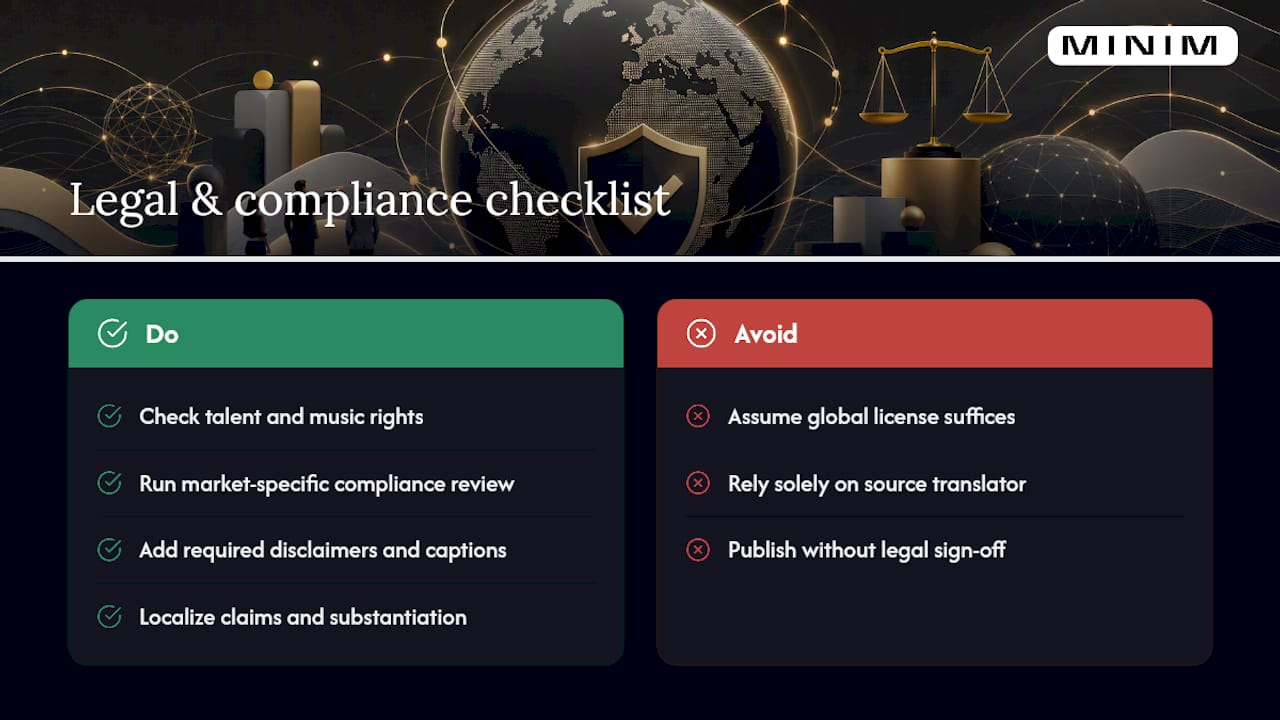
Regulatory requirements don't travel with your creative concept. Claims that are fine in one country can trigger advertising standards violations in another, particularly around health, financial, and comparative advertising claims, where thresholds for substantiation vary by jurisdiction. A supplement ad that says "clinically proven" in one market may need to drop that phrase entirely somewhere else, and a translator working from the source script alone won't catch it.
Talent and music licensing add another layer. Voice actors, on-screen performers, and licensed music tracks often carry usage rights scoped to specific territories or media types, and a dubbed or lip-synced version distributed in a new region can trigger a fresh licensing requirement even when the visual footage stays identical. Check usage rights before assuming a global campaign license covers every market you're now targeting with a localized audio track.
Data and disclosure requirements vary too. Some markets require specific disclaimers on-screen for a minimum duration, or mandate closed captioning for accessibility compliance that others don't enforce as strictly. Advertising standards bodies in different countries also treat comparative claims, testimonials, and influencer disclosures differently, so a script that's compliant in its country of origin needs a compliance pass specific to each new market, not just a linguistic one.
Build a legal review step into the approval gate for any campaign running in a regulated category, alongside the creative and linguistic sign-offs. It's cheaper to catch a compliance issue before the localized version goes live than to pull an ad after a regulator flags it.
Technical Specs and Format Requirements Across Platforms
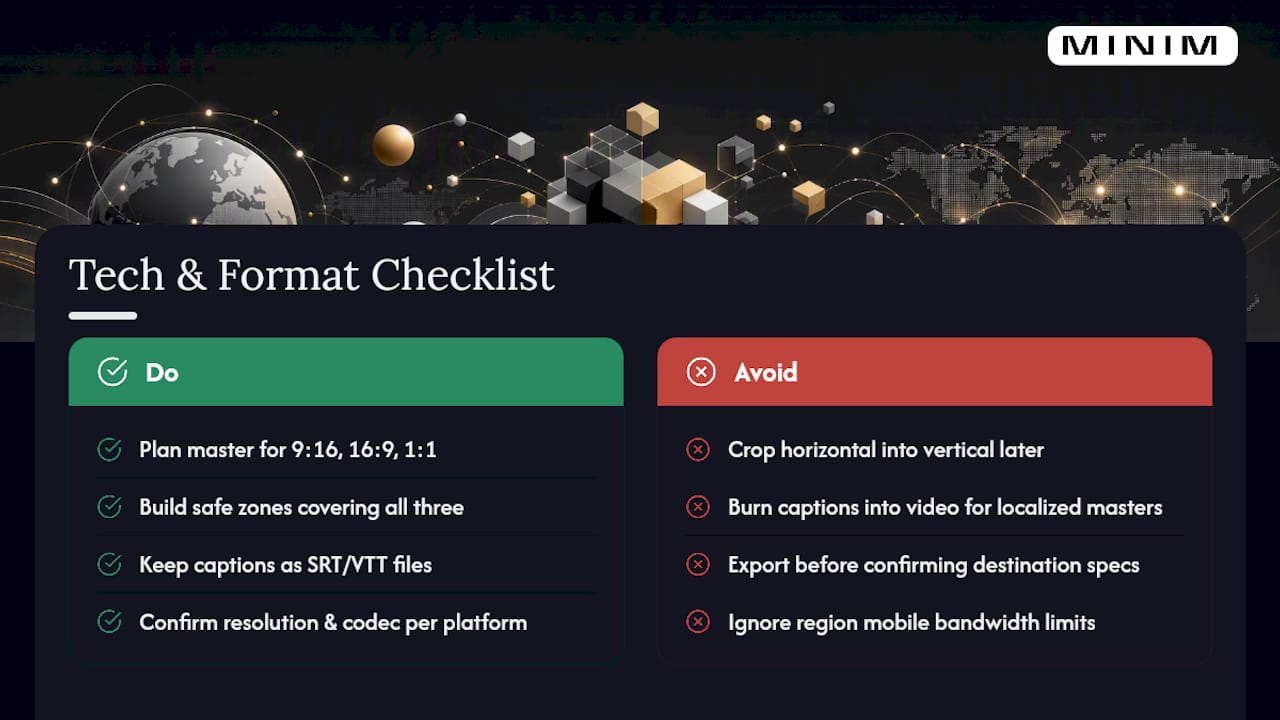
Every platform enforces its own aspect ratio, caption format, and file spec, and building master creative without those constraints in mind means a redesign cycle for every channel, multiplied by every language.
Vertical formats (9:16) dominate short-form placements, while horizontal (16:9) still holds for connected TV and pre-roll. Square (1:1) remains useful for feed placements on some platforms. Plan the master shoot with safe zones for all three, since cropping a horizontal master to vertical after the fact usually cuts off exactly the on-screen text you need for localization.
Caption and subtitle formats differ by platform too: burned-in captions work everywhere but can't be edited post-publish, while SRT or VTT files stay swappable across language versions, which matters enormously when you're localizing the same master into eight languages. Keep captions on a separate file wherever the platform allows it.
Resolution and codec requirements shift by destination as well; a file optimized for one platform's compression algorithm can look soft or artifact-heavy on another. Confirm specs before final export rather than after a market complains about quality.
Region-specific technical quirks matter too: some markets have lower average mobile bandwidth, which affects whether a heavy visual-effects-driven cut performs as well as a simpler edit. Build format and bandwidth considerations into the technical spec sheet alongside language requirements, and keep both in the same document your production partner works from.
Real Campaigns That Localized Well (and What Made Them Work)
The campaigns that localize successfully share a pattern: they treat the local market as the starting point for adaptation, not a checkbox after the fact. A global beverage brand's regional holiday campaigns, for instance, routinely swap out entire visual concepts, not just the voiceover, because holiday imagery and traditions genuinely differ by market. The core brand message stays constant; almost everything else about the execution changes.
Streaming platforms offer a useful contrast. Their marketing for original series often uses region-specific talent for voiceover and even different edit pacing for markets where viewing habits differ, rather than dubbing a single master cut. That's a heavier investment than subtitle-only localization, but it reflects an accurate read of what actually drives subscriptions in each market: recognizable local voices matter more in some regions than others.
The common thread across successful cases: the brands that localize well decide, market by market, whether the asset needs a light touch (subtitles, minor text swaps) or a heavy one (new voice cast, adapted visuals, reworked pacing), and they make that call before production starts, not during a rushed post-launch fix. Campaigns that localize poorly tend to share the opposite pattern: a single master asset gets a translation pass and nothing else, and the mismatch between message and market shows up in engagement numbers within the first week.
How Should You Test Localized Video Before Full Launch?
Testing a localized video the same way you'd test the original English version misses the point. A concept that scores well in an English focus group can flop in a different market for reasons that have nothing to do with translation quality; the visual metaphor might not register, or the pacing might feel off to viewers used to different editing conventions.
Run in-market panels wherever budget allows, not just a translation accuracy check. A native speaker fluent in the market's cultural context will catch problems a bilingual reviewer working from the source script won't, particularly around humor, gesture, and pacing.
Small-scale live testing beats theoretical review every time. Running a subtitle-only version to a limited ad spend budget in a new market for a week or two, then checking watch time and completion rate against your other markets, tells you more than any pre-launch survey. If the numbers hold up, invest in the dubbing or lip-sync upgrade. If they don't, you've saved the higher production cost on a concept that wasn't going to work regardless of localization quality.
Test the CTA specifically, separate from the rest of the creative. A CTA that reads naturally in a focus group setting can still underperform on click-through if the phrasing feels like a translation rather than something a native speaker would actually say. That's usually a sign the asset needed transcreation, not just translation, and it's a cheap fix to catch before full launch rather than after.
A Creative Director's Take on Building Localization Into the Brief
Localization has to enter the brief at the concept stage, not the delivery stage. That means choosing shots that survive translation: fewer visual puns tied to a specific language, cleaner framing that leaves room for subtitle-safe zones, and pacing that doesn't rely on a joke landing in exactly 1.2 seconds. None of that limits creativity. It just means the creative choices get made with eight markets in mind instead of one.
The tradeoffs are usually small. A slightly wider shot to leave room for longer German text. A CTA line written with an eye toward how it'll transcreate, not just how it sounds in English. One brief we'd point to as a model: a campaign scoped for six markets from day one, with editable text layers specified in the shot list itself, hit market three weeks faster than a comparable campaign that treated localization as a post-production afterthought. The savings weren't in the shoot. They were in never having to go back and re-solve a problem the brief could have prevented.
— Steven Reina
How MINIM Supports Localized Campaign Production at Scale
MINIM exists for exactly the moment described above: an agency or brand team that needs premium, localization-ready campaign production without hiring a full internal studio to do it. Instead of building out casting, dubbing coordination, and in-market QA capacity in-house, you integrate MINIM directly into your creative process, from concept through final delivery across every target market.
Outsourcing makes sense the moment your internal team is spending more time managing localization logistics than making creative decisions, or when a launch timeline requires shooting and adapting for six markets on a schedule your current headcount can't cover. It doesn't make sense for a single-market test creative you're validating cheaply on your own. Use that distinction as your decision checklist: if the campaign is high-stakes, multi-market, and time-boxed, a production partner earns its cost back in avoided rework alone.
MINIM's services cover the full range from creative strategy through 2D/3D visual effects, integrated with your team on a project basis rather than a standing retainer. Browse recent work to see how that integration plays out in finished campaigns, then reach out to scope your next localized launch.
Sources
- Transcreation vs. Translation: 6 key differences — Smartling
- Video localisation best practices — XTM
- Sync
- AI ad localization: scale one winning ad across every market — InVideo
- Video Localization 2026: Subtitles, Dubbing & Lip-Sync — Vidforges