
Before a single permit gets approved or a camera package leaves the rental house, you need a Certificate of Insurance showing Commercial General Liability coverage, commonly $1,000,000 per occurrence, along with the specific endorsements each requiring party demands. Call your broker today and confirm exactly who is asking, whether that's the permit office, the location owner, the rental house, or a union like SAG-AFTRA, because each one runs its own checklist.
TL;DR:
- Most productions require a minimum of 1 million dollars per occurrence and 2 million dollars total for general liability coverage, with larger projects often demanding higher limits.
- Insurance requirements stem from multiple sources, including statutory laws, permit offices, rental companies, and contractual obligations, which can lead to conflicting demands.
- Specialty activities like drone work, stunts, weapons handling, or digital security require separate endorsements and should be scheduled well in advance to avoid delays.
- Proper submission of a Certificate of Insurance with all necessary endorsements, correct language, and documents is crucial for acceptance and to prevent costly delays.
- Insurance costs vary widely based on equipment, activities, location, and policy length, with short-term indie projects costing around $1,200 to $2,500 and larger productions reaching $45,000 or more.
Table of Contents
- What Production Insurance Actually Covers
- Who Sets Insurance Requirements and Why They Never Match
- Policy Minimums You Should Expect to Be Asked For
- Getting Your COI Accepted the First Time
- Specialty Risks That Need Their Own Endorsement
- Timing Your Paperwork So It Doesn't Delay the Shoot
- What Production Insurance Actually Costs
- Your Pre-Permit Documentation Checklist
- MINIM's Approach to Production Risk Coordination
- Insurance Coordination Shouldn't Slow Down the Shoot
- Let MINIM Handle the Insurance Coordination While You Focus on Creative
- Where to Verify Requirements Directly
- Sources
What Production Insurance Actually Covers
Most producers picture a single policy. In practice, production insurance is a bundle built around one core piece, the Producer's Package, and several supporting lines that get added based on the type and location of your shoot.
The Producer's Package is inland marine coverage, meaning it protects moveable property tied to the production rather than a fixed building. It typically bundles together:
- Cast insurance (covers reshoot costs if a principal actor becomes unable to work)
- Equipment coverage for cameras, lenses, and grip gear, whether owned or rented
- Props, sets, and wardrobe coverage
- Media and negative film coverage, protecting the actual footage
- Extra expense coverage, for costs incurred recovering from a covered loss
- Third-party property damage (TPPD), for damage to locations or someone else's property
- Civil authority coverage, when a government order forces a shutdown
General Liability sits alongside the Producer's Package as the standard bundled program, covering bodily injury or property damage to third parties who aren't part of your crew. From there, most productions layer in Errors & Omissions for distribution and legal exposure, Workers' Compensation for crew injuries, and Hired/Non-Owned Auto if anyone drives a rental or personal vehicle for production business. An umbrella policy often sits on top when a distributor or brand client demands higher limits than your base policies carry. Stunts, drone work, weapons, or cyber exposure each require their own specialty endorsement, which we'll cover in detail further down.
Who Sets Insurance Requirements and Why They Never Match
Nobody hands you one master list. Insurance obligations on a production stack up from four separate sources, and each source runs its own checklist with different limits, different paperwork, and different deadlines.
- Statutory requirements. Workers' Compensation isn't negotiable in almost any state once you have employees on payroll, and it triggers regardless of what any contract says.
- Permit office requirements. Municipal and state film offices generally require a COI naming the jurisdiction, showing CGL at a set minimum, with the named insured matching your permit application exactly.
- Private-party requirements. Rental houses want equipment coverage at or above replacement value, plus Loss Payee status naming them directly. Location owners want proof they're covered if their property gets damaged during your shoot.
- Contractual and industry requirements. Distributors, financiers, and brand clients frequently demand higher limits than the baseline, and union agreements from SAG-AFTRA, IATSE, or the DGA add their own signatory insurance conditions on top.
The overlap is the trap. A location might accept $1,000,000 CGL, but your distributor's delivery requirements call for $5,000,000 in umbrella coverage. Collate every requirement before you start shopping for a policy, not after.
Policy Minimums You Should Expect to Be Asked For
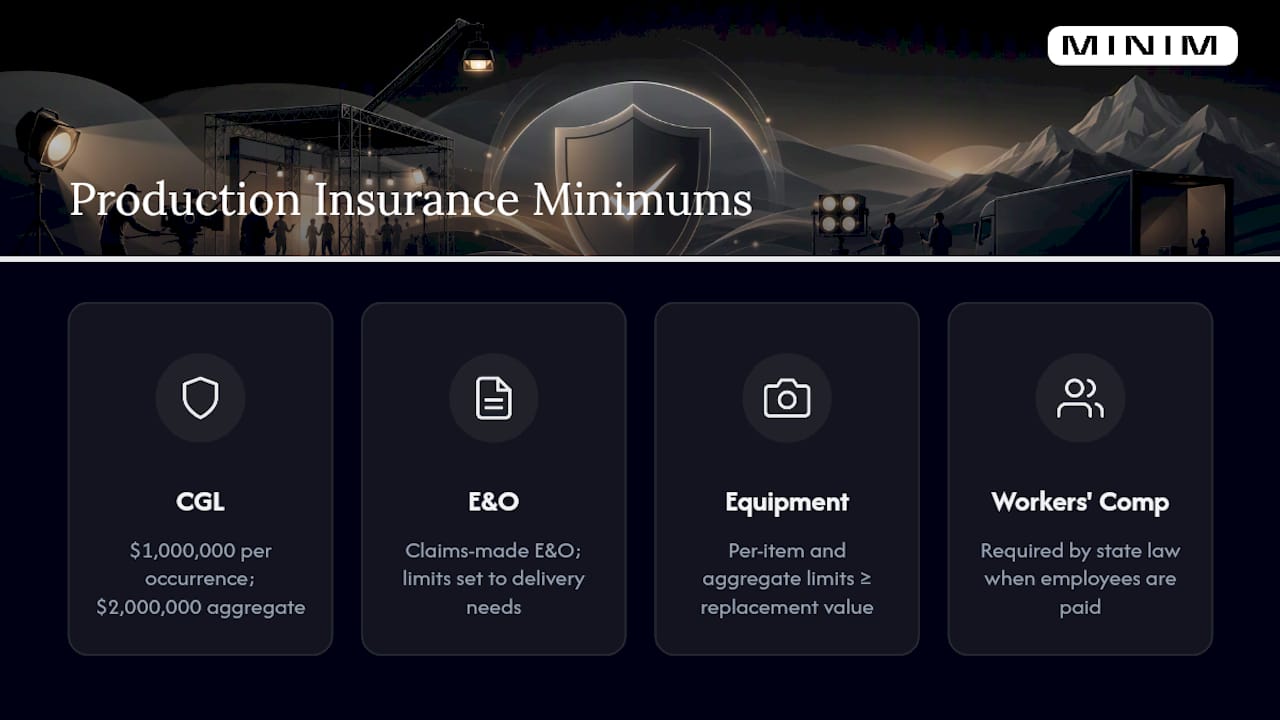
Most requiring parties settle on the same floor: $1,000,000 per occurrence and $2,000,000 aggregate for Commercial General Liability. That figure shows up on municipal film office requirements across the country and on nearly every rental house intake form. Streaming platforms and studio distributors routinely push past that floor, asking for umbrella coverage of $5,000,000 or more once a project reaches their delivery pipeline.
Beyond CGL, common insurance needs generally include Errors & Omissions policies written on a claims-made basis, where distributors often require limits aligned with their delivery needs; equipment coverage with per-item and aggregate limits matching or exceeding replacement values; Workers' Compensation as mandated by state law when employees are paid; and Hired/Non-Owned Auto insurance when crew operate rental or personal vehicles for production business.
Limits have to match whatever your contract or permit actually specifies, not a generic industry number. A last-minute increase to a $5,000,000 umbrella is not always something a carrier can turn around overnight, so lock in your real limits during pre-production, not the week of the shoot.
Getting Your COI Accepted the First Time
A Certificate of Insurance, an endorsement, and a policy declaration page are three different documents, and mixing them up is a common reason submissions bounce back. The COI is a summary snapshot of your coverage. Endorsements are the actual policy amendments that add or modify coverage. The declarations page lists your limits, deductibles, and named insured as written into the policy itself.
Municipal offices lean on standardized ISO endorsement forms, most commonly CG 20 26 (Additional Insured, Designated Person or Organization) and CG 20 12 (Additional Insured, State or Governmental Agency or Subdivision). When your paperwork cites these forms by name, review moves faster because the reviewer recognizes the exact language instead of parsing custom wording.
Three gaps cause the overwhelming majority of COI rejections:
- Missing Additional Insured endorsement naming the specific party requesting coverage
- Missing Waiver of Subrogation, which stops your insurer from coming after the additional insured to recover a payout
- Missing Primary and Non-Contributory language, which confirms your policy pays first before the other party's own insurance gets touched
Producers should have their broker submit the Certificate of Insurance directly to the permit office or rental house because many municipal offices only accept submissions from licensed brokers or agents, and DIY emails are often rejected regardless of content.
Get the certificate-holder language exact, too. If the permit says "City of Los Angeles, its officers, agents, and employees," your COI needs that same phrasing, not a paraphrase.
Specialty Risks That Need Their Own Endorsement
Standard production insurance excludes a longer list of activities than most producers expect. If your shoot involves anything on this list, budget extra underwriting time, because these endorsements rarely get issued same day.
- Drone and aerial work requires a scheduled Drone Liability endorsement, and your operator needs to hold FAA Part 107 certification, with Remote ID compliance increasingly expected on top.
- Stunts and hazardous activities (fire, water work, vehicle stunts, weapons handling) typically require specific underwriting review and get excluded from a standard policy unless scheduled in advance.
- Weapons endorsements have tightened considerably following high-profile industry incidents, and carriers now ask for more detailed safety protocols before issuing coverage.
- Cyber exposure sits outside standard production policies almost entirely. If you're handling sensitive footage, client data, or unreleased content digitally, a separate cyber policy is usually necessary, and carriers increasingly expect documented security controls before they'll write it.
Timing Your Paperwork So It Doesn't Delay the Shoot
Insurance paperwork fails on timing almost as often as it fails on content, highlighting the importance of understanding event insurance AV requirements early. Build these steps into pre-production, not the week before you roll.
- Confirm every requiring party (permit office, rental house, locations, unions, distributor) and their exact documentation demands, in writing, before you finalize a schedule.
- Submit your COI 48 to 72 hours ahead of any equipment pickup or permit deadline, since rental houses and municipal offices routinely need that lead time to process and confirm.
- Assemble your documentation folder early: signed location agreements, an equipment schedule listing serial numbers and values, chain-of-title records for E&O coverage, Workers' Comp certificates, and drone operator credentials if applicable.
- Check for mismatches before submission, since the wrong named insured, incorrect dates, or a missing ISO form reference are the fastest ways to get bounced back for revision.
Pro Tip: Photograph every location before and after your shoot. Carriers reviewing a property-damage claim want that visual record alongside the signed location agreement, and without it, even a legitimate claim can stall.
What Production Insurance Actually Costs
Budget is where most first-time producers underestimate the real number. Market examples for 2026 show a wide spread: indie shorts running roughly $1,200 to $2,500 for a short-term policy, mid-budget features landing between $15,000 and $45,000, and annual policies for production companies running several thousand dollars depending on scope. Episodic and series work generally lands higher still because insurers price for ongoing exposure across a longer shoot window.
These figures move based on a handful of factors:
- Total equipment value being insured
- Hazardous activities on the call sheet (stunts, weapons, aerial work)
- Filming territory and whether the production is union or non-union
- Claims history from prior productions
- Policy term length, since short-term policies often carry a higher effective daily rate than annual coverage
- Additional endorsements layered onto the base policy
Build a contingency line into your production budget for last-minute limit increases and broker fees. A distributor asking for higher umbrella limits two weeks before delivery is common enough that padding for it upfront beats scrambling for it later.
Your Pre-Permit Documentation Checklist
Run this list before you file a single permit application or place a single rental order.
- Exact legal named insured matching every contract and permit application
- One-paragraph project summary (title, dates, locations, activity type)
- Certificate of Insurance with current limits
- Additional Insured, Waiver of Subrogation, and Primary and Non-Contributory endorsements
- Equipment schedule listing serial numbers, replacement values, and territory
- Policy declarations page
- E&O chain-of-title documentation
- Workers' Compensation proof of coverage
- Drone operator FAA Part 107 credentials, if applicable
- Loss Payee forms for any vendor requiring one
Keep these as a single, clearly labeled folder rather than scattered emails. Name files consistently (production name plus document type) and know exactly who at the permit office or rental house should receive each piece, since a folder sent to the wrong contact is functionally the same as not sending it.
MINIM's Approach to Production Risk Coordination
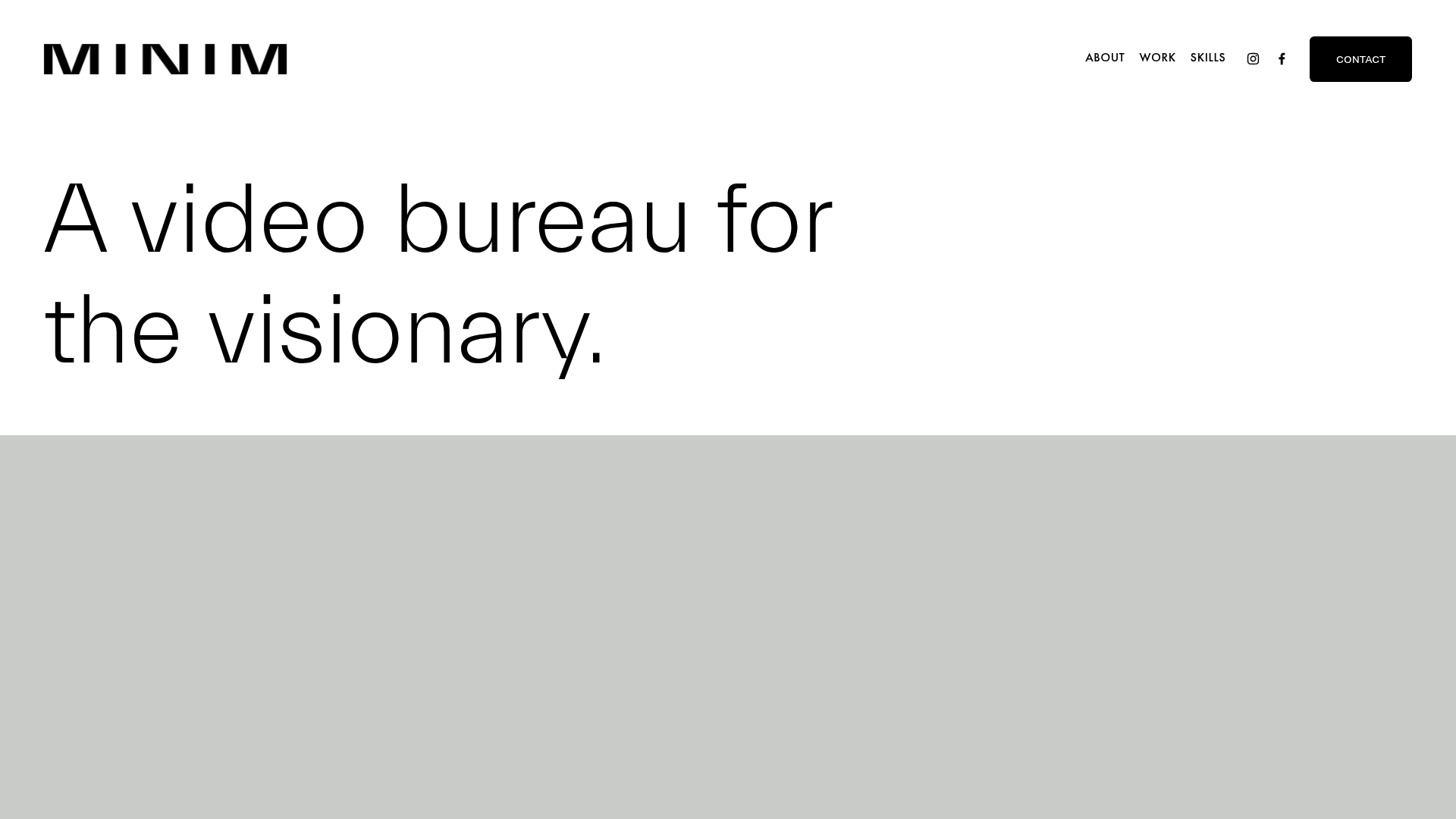
Insurance friction usually shows up at the worst possible moment: the morning of a pickup, or the day before a permit deadline. MINIM built a production risk management workflow specifically to catch these gaps during pre-production instead of on set. That means one point of contact liaising with your broker, a consolidated equipment schedule built once and reused across every rental house submission, and insurance scoping that starts alongside location scouting rather than after it. For agencies juggling multiple concurrent shoots, that coordination is often the difference between a permit clearing on schedule and a crew standing outside a location waiting on paperwork.
Insurance Coordination Shouldn't Slow Down the Shoot
We've watched enough permit deadlines and rental pickups get jammed by a missing endorsement to know the paperwork is never really the hard part. What's hard is coordinating four different requiring parties, each with a different form, on a schedule nobody controls. This coordination can be treated as part of the production itself, not an afterthought bolted onto pre-production.
— Steven Reina
Let MINIM Handle the Insurance Coordination While You Focus on Creative
The alternative to hiring a separate production manager just to chase down COIs and endorsements is to fold insurance coordination directly into full-service production, providing the agency with a single point of contact instead of multiple separate email threads with brokers, rental houses, and permit offices.
That single point of contact matters most on tight timelines. Instead of your team tracking down a Waiver of Subrogation from a rental house on a Friday afternoon, The production workflow can have the equipment schedule, the named insured language, and the broker relationship in place before the shoot date is locked. Consolidating COI delivery across every vendor and location on a project tends to clear permits earlier and avoid last-minute scrambles that stall call times. If your next campaign involves multiple locations, rented gear, or a union crew, take a look at MINIM's services and get a quote for how we'd run point on your production, insurance included.
Where to Verify Requirements Directly
Requirements shift by jurisdiction and by rental house, so confirm details against primary sources rather than secondhand summaries.
- Municipal and state film office permit pages, like the NYC Mayor's Office of Media and Entertainment, for permit-specific COI language
- SAG-AFTRA signatory pages for union insurance obligations tied to cast and crew agreements
- Specialty underwriters such as Beazley for drone, cyber, and hazardous-activity endorsements
- Individual rental house intake forms for equipment coverage and Loss Payee conditions
When two sources conflict, the permit office or the specific contract in front of you outranks any general industry guide, including this one.
Sources
- Insurance — Mayor’s Office of Media and Entertainment (NYC)
- Film production insurance: The complete 2026 guide — Akker, LLC
- Film production insurance requirements — Kelly Insurance Group