
The story arc that works for commercials is attention-first: hook in the opening seconds, name the conflict fast, and plant the brand early rather than saving it for a reveal. Save the slow-burn, three-act structure for longer hero spots where you have 60 seconds or more to earn patience. What follows are time-coded templates and a production checklist you can hand to a writer this afternoon.
TL;DR:
- Conflict is the most consistent predictor of ad success, surpassing humor, celebrities, or high production quality in predicting viewer engagement.
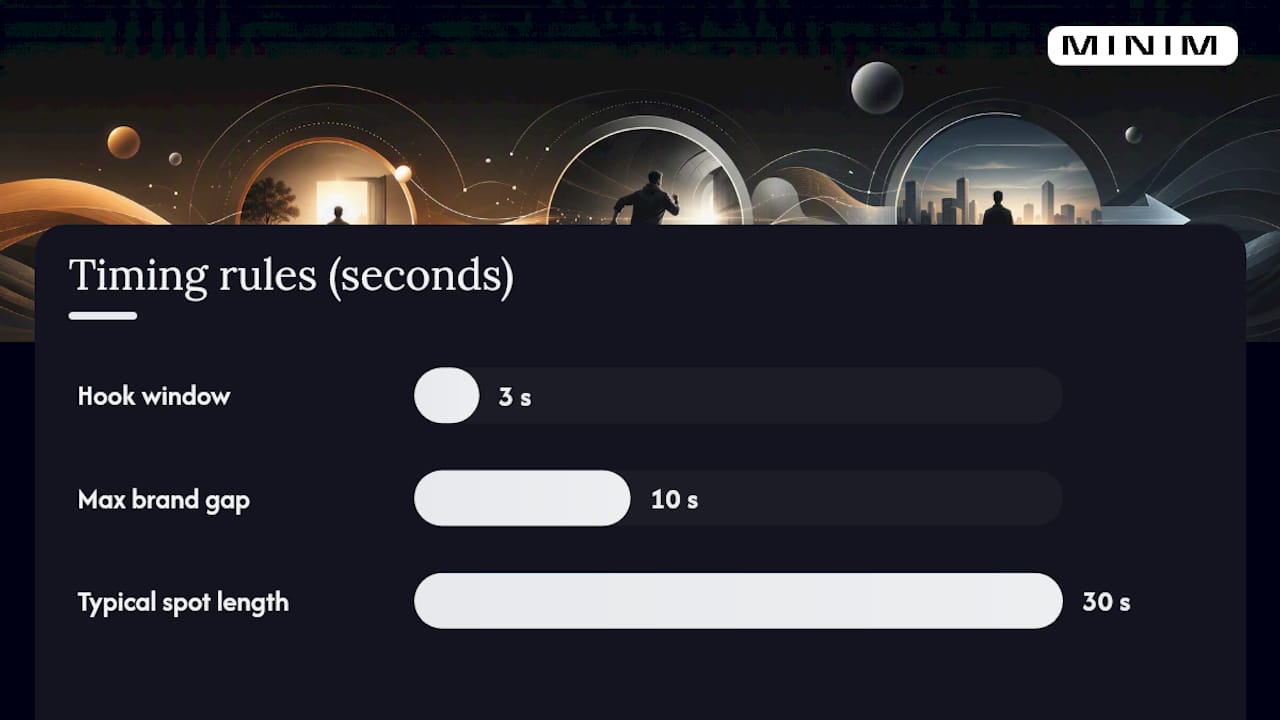
- For 15-second ads, introduce the tension within the first three seconds, show it visually, and repeat the brand early and at the end for maximum recall.
- The 30-second format requires a clear hook, conflict escalation, and resolution with at least two angles on the turning point to allow flexible editing.
- In 60-second ads, develop a character and story arc with a clear insight, ensuring the tension and brand cues are visible at key moments.
- Testing should focus on narrative completion, view-through rates, brand recall, and the effectiveness of derivative cuts across formats to optimize campaign success.
Table of Contents
- Why Conflict, Turning Points, and Insight Drive Commercial Performance
- Arc Templates for 15, 30, and 60 Second Spots
- Hooks, Misfits, and the Rules for Brand Integration
- The Production and Testing Checklist That Makes Arcs Work
- What Most Creative Reviews Get Backwards
- Get Your Story Arc Onto a Screen Without Adding Headcount
- Sources
Why Conflict, Turning Points, and Insight Drive Commercial Performance
Advertising creatives have argued about story structure for decades, but the data on what actually moves the needle is less debatable than the arguments suggest. A study of more than 400 Super Bowl ads running from 2015 to 2021 found that including conflict significantly predicts higher ad success across Ad Meter ratings, YouTube views, and Twitter engagement. Conflict, in this context, is not a full plot. It is a visible problem: a burnt dinner, a missed flight, a dog that won't stop barking at the vacuum. The moment a viewer senses something is wrong, they lean in to see how it resolves.
A large sample of ads found conflict was a highly consistent predictor of ad success, ahead of humor, celebrity casting, or high production value.
Turning points and "insight," meaning the moment a character or the brand reveals a truth the viewer didn't expect, matter too, but their effect is harder to detect in ads under 15 seconds. There simply isn't enough runway for a real reversal. That caution matters for anyone scripting short-form: don't force a twist into six seconds of screen time just because the research validates twists in general.
Translate the findings into rules you can actually apply during a table read:
- Make the tension visible in the first three seconds, not implied through tone.
- State the conflict in plain visual terms before you introduce any brand messaging.
- Repeat the brand cue at least twice, once early and once at resolution, rather than saving it for a single logo card.
- Treat insight and twist beats as bonus tools for 30 and 60 second formats, not requirements for micro-spots.
Conflict is the load-bearing wall. Everything else in a commercial's structure hangs off it.
Arc Templates for 15, 30, and 60 Second Spots
Different durations demand different shapes. Trying to cram a three-act structure into 15 seconds produces a rushed, confusing spot. Trying to stretch a hook-and-payoff into 60 seconds produces a bored one. Build the arc to fit the runway you actually have.
- The 15-second micro-arc. Open on the hook (0 to 3 seconds), name the tension immediately (3 to 7 seconds), deliver a quick payoff tied to the brand (7 to 13 seconds), and close on a clean brand card (13 to 15 seconds). Film with a single, unmistakable tension shot. Common pitfall: writers try to explain the problem instead of showing it, burning seconds you don't have.
- The 30-second standard arc. Hook (0 to 4 seconds), setup (4 to 10 seconds), conflict escalation (10 to 18 seconds), turning point (18 to 24 seconds), resolution with brand integration (24 to 30 seconds). This is the workhorse format for most linear TV and pre-roll placements. Shoot at least two coverage angles on the turning point so editors have flexibility to cut faster if the client's ad-testing partner flags a slow midsection.
- The 60-second hero arc. Here you get room for an actual character, a genuine insight, and a theme you can repeat across a campaign. Structure it as hook (0 to 5 seconds), character and world building (5 to 20 seconds), conflict (20 to 35 seconds), insight or turning point (35 to 48 seconds), resolution and brand payoff (48 to 60 seconds). This is the format worth building a full storyboard around, since the extra length means more can go wrong on set without one.
Pro Tip: Shoot the tension beat from two different angles no matter the runtime. You will not know whether the 30-second cut or the 15-second cutdown needs the wider or tighter shot until you're in the edit bay, and reshooting a tension beat after wrap is the most expensive mistake in commercial production.
Hooks, Misfits, and the Rules for Brand Integration
A hook only works if it earns attention within the first beat, and the strongest hooks tend to share a trait: they create a small, specific question the viewer wants answered. "Why is she running?" beats "Meet Sarah." Test hooks by showing the first three seconds alone, with sound off, to someone unfamiliar with the brief. If they can't guess there's a problem coming, the hook isn't doing its job.
Some of the most memorable ads deliberately break narrative logic. Ipsos calls this the "Misfits" pattern, and its research found story-driven ads are roughly twice as effective at changing behavior as ads that simply list product features. Illogical or surprising choices, a talking appliance, a scale-defying visual gag, work because they force the viewer to actively puzzle out what's happening, which deepens memory encoding.
Brand integration rules that keep the story intact:
- Place a visual or verbal brand cue at the hook, the turning point, and the resolution, not just the final frame.
- Avoid a hard cut to a logo card unless the brand has already appeared in the story world.
- For serial campaigns, build a recurring character or visual motif viewers will recognize across spots, which compounds recall over time.
- Test narrative completion (can viewers summarize the story unprompted?) alongside standard recall metrics before scaling media spend.
Pro Tip: If your brand cue disappears for more than 10 seconds in a 30-second spot, most audiences will forget who the ad was for by the time the resolution lands.
The Production and Testing Checklist That Makes Arcs Work
A good arc on paper still needs disciplined production to survive contact with a shoot day, a client note, and a media buyer's testing calendar.
Pre-production. Locking the idea, audience, and tone before writing lines reduces rework and gives editors a clear intent to cut toward. Write a one-line character brief and a one-sentence tension statement before scripting dialogue.
Production.
- Prioritize coverage of the tension beat with at least two camera setups.
- Shoot dedicated brand cue plates separately so editors can adjust placement without reshooting.
- Build editing rules in advance for micro-arc cutdowns: which shot is the non-negotiable anchor frame?
Testing and measurement.
- Run narrative completion checks before launch.
- Track view-through rate and brand-lift survey results by cutdown length.
- Watch CTR and CPA where the format supports direct response.
- Use a tiered testing pyramid: narrative anchor first, then derivative cuts, then creator content, since brands that restructured this way reported a 34% drop in blended CPA alongside a sharp lift in thumb-stop rate on 15-second units.
Steven Reina has overseen commercial production workflows where this exact sequence, lock the idea, shoot the tension twice, test the anchor before the cutdowns, separated campaigns that scaled cleanly from ones that needed a costly reshoot three weeks into media spend.
What Most Creative Reviews Get Backwards
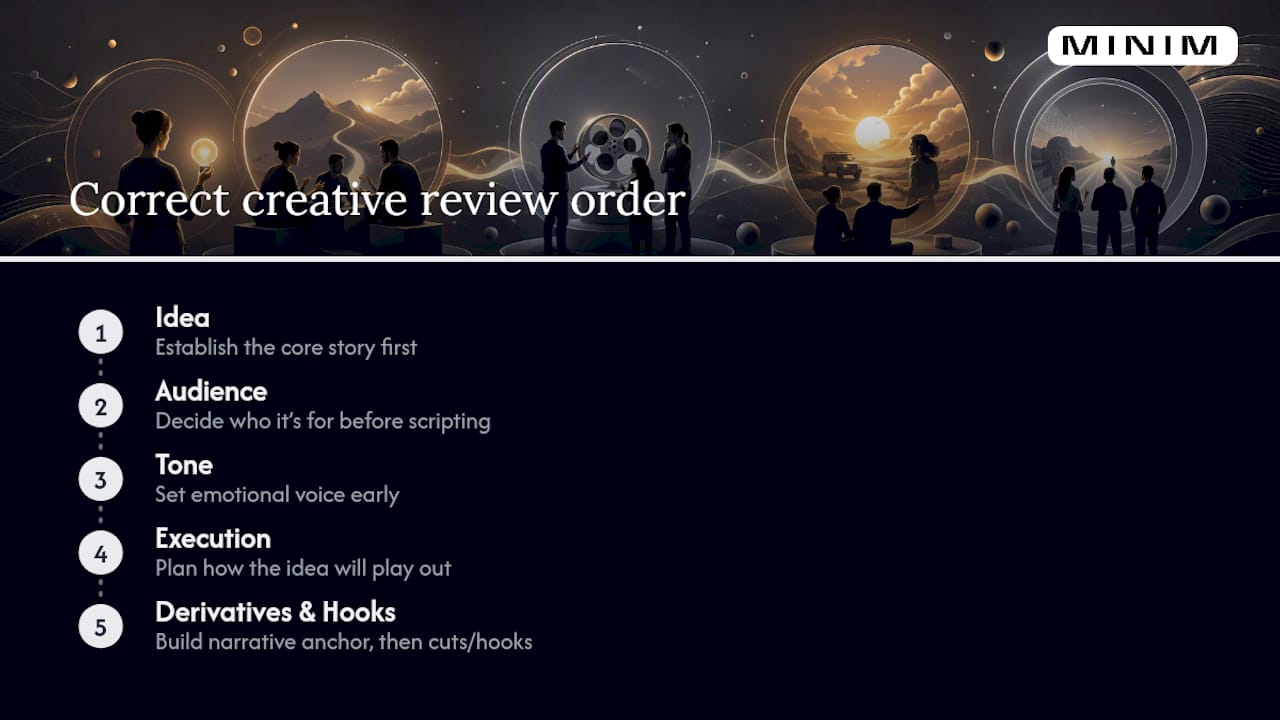
Most client feedback sessions attack the wrong layer. Someone flags a line of dialogue when the real problem is that the audience decision came after the script, not before it. Fix the order, idea, audience, tone, execution, and half the notes disappear on their own.
Defend the narrative anchor when a client pushes for a hook-first edit too early. Hooks matter, but a hook with no anchored story behind it burns out fast across a media flight. When a client says "get to the product faster," the better response is usually "let's get to the conflict faster," since that's what's actually holding attention. MINIM works inside these conversations daily as a production partner, building the anchor, then the derivative cuts, so creative teams don't have to choose between narrative integrity and a client's testing calendar.
— Steven Reina
Get Your Story Arc Onto a Screen Without Adding Headcount
Writing the arc is the easy part. Producing the narrative anchor, then generating the derivative cutdowns and platform versions that keep the campaign alive across formats, is where most in-house teams hit a wall. MINIM works as an extension of your creative team, taking a locked script through casting, shoot, and edit without you adding a single permanent hire.

MINIM's production work maps directly onto the templates above:
- Full narrative anchor production, from storyboard through final cut
- Derivative cutdowns sized for 15 and 30-second placements
- Creator and UGC-style variants for the third tier of the testing pyramid, informed by approaches like the 700-creator wave in influencer campaign engineering
- Platform-specific versioning for vertical, square, and broadcast formats
Browse MINIM's production work to see how narrative-first campaigns come together, then check MINIM's services to scope your next commercial and get a production timeline back this week.
Sources
- Sell me a story: On the role of conflict, and other story elements, in ads’ success
- Storytelling: the creative effectiveness superpower — World Federation of Advertisers (Ipsos data)