
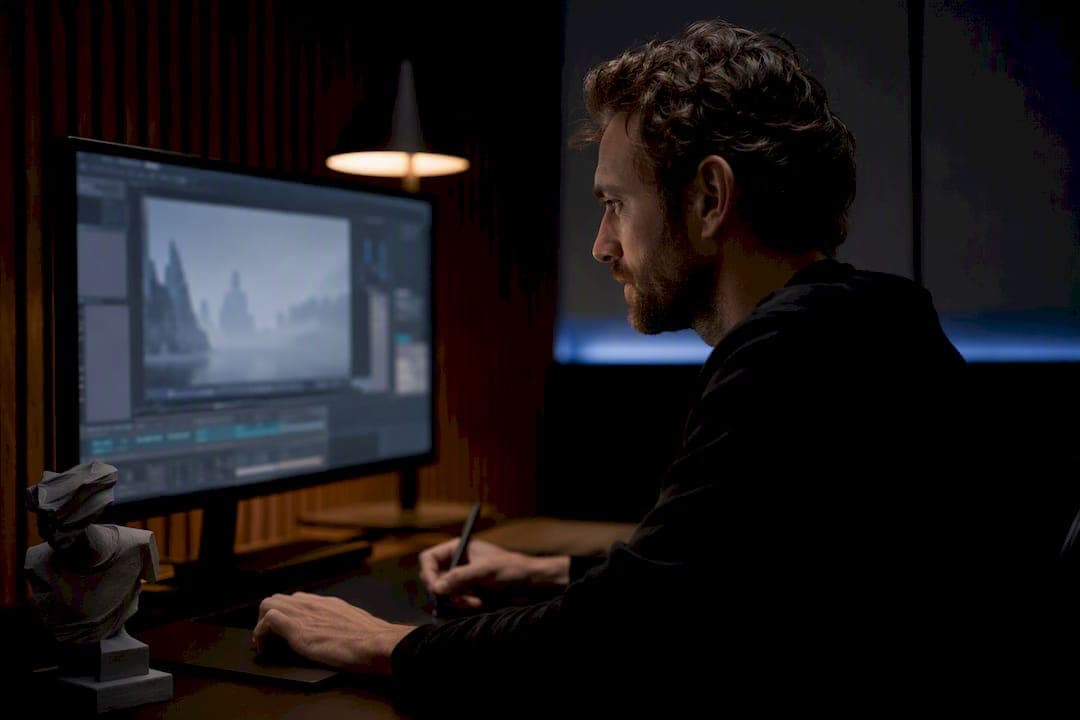
VFX earns its cost when it lets you show what a camera physically cannot capture, or when it lifts a spot from forgettable to shareable. The single rule that separates smooth productions from expensive scrambles: bring VFX into the concept and previs stage, not the post-production rescue stage. Specify VFX intent in the storyboard, book a VFX supervisor for the shoot, and build a 10% to 15% contingency into the budget before the first frame rolls.
TL;DR:
- Integrate VFX planning into the concept and previs stages to ensure creative intentions are factored into storyboards and shoot plans from the start.
- Use VFX mainly for enhancements that camera cannot capture or actions that are impractical to perform practically, such as environment extensions or photoreal creatures.
- Match VFX techniques to shot complexity early on, leveraging compositing for simple tasks and CG creation for high-end productions to control costs and schedules.
- Build a 10% to 15% contingency into budgets and lock shot lists, previs, and review stages before filming to prevent costly rework and scope creep.
- Apply AI tools to accelerate repetitive VFX tasks like rotoscoping and tracking but maintain skilled oversight for lighting, performance, and final quality.
Table of Contents
- What Can VFX for Commercials Actually Achieve?
- Which VFX Techniques Fit Which Commercial Shots?
- How Do You Integrate VFX Into Production Without Blowing the Schedule?
- What Does VFX for a Commercial Actually Cost?
- How Are AI and Virtual Production Changing Commercial VFX?
- How MINIM Approaches VFX for Agency-Led Commercials
- What Legal and Rights Issues Come With Using VFX in Ads?
- Where Should Agencies Focus Over the Next Two Years?
- Ready to Bring Cinematic VFX Into Your Next Campaign?
- Sources
- FAQ
What Can VFX for Commercials Actually Achieve?
VFX in advertising exists to solve one of two problems: make something look better than it can look on camera, or make something happen that the camera cannot physically capture. A marketer's guide to VFX in advertising frames it plainly. Advertisers use visual effects to create attention grabbing imagery, polish products, and build immersive stories that a straight shoot cannot deliver on its own.
That framing matters because it reorients the brief. VFX isn't a fix applied after a disappointing edit. It's a creative decision made at the concept stage, the same way you'd decide on a location or a casting choice.
Here's where it tends to pay off on a commercial set:
- Product polish. Removing rigs, fixing reflections, cleaning up condensation or steam that didn't cooperate on shoot day, or replacing a hero product entirely with a CG double for consistency across a campaign.
- Environment extensions. Turning a parking lot into a city skyline, adding weather, or stretching a small set into something that reads as expansive on screen.
- Characters and mascots. Photoreal creatures, animated brand characters, or digital doubles that would be impossible or impractical to cast and shoot live.
- Transitions and reveals. Morphs, particle effects, and hero product reveals that carry the emotional peak of a 15 or 30 second spot.
- Scale and spectacle. Crowd multiplication, vehicle work, or destruction sequences that would blow a production budget if shot practically.
The decision rule is simple to state and harder to apply under deadline pressure: use VFX when it enables an action the camera cannot capture, or when it measurably improves brand perception and shareability. If a shot idea only exists because "it'll look cool," that's a weaker case than a shot idea that solves a specific creative or logistical problem.
That second half, the KPI tie-in, gets skipped too often in creative reviews. VFX-heavy spots tend to outperform on social shareability and viewability simply because they're visually distinct in a crowded feed. But that only holds if the effect reads as intentional and well-executed. A rushed composite with a visible edge line does more damage to brand perception than a simpler, cleaner shot would have. This is the tradeoff every creative director needs to hold in tension: ambition against execution risk. When Framestore built a photoreal polar bear for a Pepsi Super Bowl spot, the ambition was massive, but it was backed by a full production pipeline and dedicated supervision to make sure the execution matched. Most commercials don't need that scale. All of them need that same discipline about matching ambition to resources.
Which VFX Techniques Fit Which Commercial Shots?
Not every idea needs the same toolkit, and matching technique to shot early saves money later. Here's how the core techniques break down, roughly in order of complexity.
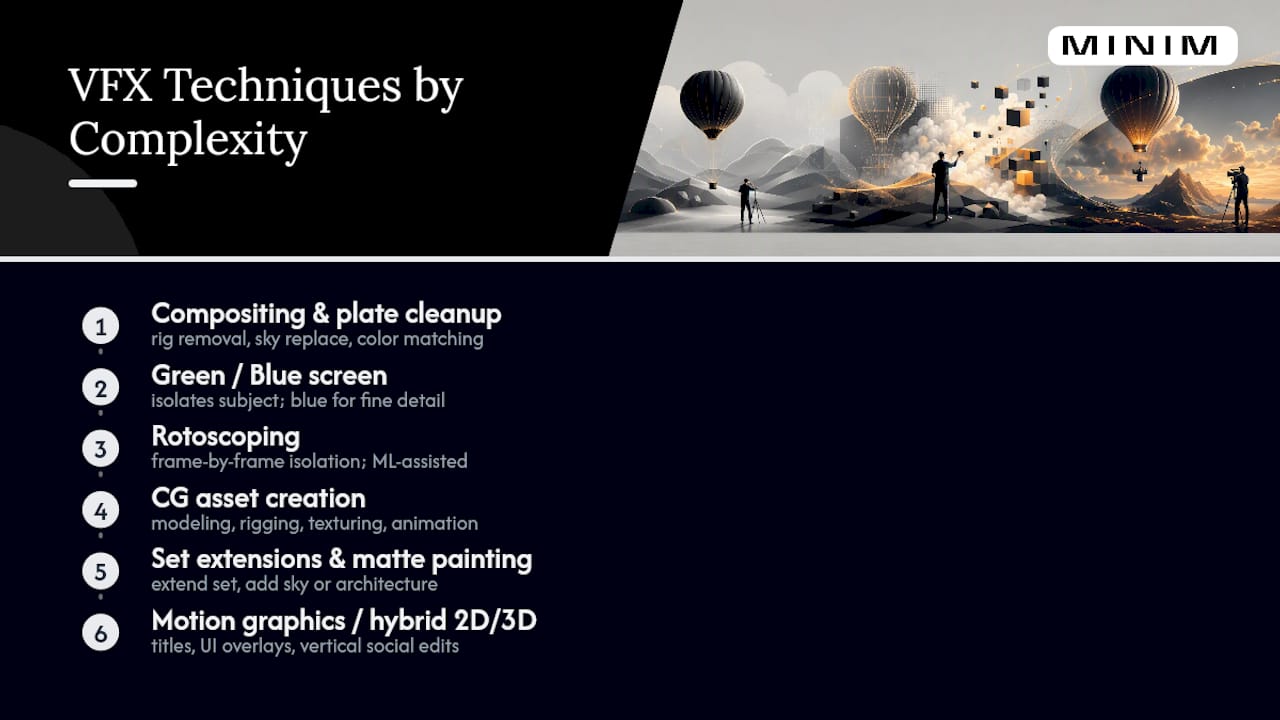
Compositing and plate cleanup sit at the entry level. This covers rig removal, sky replacement, color matching between shots, and stitching together elements shot at different times or locations into one believable frame. It's the most common VFX work on a commercial and, done well, invisible to the viewer.
Green screen and blue screen work isolates a subject for placement into a different background, whether that's a product on a seamless set dropped into a stylized environment or a talent performance composited against a CG world. Blue screen tends to handle fine detail (hair, smoke) better; green screen is more common for daylight exteriors because it avoids spill onto skin tones.
Rotoscoping is the manual or AI-assisted process of tracing an object frame by frame to isolate it from its background, usually when a clean key isn't possible. It's labor-intensive and one of the first tasks now being accelerated by machine-learning tools, a shift covered in recent trade reporting on AI's impact on commercial VFX pipelines.
CG asset creation covers modeling, rigging, texturing, and animation for anything built entirely in a computer, from a product double to a full creature. This is where budgets and timelines swing hardest. A static CG product replacement is manageable inside a normal commercial schedule. A hero character with facial animation and fur simulation, the kind of asset built for that Pepsi polar bear spot, requires a pipeline closer to feature film work: dedicated riggers, animators, and render time measured in days per frame rather than minutes.
Set extensions and matte painting stretch a practical set digitally, adding skyline, sky, or architectural detail beyond what was built or shot. Complexity depends almost entirely on how much of the frame is extended and whether the camera moves through the extended space.
Motion graphics and hybrid 2D/3D work cover title cards, kinetic typography, UI overlays, and infographic-style elements layered over live action, increasingly common for vertical social cuts of a hero broadcast spot.
Pro Tip: Match the technique to the platform, not just the story. A subtle set extension that reads fine in a 30-second broadcast spot may need to be simplified or re-composed for a 9x16 crop, because the extended detail often lands outside the frame entirely.
High-end commercials frequently borrow the exact software feature productions use. Framestore's Pepsi work leaned on Maya for animation and Arnold for rendering, the same tools behind major theatrical VFX, just adapted for a compressed schedule and a smaller crew.
How Do You Integrate VFX Into Production Without Blowing the Schedule?
The cheapest VFX fix is the one you plan for before the camera rolls. Every stage of the pipeline has a specific job in preventing rework later.
- Build VFX into previs and techvis. Storyboards and animatics should call out exactly which frames involve effects work, what plates are needed, and how the CG or composite element interacts with camera movement. A previs pass that skips this leaves the VFX team guessing on set.
- Lock the on-set capture checklist. Clean plates with locked exposure, HDRI probes for accurate relighting, dedicated motion reference passes for anything a CG element needs to match, and full camera reports with lens metadata for every VFX shot. Skipping HDRI capture, in particular, is one of the most common reasons a CG element looks pasted in rather than lit by the same light as everything around it, a gap documented in production case coverage of Framestore's work on Sky Sports campaigns.
- Set a clear review cadence. Define who signs off at each gate: rough comp, mid-res render, final grade. Version control matters here as much as creative judgment; a comment on the wrong render version wastes a full turnaround cycle.
- Plan for the social putdown before you render the hero spot. Short-form and vertical edits change crop, pacing, and sometimes shot selection entirely. Building that into the VFX schedule up front avoids a second, unbudgeted round of compositing.
Pro Tip: Freeze the edit before committing to full hero-grade renders. Deliver a graded proxy for client approval and render final frames only after sign-off. This single step, drawn from MINIM's own cost-control guidance, is one of the most common ways agencies avoid paying for re-renders on shots that were about to change anyway.
Procedural workflows built in tools like Houdini give VFX teams the flexibility to adjust environments and CG elements quickly when a client wants three tweaks to a background in one afternoon, a real constraint on any ad campaign running on a compressed post schedule. Building your storyboards with explicit VFX callouts from day one is what makes that flexibility affordable instead of chaotic.

What Does VFX for a Commercial Actually Cost?
Cost scales with four variables: shot count, CG complexity, how photoreal the final image needs to be, and how fast you need it. A single clean-plate composite might take a compositor a day. A photoreal CG creature with fur and facial animation can take a specialized team weeks, which is exactly why Framestore's Pepsi polar bear required roughly 30 artists working across offices on a compressed Super Bowl timeline.
Rather than quote a single number, think in bands tied to complexity:
- Simple VFX (clean-up, color work, basic composites): shorter turnarounds, fewer specialized artists, lower overall risk of scope creep.
- Medium complexity (set extensions, product CG doubles, moderate motion graphics): longer lookdev and render time, more review cycles.
- High complexity (photoreal creatures, major CG environments, feature-level pipelines): dedicated supervision, larger crews, and schedules that need to be locked well ahead of air date.
The Visual Effects Society recommends agencies request a clear deliverables matrix and render budget assumptions up front, before locking a bid. That single request avoids the most common source of scope creep: discovering during the color and finishing stage that "final" meant something different to the studio than it meant to the client.
A few checklist items worth putting directly into your RFP:
- Ask whether the quote is fixed-fee or day-rate, and what triggers a change order.
- Set a revision limit per shot in the statement of work, with a defined cost for revisions beyond that limit.
- Build in a contingency, typically 10% to 15% of the VFX line item, especially on any spot with a fast turnaround.
- Request the render budget and deliverables matrix mentioned above before signing off on the bid.
How Are AI and Virtual Production Changing Commercial VFX?
AI tools now handle a meaningful share of the repetitive work that used to eat junior artist hours. Rotoscoping, object tracking, and early lookdev passes are being accelerated by machine-learning tools across the industry, a shift VFX Voice covers in detail as one of the defining changes in short-form and commercial pipelines. What AI doesn't replace is judgment: matching light direction convincingly, selling a creature's weight and performance, or knowing when a shot simply isn't working yet. Those calls still require an experienced compositor or supervisor.
Virtual production, shooting against an LED volume with a real-time engine driving the background, earns its cost on specific kinds of spots. If a campaign needs multiple environments in one shoot day, or the director needs to see a final-looking background live on set to make lighting and blocking decisions in real time, an LED volume can save real money versus multiple location shoots. For a straightforward single-location product spot, the same setup can add cost and complexity with little creative payoff. The decision hinges on how much the background actually needs to interact with the live-action lighting and camera movement.
Sustainability is becoming a real line item in production conversations, not just a talking point. Agencies can request lower-carbon render practices from their VFX partners: cloud render farms powered by renewable energy contracts, smarter caching to avoid redundant re-renders, and render-farm scheduling that avoids peak-demand energy periods. None of this changes the creative outcome, but it's a legitimate question to put in an RFP.
On the tooling side, without naming specific vendors, commercial VFX teams typically rely on a compositing application for layering and color work, a 3D application for modeling and animation, a render engine to generate final frames, and a cloud-based review platform so agency and client stakeholders can leave timestamped notes on a shared cut. Agencies exploring where AI fits into their broader workflow, not just VFX specifically, can find useful groundwork in AmmarAI's guidance on pragmatic AI adoption for creative agencies.
Pro Tip: Pilot any new AI-assisted tool on a low-stakes internal or B-roll project first. The failure mode with AI rotoscoping and tracking isn't usually catastrophic, it's subtle: a slightly wrong edge or a tracked object that drifts a few pixels over 100 frames. Catch that pattern on something that doesn't have a client watching.
How MINIM Approaches VFX for Agency-Led Commercials
MINIM integrates directly with agency creative teams from the concept stage through final delivery, which changes how VFX gets planned versus a model where the effects work is farmed out separately after the edit locks. When VFX intent lives in the treatment and the storyboard from day one, the shot list, the on-set capture requirements, and the budget conversation all happen in the same room instead of as a series of surprises.
A few tactics that consistently keep VFX-heavy commercials on budget:
- Locking the shot list before the shoot, so every VFX-dependent frame has a defined plate requirement, not a vague "we'll fix it in post."
- Running previs early enough to catch problems on paper, not on set, where a fix costs ten times more.
- Scoping revisions explicitly in the statement of work, so client feedback rounds have a defined ceiling before extra charges apply.
- Building contingency into the bid from the start, typically that same 10% to 15% range, rather than treating overages as a negotiation after the fact.
On virtual production specifically, MINIM's guidance leans practical rather than trend-driven: LED volumes and real-time preview earn their cost on multienvironment shoots or spots where the director needs to make lighting decisions live on set, and they're often overkill for a single-location product spot that a well-lit practical set can handle for less money. MINIM's cost breakdown for agencies buying commercial VFX goes deeper into where that $20,000 line item tends to balloon and how to avoid it.
The most successful VFX-driven commercials treat effects as a core creative choice made at the concept stage, not a post-production patch applied when a shoot didn't go as planned. That single mindset shift, more than any specific tool or technique, is what separates a spot that feels intentional from one that feels stitched together.
What Legal and Rights Issues Come With Using VFX in Ads?
VFX introduces its own layer of rights questions on top of the usual talent and location clearances. If a CG character resembles a real person, or an AI tool trained on copyrighted material generates a background element, agencies need clearance the same way they'd clear a music track or a stock photo. Contracts with VFX vendors should specify who owns the final CG assets, whether the agency can reuse them in future campaigns without additional fees, and whether any third-party plugins, stock assets, or AI-generated elements carry their own licensing terms that travel with the final file.
Digital doubles and voice replication raise a separate concern. Using a talent's likeness generated or altered through VFX, even subtly, typically requires explicit consent language in the talent contract that covers digital manipulation, not just the original filmed performance. This has become a more active negotiating point as AI-assisted tools make likeness manipulation easier to execute convincingly.
Brand and trademark elements embedded in a CG environment, a storefront sign, a competitor's product visible in a reflection, need the same clearance scrutiny as a practical set dressing choice. Because a VFX artist can add or alter these elements after the shoot, legal review of the final composite matters as much as legal review of the shot list. Building a sign-off step into your approval gates, where legal reviews the finished VFX pass rather than just the script, closes a gap that's easy to miss when the creative and legal teams work from different versions of the cut.
Where Should Agencies Focus Over the Next Two Years?
Early integration remains the single highest-leverage change a team can make. Every cost overrun and rushed fix traced through this guide comes back to the same root cause: VFX decisions made too late to be planned properly. That's not a new problem, but it's getting more expensive to ignore as audience expectations for polish rise while turnaround windows keep shrinking.
If you're setting priorities for the next 12 to 24 months, three moves matter more than the rest. Pilot one AI-assisted step, rotoscoping or tracking are the safest entry points, on a project with low stakes before trusting it on a client-facing spot. Require dedicated VFX supervision on any shoot involving CG characters, complex composites, or virtual production, not just a compositor reviewing footage after the fact. And build a 10% to 15% VFX contingency into every fast-turn bid as a standard line item, not an apology you make when the budget runs over.
None of this requires a bigger internal team or a longer production calendar. It requires treating VFX as a creative decision made in the room where the concept gets approved, not a technical problem handed off once the edit is locked.
— Steven Reina
Ready to Bring Cinematic VFX Into Your Next Campaign?
A direct production partner can offer agencies premium VFX execution without adding permanent headcount or managing a separate vendor relationship. Integration with the creative team from the treatment stage helps ensure the shot list, the previs, and the budget contingency get built in from day one instead of negotiated after a rough cut reveals a problem.
A typical starting brief looks like this: a storyboard with VFX shots flagged, a target air date, and a rough sense of whether the spot needs product polish, a full CG environment, or something closer to feature-level character work. From there, we scope the shot list, flag where virtual production would actually save money versus add complexity, and build the contingency into the bid before you present it internally. Review our production and VFX capabilities or browse recent commercial work to see the range of complexity we've handled, then reach out to schedule a discovery conversation about your next spot.
Sources
For technical standards and deliverables guidance, the Visual Effects Society is the industry's professional association. For a look at feature-level commercial VFX in practice, Autodesk's writeup on Framestore's Pepsi Super Bowl spot and TVBEurope's coverage of Framestore's Sky Sports campaign both go deep on pipeline and on-set capture practices.
- How Framestore created a Pepsi‑loving polar bear for the Super Bowl — Autodesk Media & Entertainment blog
- NEW TECH AND VFX ADVANCES SPARK COMMERCIALS AND SHORT-FORM — VFX Voice
- Visual Effects Society (VES)
FAQ
How Much Does VFX Cost for a Commercial?
Costs vary widely by complexity, from simple clean-up composites at the low end to feature-level CG character work requiring dozens of artists at the high end. Agencies should request a deliverables matrix and set a contingency of 10% to 15%, as detailed in MINIM's VFX cost breakdown.
Is AI Replacing VFX Artists in Commercials?
No. AI is accelerating repetitive tasks like rotoscoping and object tracking, but industry reporting confirms skilled artists remain essential for lighting, performance, and final creative judgment.
Is VFX a High-Paying Field to Work In?
Compensation varies by role and specialization, with supervisors and senior CG artists on feature-level campaigns, like the crew behind Framestore's Pepsi Super Bowl spot, commanding premium rates due to the technical skill and pipeline experience required.
What Are the Main Types of VFX Used in Commercials?
The core categories are compositing and cleanup, CG asset creation (modeling, animation, rendering), and set extensions or matte painting, each suited to different shot complexity and budget levels.
How Do I Brief a VFX Team Effectively for a Commercial?
Include VFX callouts directly in the storyboard, specify the on-set capture requirements like clean plates and HDRI probes, and request a deliverables matrix and render budget assumptions before locking the bid.