

Inclusive casting means putting underrepresented people (across race, disability, body type, age, gender identity, and sexuality) in central, authentic roles rather than background or token spots. The immediate action is simple: build representation goals into the creative brief before you post a single casting call, and bring in a diversity-aware casting partner from day one. Done right, it also tends to perform better with audiences.
TL;DR:
- Building representation goals into the initial creative brief and engaging diversity-aware casting partners from the start prevents costly rework.
- Authentic inclusive casting places underrepresented talents in central roles that drive the story, not just token or decorative parts.
- Planning on-set accommodations and budgeting for accessibility upfront ensures smoother production and avoids last-minute issues.
- Using specific language and outreach in casting calls attracts genuine talent with lived experience, avoiding superficial diversity efforts.
- Tracking applicant diversity, audience sentiment, and performer feedback helps measure whether inclusive casting is effective and authentic.
Table of Contents
- What Does Inclusive Casting Actually Mean?
- Why Inclusive Casting Ads Perform Better
- How Do You Build Inclusive Casting Into Your Workflow?
- Tokenism vs. Authentic Casting: What's the Difference?
- Where Do You Find Underrepresented Casting Talent?
- What Accessibility Details Matter on Shoot Day?
- How Production Partners Make Inclusive Casting Operational
- Campaigns and Resources Worth Studying
- Sample Casting Call Language for Underrepresented Talent
- How Do You Measure Inclusive Casting Success?
- Working With Cultural Advisors and Community Consultants
- A Production-Ready Inclusive Casting Checklist
- A Producer's Honest Take on the Tradeoffs
- MINIM Handles Inclusive Casting So Your Team Doesn't Add Headcount
- Sources
- FAQ
What Does Inclusive Casting Actually Mean?
Inclusive casting is the deliberate effort to feature underrepresented groups, including people with disabilities, diverse ethnicities, and non-binary identities, in roles that carry the story rather than decorate it. The Tesco "Now We're Cooking" campaign, developed after a Channel 4 diversity award, is a useful reference point: it was built as inclusive by design from the concept stage, not patched in during casting.
That distinction matters because "diverse casting calls" and true inclusion are not the same thing. A casting call that lists ten identity boxes but hands every meaningful line to the same demographic is still exclusionary. Genuine inclusive casting asks who holds the story, not just who appears in the frame.
Why Inclusive Casting Ads Perform Better
Representation that puts underrepresented people in real, central roles, not decorative ones, tends to drive stronger engagement than diversity added as an afterthought, according to Kantar's research on advertising and brand growth. The effect shows up specifically when the story itself isn't about diversity. A campaign that centers a wheelchair user cooking dinner for friends reads as authentic. One that centers a wheelchair user explaining what it's like to use a wheelchair reads as a lesson, and audiences notice the difference immediately.
Kantar's finding on diverse advertising: Ads that place underrepresented people in ordinary, central roles (not roles built around their identity) tend to outperform ads that treat diversity as the message itself.
There's a reputational layer too. Casting decisions that read as tokenized or careless about accessibility now circulate fast on social platforms, and the reputational cost of getting it visibly wrong usually outweighs the cost of doing the work upfront.
How Do You Build Inclusive Casting Into Your Workflow?
Inclusive casting fails most often not from bad intentions but from bad timing. Teams try to fix representation at the casting stage when the script, budget, and schedule were already locked without it in mind. The fix has to start earlier.
- Set representation goals in the brief, not the callback. Decide whether the goal is audience-matching (casting that reflects who buys the product) or identity-intent (a specific community's story), because the two require different sourcing and different consultants.
- Get lived-experience eyes on the script before casting opens. A disability consultant or cultural advisor reviewing the storyboard can catch a stereotype or an inaccessible location before it becomes an expensive reshoot.
- Write the casting call in plain, specific language. Avoid vague appeals like "diverse talent encouraged" and instead specify the role's real requirements, dropping physical descriptors that aren't essential to the story. NAVA's best practices for authentic casting recommend open casting calls distributed beyond the usual talent lists.
- Budget time and money for accessibility and fair pay upfront. That includes interpreter costs, accessible audition locations, and rates that reflect the actor's experience, not a discount for being harder to find. Reviewing SAG commercial rules before you finalize the budget avoids surprises later.
- Plan on-set accommodations before the call sheet goes out. Mobility access, rest breaks, and communication aids belong on the schedule, not improvised on shoot day.
Pro Tip: Add a single line item to your production budget labeled "accessibility and accommodation contingency." Teams that treat it as a real line item, not an afterthought pulled from the general contingency, rarely scramble on shoot day.
A video creative brief template that includes a representation section forces this conversation to happen at the start, when changes are cheap, instead of at casting, when they're expensive.
Tokenism vs. Authentic Casting: What's the Difference?
Tokenism shows up when a brief is quota-driven: one role filled to check a demographic box, with no attention paid to whether the character has depth or agency. Identity-conscious casting, by contrast, invites the actor to bring their actual lived experience into the role, rather than pretending identity doesn't exist ("color-blind" casting) or making identity the entire point of the character.
- Tokenism signal: the character's only defining trait is their identity, and removing them wouldn't change the story.
- Authenticity signal: the character has a job, a goal, a relationship, and their background shapes but doesn't define them.
- Compensation signal: if a performer's identity or expertise (a sign language interpreter, a disability consultant) adds value to the production, their pay and reuse terms should reflect that, not treat it as a bonus favor.
Writing character context with specificity, what this person wants, why they're in the scene, solves most tokenism problems before casting even opens.
Where Do You Find Underrepresented Casting Talent?
Standard casting databases rarely surface the talent you need for genuinely inclusive work, so sourcing has to be intentional.
- Disability-first casting agencies maintain vetted pools of performers experienced with on-set accommodations, which saves time compared to negotiating access needs from scratch.
- Multicultural casting networks and community theater groups often reach talent that never appears on mainstream platforms.
- Voice talent organizations, including NAVA, maintain standards around authentic voice casting and can point toward vetted voice actors for specific accents or lived experiences.
- Direct community outreach, posting on community boards, reaching out to advocacy organizations, and partnering with local cultural centers, expands your pool beyond whoever already has an agent.
When evaluating a new casting partner, ask for references tied specifically to accessibility experience and past inclusive work, not a general client list. Specialized talent agencies with deep community networks tend to produce more authentic results than a broad, general-purpose casting call.
What Accessibility Details Matter on Shoot Day?
Accessibility isn't a post-production checkbox. Structured multilingual TTS production and audio solutions like those from Arkian ensure accessible audio deliverables and multilingual captioning are built into the process. It starts with how the set itself is built.
- On-set logistics: scheduling that accounts for travel and rest needs, mobility access to the location, and communication aids like ASL interpreters when needed.
- Call sheet practices: listing accessibility contacts and accommodations directly on the call sheet so crew members aren't caught off guard.
- Deliverable formats: captions, audio description tracks, and high-contrast versions of key visuals so the finished ad reaches audiences with sensory disabilities.
Accessibility built in from concept to delivery, not bolted on afterward, tends to work as a creative advantage rather than a compliance burden, reaching audiences competitors overlook entirely.
Before any asset ships, run a short QA pass: captions accurate and synced, audio description present where required, alt text written for static assets, and file formats compatible with assistive technology.
How Production Partners Make Inclusive Casting Operational
Agencies rarely lack the intent to cast inclusively. They lack the bandwidth to manage an extra layer of vetting, consultation, and accessibility QA on top of an already tight production timeline. A production partner can integrate directly with agency creative teams to handle that operational layer, building representation checkpoints into the brief, coordinating with casting partners experienced in accessible production, and managing on-set accommodations, without requiring the agency to hire additional staff.
The procedural steps that make the biggest difference are consistent: representation goals locked into the brief, a lived-experience review before casting opens, and accessibility deliverables scoped into the budget from the start.
Pro Tip: Ask any production partner how they handle accessibility deliverables before you sign. If the answer is vague, that's a preview of how shoot day will go.
Campaigns and Resources Worth Studying
The Tesco "Now We're Cooking" campaign remains one of the clearest examples of inclusive-by-design production: accessibility and representation were built into the concept, not added during casting, and the campaign's reception reflected that groundwork.
For ongoing reference, keep three resource types on hand: casting best-practice guides like NAVA's, research on representation's business impact like Kantar's, and case studies from campaigns that modeled the process well.
Smaller budgets can still apply these lessons. Even without a dedicated diversity consultant, a single lived-experience review of the script before casting opens, and one honest conversation about accessibility needs before shoot day, captures most of the value at a fraction of the cost.
Sample Casting Call Language for Underrepresented Talent
Vague casting calls produce vague results. Specificity in the call itself does more to prevent tokenism than any policy statement.
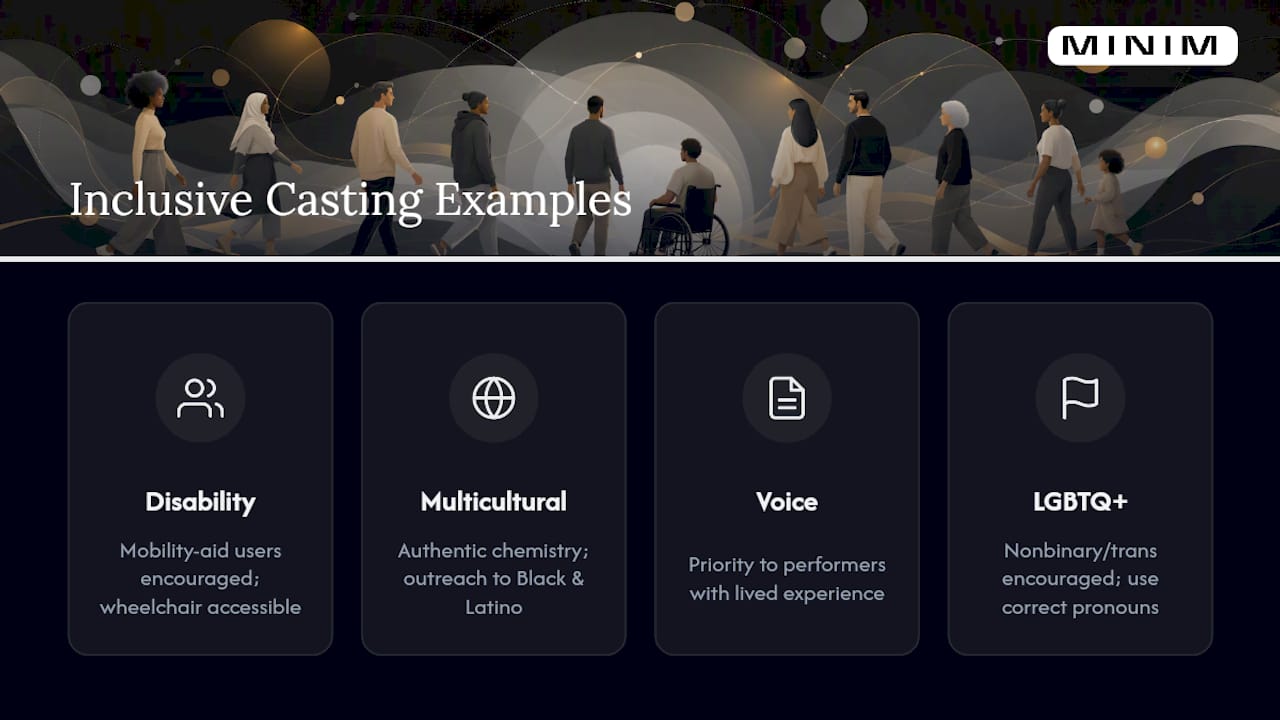
For a role open to performers with disabilities: "Seeking an actor for the role of Maya, a project manager juggling a product launch and a chaotic morning routine. Maya's mobility device is part of her daily life, not the focus of the scene. Performers who use mobility aids strongly encouraged to apply. Set is wheelchair accessible; accommodations available on request."
For multicultural or ethnicity-specific outreach: "Casting a father and daughter for a home renovation storyline. We're looking for authentic family chemistry over a specific look. Open casting call; performers of all backgrounds welcome, with particular outreach to Black and Latino talent pools given the story's setting."
For voice work requiring lived cultural context: "Voice talent needed for a first-generation immigrant character navigating a new city. We want the accent and cadence to come from real experience, not imitation. Priority given to performers who share this background."
For LGBTQ+ representation: "Casting a supporting role: a nonbinary barista whose storyline has nothing to do with their gender identity. Nonbinary and transgender performers encouraged to apply. Please use your correct name and pronouns on your submission."
Each example does the same three things: states the real function of the role, names who's encouraged to apply without demanding a performer disclose more than necessary, and confirms accessibility or comfort details upfront. That combination is what separates an inclusive casting notice from one that just uses inclusive language.
How Do You Measure Inclusive Casting Success?
Representation without measurement is a guess dressed up as a strategy. Track it at two points: the casting process itself and the ad's reception.
On the process side, track the diversity of your applicant pool against your final callback list. A wide, diverse applicant pool that funnels into a narrow, homogenous callback list signals a problem in how decisions get made, not in who applied. Track accommodation requests fulfilled versus requested, and note any accessibility gaps that surfaced on shoot day so the next production doesn't repeat them.
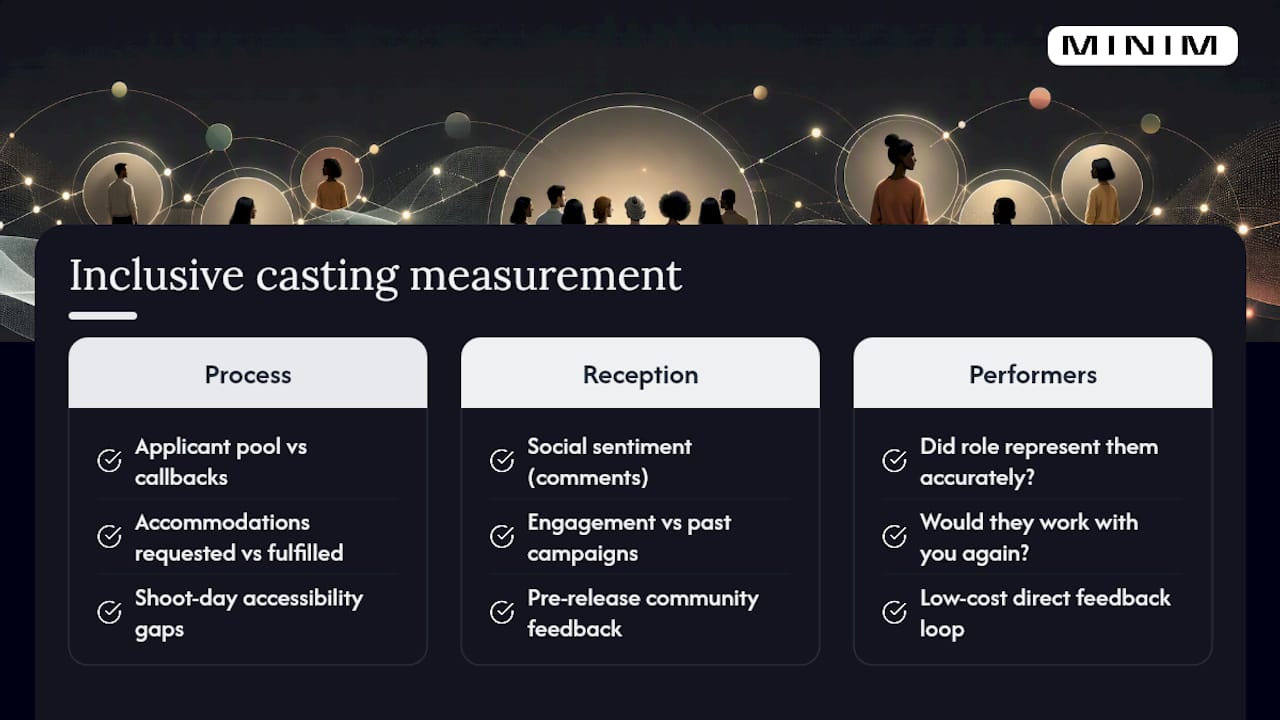
On the reception side, sentiment analysis on social comments can flag whether audiences read the casting as authentic or performative, since backlash usually clusters around specific language ("forced," "checking a box," "pandering") that's easy to spot in a comment thread. Compare engagement metrics for campaigns with central, authentic representation against past campaigns without it. Exit surveys or focus groups with audience members from the represented community, run before wide release, catch problems no internal review will.
The clearest signal, though, is usually simpler than any metric: ask the performers you cast whether they felt the role represented them accurately, and whether they'd work with your production again. That feedback loop costs nothing and tends to surface what dashboards miss.
Working With Cultural Advisors and Community Consultants
A cultural advisor brought in after the script is locked can only flag problems, not prevent them. Bring consultants into the process at the brief and script stage, when their input can still shape the story rather than just patch it.
Pay consultants for their time and expertise the same way you'd pay any specialist on the production, and be specific about what you're asking them to review: character believability, cultural accuracy, language, or all three. Vague requests like "does this feel okay?" produce vague feedback.
Give the consultant real authority to flag concerns, not just a courtesy pass. If a consultant raises a red flag about a scene or line, that should trigger a real conversation with the creative team, not a polite dismissal because the shoot date is close. Productions that treat consultant feedback as optional tend to be the ones that end up walking back a campaign publicly.
Document the consultant's input and the changes made in response. This isn't just paperwork. If a similar question comes up on a future production, you have a record of what worked and why, instead of relitigating the same debate from scratch.
Finally, keep the relationship ongoing rather than transactional. A consultant who's worked with your team before understands your brand's voice and can move faster and catch subtler issues than someone brought in cold for a single project.
A Production-Ready Inclusive Casting Checklist
Use this as a working document, not a formality to file after the shoot wraps.
Brief stage:
- Representation goals defined (audience-matching vs. identity-intent)
- Budget line for accessibility and accommodations included
- Casting call language reviewed for specificity, not vague diversity appeals
Script and pre-production:
- Lived-experience or cultural consultant reviewed the script and storyboard
- Character context written with real motivation, not identity as the sole trait
- Consultant feedback documented and addressed
Casting:
- Casting call distributed to at least one specialized or community channel beyond standard lists
- Compensation confirmed as equitable, including any consulting or expertise premium
- Callback list checked against applicant pool diversity
Shoot day:
- Accommodations confirmed and listed on the call sheet
- Rest and communication needs scheduled, not improvised
- On-set point person named for accessibility questions
Delivery:
- Captions, audio description, and high-contrast versions produced
- Alt text written for static assets
- Post-release sentiment and engagement tracked against past campaigns
A Producer's Honest Take on the Tradeoffs
The real constraints are always time, budget, and a client who's nervous about getting it wrong. None of that requires abandoning the work. It requires sequencing it earlier, when a script change costs an email instead of a reshoot. Two signs it worked: your callback list actually reflects your applicant pool, and the performers you cast would work with you again.
— Steven Reina
MINIM Handles Inclusive Casting So Your Team Doesn't Add Headcount
Most agencies know what inclusive casting requires. What they lack is a production partner who executes it without adding another specialist to payroll. A production partner can integrate directly with your creative team to build representation checkpoints into the brief, coordinate with casting partners experienced in accessible production, and manage the accommodations and post-production deliverables that make a campaign genuinely accessible, from captions to high-contrast assets.
That's the practical difference between reading a checklist and having it executed on a live production timeline. If your next campaign needs inclusive casting handled by people who've built it into commercial production before, explore MINIM's services and see how the integration works for your next brief.
Sources
- Tesco ‘Now We’re Cooking’ debuts after £1m Channel 4 diversity award win | The Drum
- Embracing Diversity: Advertising Campaigns with Inclusive Casting | LumaResearch blog
- How diversity in advertising can unlock brand growth | Kantar North America
- Best Practices for Authentic Casting - NAVA
FAQ
What Does "Inclusive Casting" Mean?
Inclusive casting means actively casting underrepresented people, including those with disabilities, diverse ethnicities, and non-binary identities, in central, authentic roles rather than as background or token characters.
Can You Give an Example of Inclusive Marketing?
Tesco's "Now We're Cooking" campaign is a strong example: it was built as inclusive by design, embedding representation and accessibility into the concept rather than adding them at casting.
How Do You Get Cast for Commercials?
Submit through open casting calls posted by production companies or casting agencies, and specialized or community-focused casting agencies often surface opportunities that never reach mainstream talent platforms.
How Do I Know if My Casting Call Is Tokenizing Talent?
If a role's only defining trait is the performer's identity, and the character adds nothing else to the story, that's a strong sign of tokenism rather than authentic representation.
Who Should Review a Script for Authentic Representation?
A lived-experience consultant or cultural advisor should review the script and storyboard before casting opens, since fixing a stereotype after filming starts is far more expensive than catching it early.