
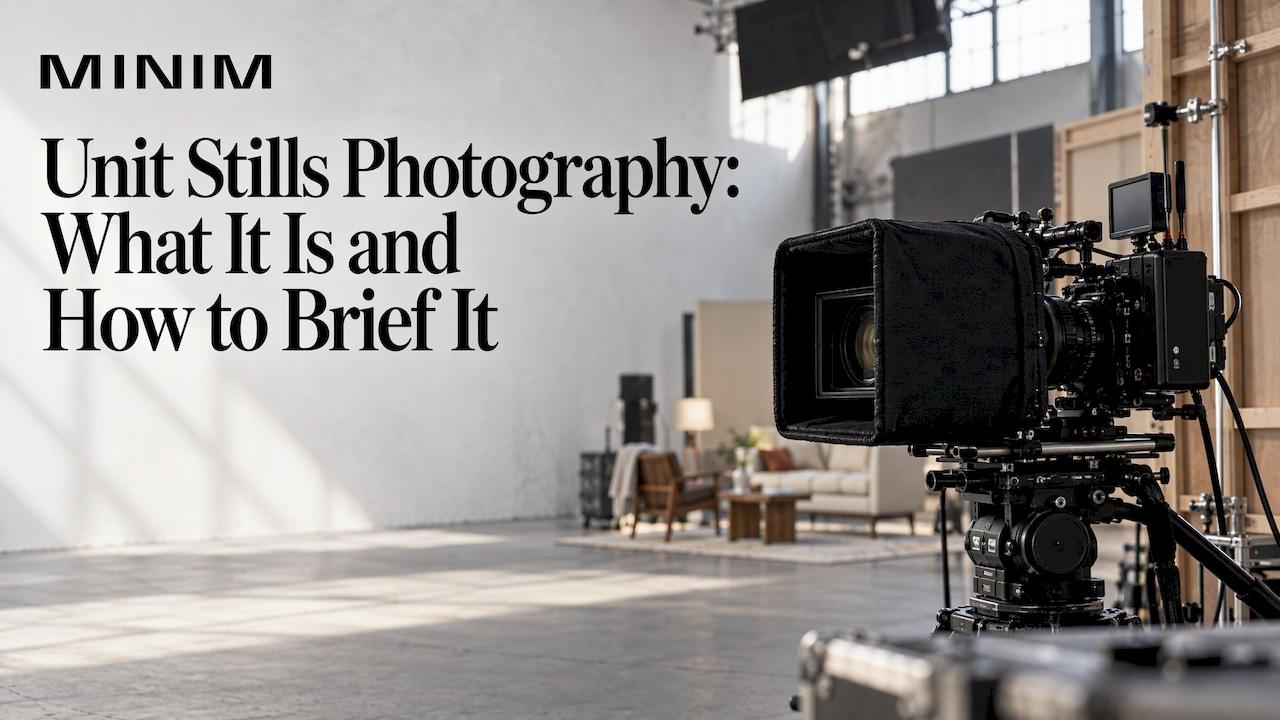
Unit stills photography is the work of a dedicated still photographer who shoots on set while the motion cameras roll, producing images for publicity, marketing and the production's own records. If you are an agency creative director or a marketing lead commissioning a cinematic shoot, it is the difference between leaving with a few frame grabs and leaving with a library of campaign-ready photographs that tell the story of the work.
This guide covers what a unit photographer does, how they work around a crew, what gets delivered, who approves what, and how to brief the role so your stills are usable the day after wrap.
TL;DR
- A unit still photographer shoots publicity and behind-the-scenes images during production, working beside the camera department without interrupting takes.
- Clients generally prefer real stills over frame grabs from motion cameras because stills are composed and lit as photographs.
- Plan the deliverable first: number of selects, specs, captions, metadata, talent approvals and who signs off.
- Settle usage rights in writing before the shoot. Photographers own their images unless the contract says otherwise.
- Treat stills and motion as one campaign plan, with one hero asset named up front.
Table of Contents
- What unit stills photography actually is
- What a unit photographer shoots
- How a unit photographer works around the shoot
- Applying unit stills to commercial and campaign work
- What gets delivered, and how fast
- Approvals, rights and confidentiality
- Our perspective
- How to brief a unit stills photographer
- Work with a production partner that plans stills and motion together
- FAQ
- Sources
What unit stills photography actually is
A unit still photographer creates still photos for the publicity and marketing of feature films and television productions. The same role also records set details such as wardrobe and set appearance, according to a general reference entry on the role. An academic chapter on the subject describes the scope as scene coverage and behind-the-scenes photos for marketing and publicity, plus prop stills and tests for the production.
The Setiquette guide, written for the guild community in the United States, puts the job in one line: interpret the project in single frames that accurately represent the story, the production value, the stars and the feeling of the show. It adds that whenever the public sees images of a show other than the video or film itself, those images should come from the unit still photographer.
That last point matters for brand work. Posters, press, social posts, case study pages and award entries all draw on the same pool of stills. If nobody owns that pool during the shoot, someone scrambles to build it afterward from frame grabs and phone snaps.
Unit stills, key art and continuity are different jobs
Three terms get mixed up on briefs:
- Unit stills: images captured on set during production for marketing and publicity. The vast majority of a unit photographer's on-set images go to marketing and publicity.
- Continuity photos: records of wardrobe, props and set dressing so scenes match. Unit photographers generally do not shoot these, because department heads shoot their own.
- Key art or gallery shoots: staged portrait sessions designed as the poster or hero image. They are planned separately, often in a studio, with lighting built for a single frame.
On a commercial campaign, the same logic holds. The hero portrait or poster frame is a planned, lit shoot. The unit stills are the living record of the production around it.
What a unit photographer shoots
According to a published unit stills workflow guide, three kinds of image come off a unit:
- Frames captured as the scene plays out. This is the bulk of coverage: the performance, the light, the composition as the take happens.
- Behind-the-scenes moments. The director working with cast, the crew at work, the rig.
- The set-up shot. A brief re-run of a small section of a take, negotiated between the photographer and the first AD, to capture a key frame that cannot be shot during a take.
The Setiquette guide lists what publicity teams look for: characteristic shots of each scene, shots of actors acting together, images that convey the look and atmosphere, strong character shots, the director directing, effects being rigged, and special make-up being created. For an agency, translate that list into your own world: the product moment, the talent connection, the craft behind the look, and the people who made it.
How a unit photographer works around the shoot
The photographer sits inside the camera department's orbit. The guide above describes them framing similar compositions to the motion camera while shooting quietly during takes, so actors, sound and the first AD's schedule are not disturbed. Silent or blimped camera bodies help.
The sound problem is real. Unit photographers go to great lengths to muffle the motor drive and shutter so they stay inaudible on recorded dialogue, typically using a sound blimp, a sound-absorbing case operated by remote cable.
Position is the other discipline. A photographer on a scripted series described the need to find a position outside the actor's eyeline without disturbing crew and talent. Distracting an actor can get the photographer called out. The same IndieWire piece quotes unit photographer Jake Giles Netter on reading scripts first to find the beats that make interesting moments, while staying loose enough to improvise.
Why this protects your schedule
A unit photographer is not a second shoot. When a key image cannot be taken during a take, the set-up shot can be slotted into a natural pause and costs the schedule little when anticipated. The words that matter are "when anticipated." Tell the first AD and the director which frames you need before the day starts, not at 6 p.m. when the light is gone.
The role also has a creative payoff inside the crew. Adam Bricker, the director of photography on every season of Hacks, told IndieWire that still images are essential reference points while a team develops its aesthetic. Stills from day one inform lighting and color decisions for day ten.
Applying unit stills to commercial and campaign work
Most of the published material on this role comes from film and television. Agency shoots run on smaller crews and tighter days, but the logic transfers cleanly: stills are captured in parallel with motion, from near the lens, by someone whose only job is the photograph.
Where that pays off for a campaign:
- Social and paid cuts that need stills. Carousels, static ads, email headers and out-of-home all need photographs, and frame grabs rarely hold up at print or large-format size.
- PR and case studies. A clear set of behind-the-scenes images gives you earned-media material without a second production day.
- Client and internal storytelling. Your CMO sees the work in progress, and your new-business team gets visuals for pitches.
- Awards entries. Judges respond to process as well as result.
Our own guidance on capturing a hierarchy of photo and video assets in one shoot goes deeper on how to plan both disciplines against the same call sheet.
What gets delivered, and how fast
Deliverables are where most briefs fail, because nobody wrote them down. Here is what the published guidance says to plan for.
Selects, not volume
Production and publicity teams typically expect same-day selects within two to four hours of wrap, with 10 to 20 hero shots that could go to press if needed, rather than 200 images. A Hollywood still photographer interviewed by Fstoppers described backing up constantly during downtime, building 1:1 previews for edits that must stay ahead of production, and sending a highly curated set of finals so photo editors can choose quickly.
Scale this to your project. A studio commercial day will not generate the volume of a long feature shoot, but the principle stands: a short, strong, fast selects gallery beats a large unsorted dump.
Captions, credit and metadata
Once the unit publicist or producer finalizes key selects, each one needs a caption identifying the production and the people from left to right, plus photographer credit and a copyright line. Files are converted from RAW to JPG, embedded with IPTC metadata, and transferred securely so only signed-off images reach distributors and sales agents.
A real-world spec example
Broadcasters publish their own requirements. Discovery's unit stills guidelines, updated in 2021, are a useful benchmark. They ask for a minimum of 60 images for one-off programs or specials and 30 images per episode for series, with talent approval before delivery. Images must be high-resolution JPEGs from an SLR of 8 megapixels or higher, at least 300 dpi and 4,000 pixels on the shortest side, with required metadata and post-production on all selects, including color correction, burning down highlights and squaring up lines.
Your project will have its own spec. Write it into the brief the same way: count, size, format, retouching level, caption format, turnaround.

Approvals, rights and confidentiality
Who picks the final images
On bigger productions the unit publicist forms a team with the photographer. Per Setiquette, the publicist suggests set-ups, writes photo idents, selects photos, secures approval from the stars, writes press kits and arranges media visits. On an agency shoot, one named person should hold that role, even if it is a producer doing it alongside other duties.
Talent approvals
Talent contracts often give performers a right to reject a share of their images. One 2026 workflow article reports that most contracts let actors kill 50% of solo images and 75% of group images, though the numbers vary by contract. It also notes the Digital Replica Rider in the 2025 SAG-AFTRA Commercials Contract, which requires written consent before digital replicas of talent are created. Read your talent agreements before promising a gallery size, and ask your legal counsel about likeness and AI-related terms.
Who owns and licenses the images
Per the Artist Management Association's national guidelines, U.S. copyright law gives photographers all rights to their images. Unless the advertiser's, agency's or publisher's contract says otherwise, the photographer may license a number of select images or all of them. Usage is defined by term, territory, media, exclusivity and deliverables. In practice, put a usage clause in the photographer's agreement that matches how you plan to run the campaign: paid media or organic, one year or perpetual, U.S. only or global.
Confidentiality
Embargoed campaigns need image security. A 2026 article on production photos under NDA explains that compliance means controlling who can access files at every stage. It warns that embedded metadata such as GPS coordinates, camera serial numbers and original filenames with scene numbers can leak production details, and recommends timestamped records of who saw which photos and when. Strip or standardize metadata on anything leaving the production, and share selects through a controlled gallery rather than email or consumer file links.
Union and location considerations
On union productions in the United States, the unit stills role sits within the guild structure, so check your production's agreements before hiring. The ICG Local 600 describes the position as a revered one, because the stills photographer often has one spot and sometimes one chance to capture a frame. Location shoots also bring their own paperwork, which is why we tell producers to call about filming permits before they scout.
Our perspective
Agencies rarely lose a campaign on the hero film. They lose momentum on everything around it: the stills that never got shot, the social cutdowns that look like screenshots, the press images that arrive three weeks late.
We plan stills and motion as one production. Before a shoot, we name the hero asset, decide which frames must exist as true photographs, and put them on the same schedule as the film coverage. That is the logic behind naming the hero asset first in stills and motion campaigns, and it is how a photographer working beside the camera team becomes part of the creative, not an interruption to it.
Our approach is to integrate with your creative team and manage every project as a high-end production, whatever the budget. For you that means no extra headcount to coordinate photo, film, art direction and post, and a set of selects that your team can actually use the next morning.
Steven Reina
How to brief a unit stills photographer
Use this order. It keeps the brief short and it covers the failures we see most.
- State the use cases. Poster, paid social, PR, website, case study, awards. Each one changes the frames you need.
- Name the must-have frames. List five to ten, tied to the script or storyboard, with the hero asset first.
- Share the script and look references. Photographers who read the script first find the beats worth capturing.
- Agree the set-up shot windows. Ask the director and first AD for two or three planned pauses rather than improvised interruptions.
- Set the deliverable. Number of selects, turnaround, file size, retouch level, caption and credit format, metadata fields.
- Define approvals. Who selects, who clears talent, who signs off on the final gallery, and in what order.
- Write the usage terms. Term, territory, media, exclusivity, and who owns the files.
- Plan security. Embargo dates, gallery access, metadata stripping, backup routine.
If your shoot is a lit, staged portfolio of the product or talent, look at how we approach cinematic poster-shot templates and studio lighting setups for commercials. Those frames are planned rather than caught, and they belong on their own line in the schedule.
Common mistakes to avoid
- Hiring the photographer after the shoot day is locked, which leaves no time to plan set-up shots.
- Briefing for volume instead of selects.
- Leaving talent approval until after delivery.
- Treating stills as free by-products of the film crew. A person focused on the photograph will produce better frames than a crew member splitting attention.
- Forgetting to write the usage terms down.
Work with a production partner that plans stills and motion together
If you need photography, film, art direction and post handled as one production, that is what we do for agencies and brand teams. MINIM covers creative strategy, campaign development, screenwriting, photography and film, an in-house photo studio and 2D/3D visual effects, integrated with your creative team on a project basis. You can see the full range on our services page and the finished campaigns on our work page.
To discuss how stills fit into your next campaign, start from our company page and tell us what the shoot has to deliver.
FAQ
What is the difference between a unit still photographer and a set photographer?
The terms are usually interchangeable. The Los Angeles Times describes unit photographers as also known as on-set or still photographers. They capture images for press packages, production websites, billboards and social media, covering both scenes from the film and behind-the-scenes views.
Do unit stills replace frame grabs from the motion camera?
For most campaign uses, yes. Clients tend to prefer unit photographers over frame grabs from motion cameras, since a dedicated photographer composes and exposes for a still frame. Frame grabs can still help for quick social posts or animatics.
How many photos should a unit photographer deliver?
That depends on the project and your use cases. As a benchmark, publicity teams typically want 10 to 20 hero shots within a few hours of wrap, and broadcaster guidelines such as Discovery's set minimum counts per program. Define your count and turnaround in the brief.
Who owns the photos from a shoot?
Under U.S. copyright law, the photographer owns the images unless the contract says otherwise, and usage is licensed by term, territory, media and exclusivity. Put the license or transfer terms in writing before the shoot.
Does a unit photographer slow down filming?
A good one does not. They work from near the camera, shoot quietly during takes, and ask for a brief set-up only when a key frame cannot be caught live. Planning those moments with the first AD in advance keeps the cost to the schedule small.
Sources
- Unit still photographer (reference entry)
- What Is Unit Photography? (Taylor & Francis)
- Setiquette guide
- Unit stills photography guide
- Delivering approved stills
- Where Do TV Show Production Photos Come From? (IndieWire)
- The (Un)Glamorous Life of the Hollywood Still Photographer (Fstoppers)
- What They Do in the Shadows (ICG Local 600)
- Discovery Unit Stills Guidelines
- Unit Still Photography Workflow
- How to Run Talent Photo Approvals
- How to Organize Production Photos Under NDA
- AMA National Guidelines
- How to become a unit photographer (Los Angeles Times)