
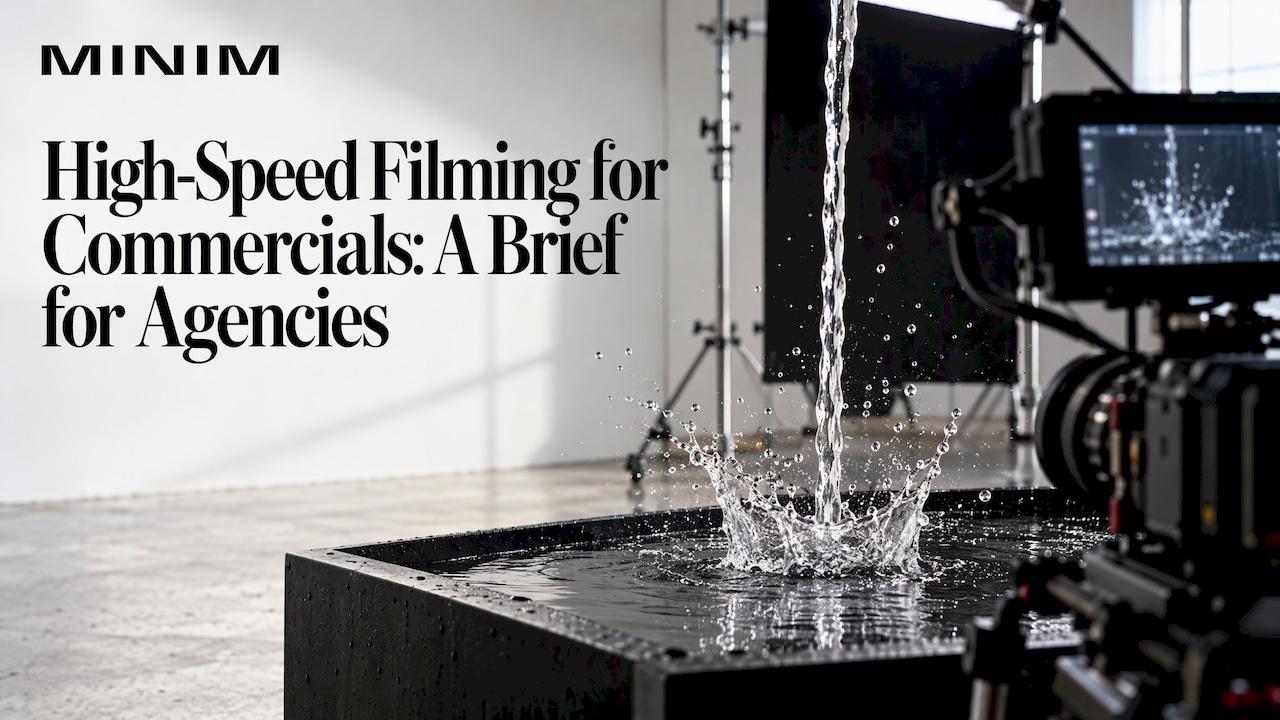
High-speed filming means capturing far more frames per second than the footage is played back at, so motion that is too fast to see becomes fluid slow motion on screen. In a commercial it is a storytelling tool: it isolates a splash, a pour, an impact or a gesture and makes the product the event. The decisions that decide whether it works are made before the camera rolls: the frame rate your board needs, the light that rate demands, and the data it produces. This guide covers those decisions for creative and marketing directors who commission the work.
TL;DR
- Slowdown equals capture frame rate divided by playback frame rate. 96 fps played at 24 fps gives quarter-speed motion.
- Work backward from the board: the screen time you want and the real length of the action set the frame rate, not the camera's maximum.
- Light is the hidden budget line. High frame rates need very high output without flicker or heat, and that shapes the set, the crew and the product.
- Data volume, offload time and a clear reason for each slow-motion shot decide whether shoot day runs smoothly.
- A single production partner that integrates with your creative team keeps concept, shoot, effects and delivery aligned.
Table of Contents
- What high-speed filming actually does
- Choosing a frame rate by subject
- What works in slow-motion commercials
- Camera choices, in plain terms
- Lighting is where the budget goes
- Plan the shoot in six steps
- Choosing the right production partner
- How MINIM fits in
- Our perspective on slow motion
- FAQ
- Sources
What high-speed filming actually does
A normal commercial plays at around 24 frames per second. High-speed capture records more frames than that in the same real second. Played back at the standard rate, those extra frames stretch time. As SHOOTonline explains, the faster you shoot, the slower the playback, which accentuates action that is conventionally too fast to see clearly and can emphasize narrative details, product features and character development.
The key point for anyone approving a board is that real slow motion needs real extra frames. RedShark News notes that simply slowing 24-fps footage to 6 fps makes the event four times longer but does not look fluid, because too few original frames remain. That is the difference between a shot that was planned as slow motion and a shot that was slowed afterward.
The math you need
The formula is simple: capture rate divided by playback rate.
- 96 fps played at 24 fps is a quarter of real speed.
- 240 fps captured and played at 24 fps is one-tenth speed.
- Videomaker's example: a 10-second action at 120 fps and 30 fps playback becomes 40 seconds on screen.
- At 1,000 fps played at 25 fps, the slowdown is 40 times, so one real second fills 40 seconds of screen time.
Now a worked example, which is the calculation a director actually runs. Your board calls for a quarter-second splash to hold for six seconds of screen time at 24 fps playback. Six divided by 0.25 means the action must be stretched 24 times. Multiply by the 24-fps playback rate and you need to capture at about 576 fps. In practice you would round up to the next rate your camera offers at the resolution you need, and confirm it in a test.
That approach is also how HSM University recommends starting: calculate the capture rate from the board's duration and the real length of the event.
Choosing a frame rate by subject
More is not better. Every step up in frame rate costs light, storage and time, and it can slow the shot past the point where it holds attention. RED describes 2x to 4x slowdowns as standard for replays and artistic effects, commonly captured at 60 to 90 fps. Rates near or above 300 fps start to reveal details such as water splashes, insects and explosions that viewers cannot normally resolve.
HSM University's practical ranges give a useful starting grid for planning conversations:
| Subject | Typical capture range |
|---|---|
| Hair and fabric | 150 to 500 fps |
| Athlete movement | 200 to 1,000 fps |
| Food drops | 500 to 1,000 fps |
| Liquid splash crowns | 1,000 to 2,000 fps |
| Glass or balloons | 2,000 fps and above |
| Bullet or spark effects | 10,000 fps and above |
Treat these as ranges to test against, not specifications. The right number depends on the lens, the lighting package, the resolution and how long the shot needs to hold on screen.
What works in slow-motion commercials
High speed earns its place when the slowed moment tells the viewer something. SHOOTonline says it is especially suited to brief impacts, collisions, explosions and intrinsically rapid action, as well as emotionally significant moments. Food and beverage is a standout category: high speed isolates the motion of ingredients and liquids and can emphasize properties such as creaminess or pulp.
The older engineering literature lists the same subjects. Photo-Sonics names liquid pours, cereal pours, explosions, car stunts and sports among the natural fits for pin-registered cameras, and airbags, droplets, small explosions, golf-ball impacts and bullets for rotary-prism cameras.

The idea also has to survive the media plan. At 1,000 fps, a quarter-second event yields almost 10 seconds of slow-motion playback, which gives social and digital teams a long, clean clip to cut cutdowns from. If your campaign needs many assets from one day, our guide to dynamic video creative for agencies shows how to plan the shoot around the full deliverables list.

Slow motion inside a larger idea
The strongest spots rarely run at one speed. Dynamic velocity ramping changes speed within a shot, stretching or accelerating time to serve the rhythm of the story. Some campaigns combine high-speed footage with standard-speed plates and effects. In Cadillac's U.S.-filmed "Freeze" spot, 1,000-fps footage of the cast ran alongside standard-speed footage of actors standing still, with digital effects adding champagne spray, confetti and snow.
That is where planning across disciplines matters. A hero slow-motion beat often needs a live-action plate, an effects pass and a grade that all match. Our piece on stopping VFX overruns on commercials covers how to keep that last stage on budget.
Camera choices, in plain terms
You do not need to select the camera yourself, but you should understand the trade-offs your production partner will weigh. Photo-Sonics describes two basic families: pin-registered cameras, with rock-steady registration and superior image quality but lower maximum frame rates, and rotary-prism cameras, which reach higher rates but can show slight image bounce and side weave.
Modern digital cinema cameras blur those lines, and the choice usually comes down to three things:
- Frame rate at the resolution you need. RED warns that higher frame rates raise storage and write-speed demands and may force a lower resolution or heavier compression.
- Sensitivity and lenses. On a high-speed yogurt commercial, ARRI's account describes an ALEXA Mini used up to 200 fps and a Phantom Flex4K above that. Sharp lenses help too: on a commercial shot at 400 to 1,000 fps, cinematographer David Kruta valued Master Primes because he could open up a stop or two without losing sharpness.
- Shutter. A common rule of thumb sets shutter speed at about twice the capture frame rate, for example 1/240 at 120 fps, to control motion blur.
Also confirm what the camera gives up at high rates. Canon's EOS R8 manual, for instance, notes that High Frame Rate movies record without sound and that the playback file is created at the standard rate, not the capture rate. Sound is usually added in post for slow-motion beats, so build that into the schedule.
Lighting is where the budget goes
Short exposures mean the camera sees little light per frame. The higher the rate, the more output you need, and the less forgiving the set becomes. ARRI notes that the lighting challenge grows with high frame rates, lower-sensitivity cameras, small-aperture snorkel lenses and speeds approaching 1,000 fps, and that fixtures must deliver high output without flicker or excessive heat.
Two real examples show the range of the problem:
- On a macro beauty campaign for Estée Lauder, the crew shot around 200 fps and lit to roughly T11 or T16 to hold the product in focus, which created heat on set.
- On the yogurt spot, three SkyPanel X units supplied the output without heating a temperature-sensitive chocolate product.
Flicker is the other risk. Many lights pulse at a rate that shows up on high-speed footage; Canon warns that fluorescent or LED lighting may flicker when recording at high frame rates. Purpose-built options exist: ARRI states its High Speed ballasts can run lamps at frequencies up to 1,200 Hz for flicker-free images at 1,000 fps and, in many cases, beyond.
For a creative director the takeaway is practical: a product that melts, wilts or reflects will shape the lighting plan, and the lighting plan will shape the set. If you are weighing where to shoot, a controlled space helps. Our guide to studio lighting setups for commercials walks through three approaches.
Plan the shoot in six steps
High-speed work punishes improvisation. Use this sequence, whoever is producing.
- State why the shot is slow. Epidemic Sound advises deciding what a slow-motion shot adds, and writing notes detailed enough that anyone could stage it. If the answer is only that it looks good, cut it or shorten it.
- Calculate capture rate from the board. Use the screen-time method above and add a margin so editorial can choose the speed.
- Test at the planned frame rate. HSM University recommends testing fixtures at the frame rate and dimmer level you plan to use. A light that behaves at 24 fps can flicker or fall short at 500.
- Rehearse the action. The moments last fractions of a second, and resets of liquids, food and props take real time. SHOOTonline stresses that camera, lighting, grip and special-effects teams must work collectively and precisely around custom rigs and choreographed elements.
- Schedule data handling. TV Technology reports that shooting a Phantom Miro M320S at 1,540 fps at 1920×1080 fills media quickly, and recommends trimming shots in RAM and keeping a download station close. HSM University adds fast media, a data wrangler or DIT, metadata for frame rate, shutter and trigger, and a review of every take before moving on.
- Hand off a clean edit and finish. Slow-motion files come in heavy, and the finish often includes speed ramps and effects. Our post-production workflow guide and deliverables guide cover the handoff.
Where plans usually slip
The common failures are predictable: a frame rate chosen for bragging rights rather than the board, lights tested only at normal speed, no time budgeted to offload cards, and no plan for sound. Each one is cheap to fix in prep and expensive on the day. High-capacity storage is a recurring theme even at the industry level: the American Society of Cinematographers notes 900-fps cameras are specialty items and that 4K RAW workflows strain storage.
Choosing the right production partner
When the brief includes high-speed work, the question is who owns the whole chain: concept, camera and light, effects, and final delivery. Handing those pieces to separate vendors multiplies the chances of a mismatch between a slow-motion plate and the effects built on it. When you compare options, look at how a partner's process connects pre-production to delivery, and consider browsing verified agency profiles to see how specialty, budget and client fit are laid out for comparison.
How MINIM fits in
MINIM is a strategic production partner for agencies that need premium commercial execution without expanding internal headcount. We integrate with your creative team and take a campaign from concept through final delivery, with creative strategy, screenwriting, art direction, photography and film, 2D/3D visual effects and an in-house photo studio under one roof. For a high-speed spot, that means the slow-motion beat is planned with the idea, the effects and the finish, not handed over late.
If you have a board with a slow-motion moment in it, see our full list of services or talk to us about your project.

For a campaign built around a single hero moment, our cinematic ad template shows how we think about frames that carry a whole story.
Our perspective on slow motion
We treat slow motion as a creative decision that happens to have technical consequences, not the other way around. The first question on any board is what the viewer should feel in that stretched second. Once that is clear, frame rate, light and data follow from it.
Agencies come to us for premium execution without adding headcount, and high-speed work is a good test of that. Every project we take on is managed as a high-end production regardless of budget, which means the test day, the lighting plan and the data plan are in place before anyone calls action.
The best results come when production sits inside the creative team early. A shot designed with the effects, the grade and the cutdowns in mind costs less to finish and looks more like the idea you pitched.
Steven Reina
FAQ
What frame rate should I use for slow-motion commercials?
Start from the board. Divide the screen time you want by the real length of the action, then multiply by your playback rate. As a reference, 2x to 4x slowdowns commonly use 60 to 90 fps, while splashes and food drops often need several hundred to a couple of thousand frames per second. Confirm the number in a test.
How long does slow-motion footage last on screen?
It depends on the ratio. A 10-second action shot at 120 fps and played at 30 fps runs 40 seconds. At the high end, a quarter-second event at 1,000 fps gives almost 10 seconds of playback, according to SHOOTonline.
Why does high-speed video need so much light?
Each frame is exposed for a very short time, so the camera collects less light per frame. Lights also have to avoid flicker and heat at those speeds. ARRI's tabletop guidance describes the need for high output without flicker or excessive heat as rising with frame rate.
What products suit high-speed advertising?
Anything where motion is part of the appeal: liquids, food, beverages, impacts, sports and fabric or hair. SHOOTonline calls food and beverage a strong application, since high speed can emphasize qualities such as creaminess or pulp. Emotional beats in a story also work when the slowdown has a purpose.
Sources
- High Speed Shooting, Why And How? (SHOOTonline)
- Slow Motion Explained, Quickly (RedShark News)
- Intro to Slow Motion Video (RED Digital Cinema)
- Choosing the right frame rate for your slow motion sequence (Videomaker)
- High-speed cinematography, CINE-330 Lesson 4 (HSM University)
- The Tools and Techniques of High-Speed Cinematography (Photo-Sonics)
- Cadillac filmed innovative Freeze ad in New York (Screen Global Production)
- Shooting slow motion with a robot and a Phantom camera (David Kruta)
- How to film and edit slow-motion video (Epidemic Sound)
- DP Winnie Heun on using SkyPanel X for a high-speed tabletop shoot (ARRI)
- Capturing Beauty for Estée Lauder (ASC)
- Canon EOS R8 manual: High Frame Rate
- High Speed Range ballasts (ARRI)
- The Science of High-Speed Video (TV Technology)
- Report from the American Society of Cinematographers (ASC, 2014)