
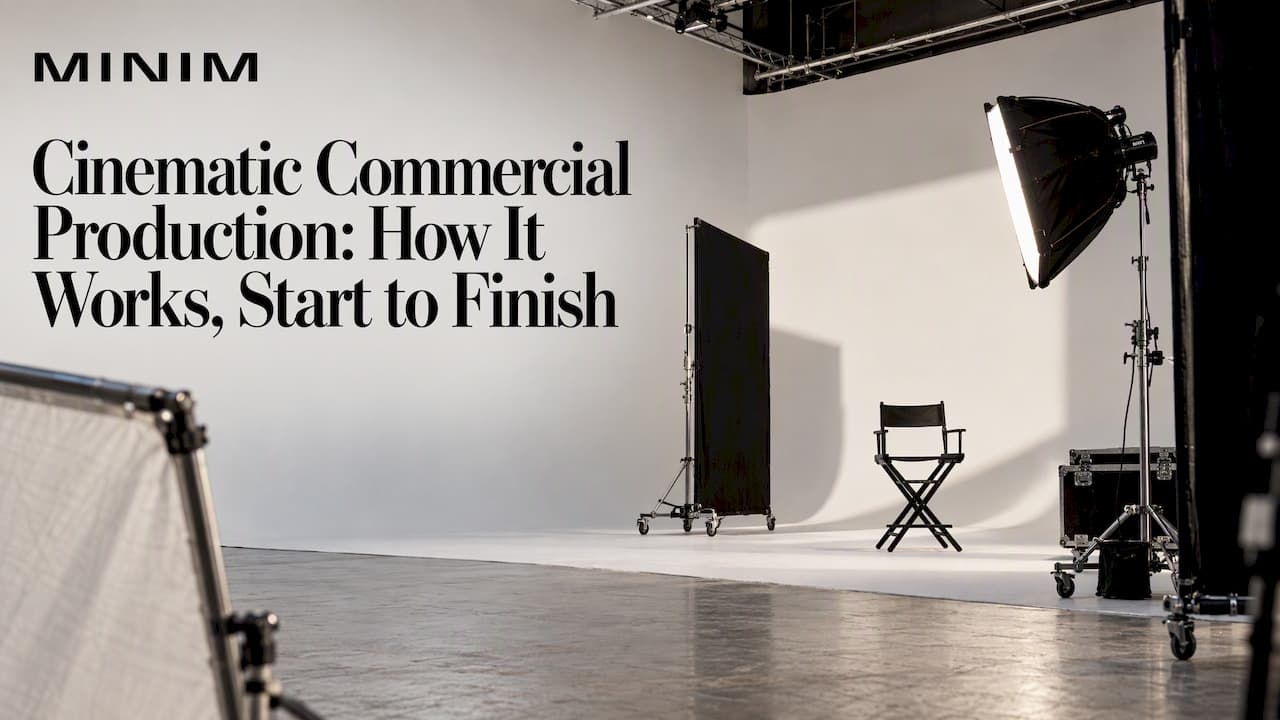
Cinematic commercial production is the practice of making advertising with the visual language and discipline of feature filmmaking: deliberate lighting, considered composition, controlled lens choices, and a story that earns attention instead of interrupting it. It is not a camera package. It is a set of decisions made from the brief through final delivery, and it works only when strategy, craft and logistics are managed as one production.
This guide is written for creative directors, marketing directors and founders who commission campaigns. It explains what the term means, which choices create the look, how the work moves through stages, and what drives cost and schedule, so you can brief a production partner with confidence.
TL;DR
- "Cinematic" in advertising usually means lower-key lighting, shaped shadows, atmosphere, shallow depth of field and composed frames, rather than bright, flat, front-lit imagery.
- The look is decided in pre-production. A sharp brief, a script and storyboard, and a locked plan for crew, locations and schedule matter more than any single piece of gear.
- Plan deliverables early. Post-production ends with files sized and formatted for each channel, so platform needs should shape the shoot.
- Budget and schedule move when scope moves. A new shoot day or a script change has a cost, and good partners flag it before incurring it.
- Judge the result against the goals in the brief, not against how the footage looks in isolation.
Table of Contents
- What "cinematic" actually means in advertising
- The craft choices behind the look
- The stages of a cinematic commercial
- What to settle before the camera rolls
- Shooting and finishing for every platform
- What drives budget and timeline
- Our perspective: cinematic work is a production discipline
- Work with MINIM on your next campaign
- How to tell whether the commercial worked
- FAQ
- Sources
What "cinematic" actually means in advertising
People use the word loosely, so it helps to anchor it in how working cinematographers describe it. In a piece on the craft of commercial cinematography, the American Society of Cinematographers describes cinematic looks as drawing on shallow depth of field, low-key lighting, shadow shape, smoky atmosphere and artistic compositions, and notes that filmmakers may add wider aspect ratios and anamorphic lenses for a movie-like quality.
The same piece quotes Christopher Probst, ASC, contrasting that approach with the bright, front-lit style long associated with conventional commercials. That contrast is the most useful working definition: a cinematic commercial treats light and frame as storytelling tools, not as a way to simply show the product evenly.
Two things follow for a commissioning team.
First, cinematic is a direction, not a budget tier. A tight, well-lit single-location spot can feel more cinematic than a sprawling shoot with no point of view. Second, the look has to serve the story and the brand. Low-key lighting suits a fragrance or a car at dusk. It may be the wrong call for a product whose promise is freshness and clarity. The brief decides.
There is a commercial reason to care. Researchers writing in Quirks argue that high production values and skilled moviemaking storytelling are essential to attracting audience attention and motivating consumer behavior. Craft is not decoration. It is how a spot earns the viewer's next three seconds.

The craft choices behind the look
When a director or DP talks about making something feel like film, they are usually making a handful of decisions.
Light and shadow
Lower-key lighting, with a wrapped key light and deliberate shadow shape, is the single biggest separator between a cinematic frame and a corporate one. Atmosphere, such as haze or smoke, gives light something to travel through and adds depth. If your spots are shot in a studio, how the light is built matters enormously, and our breakdown of three studio lighting setups for commercials shows practical starting points producers and DPs can adapt.
Lens, sensor and aspect ratio
Shallow depth of field isolates the subject and directs the eye. Wider aspect ratios and anamorphic lenses add the proportions and optical character people associate with theatrical work, as the ASC piece above notes. Cinematographer Greig Fraser, ASC, ACS, has argued that choices such as sensor size, lens type and lighting tools let cinematographers reclaim creative choice in the digital era. For a brand, the takeaway is simple: these are choices to make on purpose, early, and to document in the treatment.
Composition and the hero frame
Cinematic spots are built around a few frames that carry the idea. Thinking in poster shots, meaning one image that could stand alone, forces clarity about subject, light and mood. We lay out that method in Cinematic Ads for Agencies: Copy the Poster Shot Template.
Motion, sound and color
Camera movement, pacing, sound design and the color grade finish the impression. They are also the elements most often under-budgeted, because they live in post. A look that was carefully lit on set can be flattened by a rushed grade, so plan time for it.
The stages of a cinematic commercial
Production guides from different sources describe the same arc. Amazon Ads outlines the core steps as creative brief, concept, script, storyboard, pre-production planning, filming, post-production and final delivery to specific channels. Here is how that plays out on a commercial campaign.
- Brief and strategy. Goals, audience, message and deliverables are written down and agreed.
- Concept and script. The big idea becomes a script and a visual treatment, with the look defined in specifics: lighting, lensing, palette, reference frames.
- Storyboard and pre-production. Casting, locations, props, wardrobe, equipment, crew and schedule are locked.
- Shoot. Execution against the plan, with the director, DP and producer working from shared references.
- Post-production. Edit, color, sound, graphics and visual effects.
- Delivery. Final assets exported to each channel's technical requirements.
For a week-by-week view of how those stages fit into a real schedule, see our 4-8 week commercial production process playbook for agencies.
What to settle before the camera rolls
Most cinematic work is won or lost here. Amazon Ads advises that before filming you define the brief, concept, script and any storyboard, plan casting, locations, props, wardrobe, equipment and post-production needs, and align the delivery date and scope.

The creative brief
A good brief states project goals, audience, messaging and specific deliverable requirements, which Amazon Ads calls the foundation for concept development. For performance-driven creative, the same company's 2026 guidance adds that the audience brief should be as developed as the creative brief. If you need a starting format, our video creative brief template, examples and field guide covers the fields that matter.
Script, storyboard and look book
Cinematic intent should be visible on paper before anyone is paid to light a set. Pair the script with a storyboard and a look book: reference frames for light, color and framing. This is also where agency and production teams align on what "cinematic" means for this brand, so the DP and the creative director are picturing the same thing.
Crew, locations and schedule
The AICP National Guidelines describe the production company's bid as the articulation of a creative contract between production company and client, a road map for execution. In the AICP's Standard Commercial Production Agreement, the producer supplies everything required for complete production and delivery, including personnel and set or location facilities, unless exceptions are noted in the addendum. Read the bid with that in mind: what is included, what is excluded, and who owns each decision.
The pre-production meeting, where advertiser, agency and production team walk through every detail, is the checkpoint that protects the shoot. One Belgian production guide says the meeting typically happens at least one week before shooting, and the same logic applies in the US: hold it early enough that you can still change things. Our complete pre-production checklist for film and video is a practical way to run it.
Picking the right partner
Choosing who will execute matters as much as the concept. We explain how agencies narrow the field in Shortlist Two or Three: How Agencies Choose a Production Company.
Shooting and finishing for every platform
A cinematic hero spot rarely lives in one place. It may run as a broadcast or streaming spot, a pre-roll, a social cut and a set of stills. The planning rule is to define deliverables before production starts. As the Amazon Ads guide explains, post-production refines footage through editing and audio or graphic elements, then final assets are delivered in each channel's required sizes, aspect ratios or formats.
In practice that changes what happens on set:
- Frame for more than one ratio. If a vertical cut is on the deliverables list, protect the action in a safe area, or shoot specific vertical coverage.
- Capture extra material. Alternate takes, product inserts and clean plates are cheap on the day and expensive afterward.
- Build the edit plan with the shoot. Decide the 30, 15 and 6 second structures before you shoot, not after.
Broadcast adds technical rules. The AICP agreement requires that completed commercials be of the highest applicable technical quality and conform with all network technical requirements. That is why delivery specs belong in the brief. Two of our guides go into detail: broadcast deliverables and what broadcasters need to accept a spot and mezzanine-first broadcast delivery specs.
What drives budget and timeline
Production cost is mostly a function of scope: number of shoot days, locations, cast, crew size, visual effects and the volume of final deliverables. The most useful thing a commissioning team can know is how change is handled.
- Changes alter the price. According to the AICP National Guidelines, changes to project specifications can alter the contract price, and a major change such as adding a shoot day increases it by the amount of the overage.
- Script and storyboard changes need approval. Under the AICP's standard agreement, if such changes cause added costs, the producer must notify the client of the amount before incurring them and proceed only once an authorized representative approves.
- Budget or schedule shifts after award matter. For a single-bid project, the guidelines say the production company should have the right to withdraw if budget or schedule changes after the award.
Timelines depend on the same scope. Amazon Ads reported one streaming TV asset for Traditional Medicinals going from concept to live campaign in three weeks, including client review cycles. That is an example of what a tight, well-defined project can do, not a promise for every brief. Fast schedules work when decisions are fast: one approver, one consolidated round of feedback and locked deliverables.
To keep control of both, approve the look book and storyboard before the bid is finalized, name a single decision-maker on your side, and agree up front how a change request is priced and signed off.
Our perspective: cinematic work is a production discipline
We see the same pattern on nearly every campaign. The idea is rarely the problem. What separates a spot that feels like a film from one that feels like content is how well the team protected the idea between the brief and the final export.
That is why we work as a production partner integrated with your creative team, not as a vendor you hand a script to. Strategy, art direction, photography and film, and visual effects are connected from the first conversation, so the look you approved in the treatment is the look that arrives in the edit.
Our position is that every project should be managed as a high-end production regardless of budget. A smaller budget changes the scope, the number of locations, the size of the crew. It should never change the standard of planning, lighting or finish. A single well-lit frame, carefully composed, does more for a brand than ten rushed ones.
For agencies, the value is capacity without headcount. You keep the client relationship and the creative lead. We bring the production muscle, reliably and at scale, so your team can take on the campaign without hiring around it.
Steven Reina
Work with MINIM on your next campaign
MINIM is a strategic production partner for agencies and brand teams that need premium commercial execution without expanding internal headcount. We integrate with your creative team and carry a campaign from concept through final delivery, covering creative strategy, campaign development, screenwriting, photography and film, 2D/3D visual effects and our in-house photo studio.
If you have a brief and want to talk through look, scope and schedule, see everything we do on our services page, or learn more about the team at MINIM. For art-direction-led projects, start with creative and art direction.
How to tell whether the commercial worked
Judge results against the goals written in the brief. If the brief set an awareness target, look at reach and view-through. If it set a response target, look at the actions that followed. Decide the measures before the shoot, so the production plan and the measurement plan agree about what the spot is for.
Production quality belongs in that evaluation too. The Quirks authors' argument is that skilled storytelling and production values help attract attention and motivate behavior, so when you compare cuts, compare craft along with copy. A useful habit is to test the hero spot and its cutdowns across channels and note where the cinematic version holds viewers longest, then carry that learning into the next brief.
FAQ
What makes a commercial cinematic?
It comes down to deliberate visual choices: lower-key lighting, shaped shadows, atmosphere, shallow depth of field and composed frames, often with wider aspect ratios or anamorphic lenses. Working cinematographers describe the look as the opposite of bright, front-lit advertising. The story and pacing matter as much as the gear.
Do you need a big budget for cinematic commercial production?
No. Cinematic quality comes from planning, lighting and composition, which a smaller scope can still do well. A budget changes how many locations, shoot days and crew you can afford, so tighten the concept to fit. We manage every project as a high-end production regardless of budget.
How long does it take to produce a cinematic commercial?
It depends on scope, approvals and the number of deliverables. Our own process playbook frames a typical commercial as a 4-8 week production process, and well-defined projects can move faster when feedback is consolidated and decisions are quick.
What should be in the brief for a cinematic spot?
Project goals, audience, messaging and specific deliverables, as Amazon Ads lists them. For cinematic work, add look references, such as lighting, color and framing examples, so everyone shares one picture of the finished spot.
How do I prepare one shoot for several platforms?
List every channel and format before production, then plan framing, coverage and edit structures around them. Final assets are exported to each channel's required sizes, ratios and formats, so knowing those up front avoids reshoots and rushed reframing.
Sources
- Shot Craft: The Art of the Ad, ASC
- Greig Fraser, ASC, ACS Talks Creative Choices at AFI
- What is Video Production? How the Process Works, Amazon Ads
- AI video strategy tips for brands, Amazon Ads
- Traditional Medicinals streaming TV case study, Amazon Ads
- AICP National Live Action Guidelines
- AICP Standard Commercial Production Agreement
- BCP Production guide
- Using the elements of moviemaking to drive video advertising impact, Quirks