
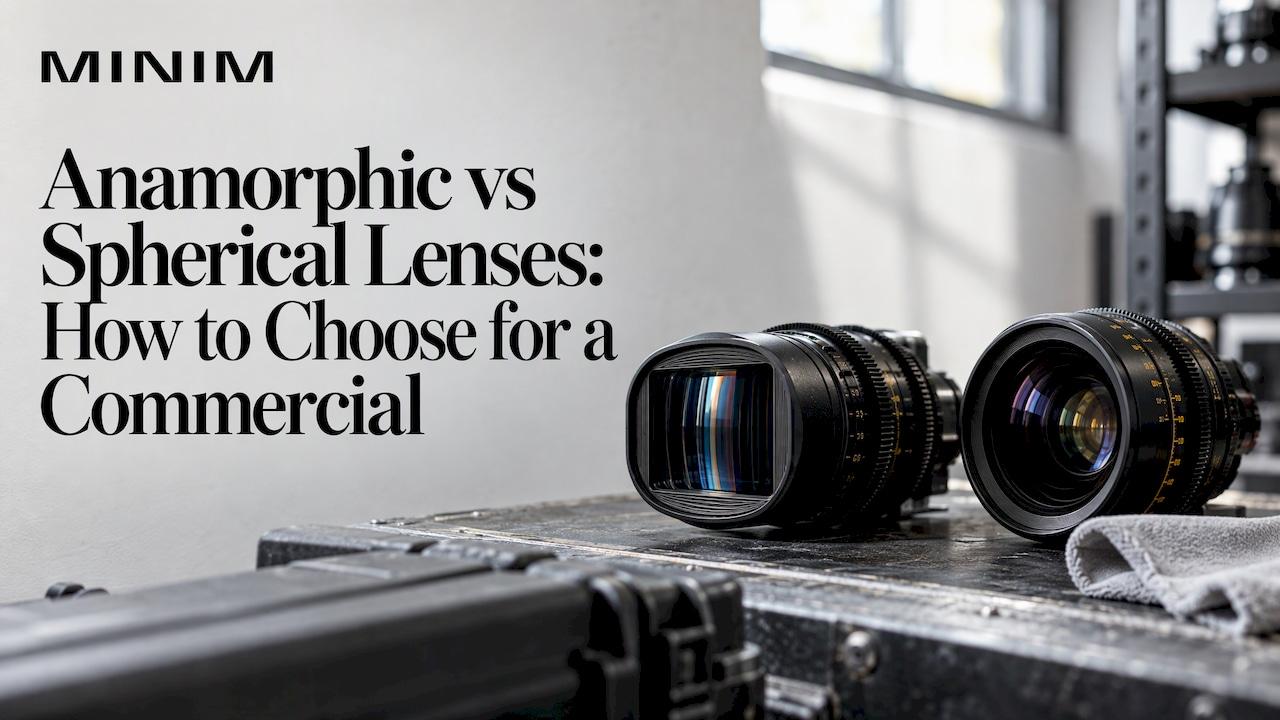
Anamorphic lenses squeeze a wide image onto the sensor and get stretched back out later. Spherical lenses record the image at the shape of the sensor, with no squeeze. Neither is better. Anamorphic gives you a distinct widescreen look: oval bokeh, horizontal flares and a shallower feel. Spherical gives you speed, sharp edges, simpler logistics and the freedom to choose any aspect ratio. For a commercial, the right pick depends on the story, the delivery formats and the light you have, not on which one sounds more cinematic.
This guide is written for creative directors, marketing directors and brand owners who have to approve the lens decision, not operate the camera. You get the optics in plain terms, what each choice changes on set and in post, and a way to decide before the budget is locked.
TL;DR
- Anamorphic lenses optically squeeze the image horizontally, typically 2x, and it is de-squeezed later. Spherical lenses do not change the image's proportions.
- The anamorphic look: oval bokeh, streak flares, softer edges and a wide frame with a close-up feel. The spherical look: round bokeh, clean edges, a neutral canvas.
- Anamorphic lenses are generally heavier, slower, more expensive and harder to focus. Spherical lenses are faster and better in low light.
- Modern sensors record wide aspect ratios natively, so spherical plus a crop can deliver widescreen. Choose anamorphic for its character, not because widescreen demands it.
- Settle the lens decision in pre-production, together with delivery formats, color pipeline and schedule.
Table of Contents
- What each lens does
- Anamorphic vs spherical at a glance
- How the look differs on screen
- Is anamorphic needed for widescreen?
- What changes on set and in post
- Budget and schedule
- Composition: how the ratio changes what you can frame
- How to decide for a commercial
- Where MINIM fits
- Our perspective
- FAQ
- Sources
What each lens does
Spherical lenses
Spherical lenses are the most common cinema lenses. They project the image onto the sensor without changing its proportions, so the aspect ratio is dictated by the shape of the imager. Their elements are round, and what the lens sees is what the camera records. If you shoot a 16:9 sensor area, you get 16:9. If you want 2.39:1, you crop.
Anamorphic lenses
An anamorphic lens captures a wider horizontal field of view than the sensor shape would normally allow. It does this by optically squeezing the image width at capture. A complete anamorphic lens usually consists of a spherical taking lens plus an anamorphic block with cylindrical elements, and the squeeze is undone digitally or in real time on a monitor.
The classic squeeze is 2x. The American Society of Cinematographers explains that traditional anamorphics use a 2:1 horizontal squeeze, with other ratios such as 1.3x and 1.25x also in use. The result is a horizontal angle of view twice as wide as a spherical lens of the same focal length.

Squeeze factors have multiplied because sensors have. Panavision now offers 1.3x, 1.6x and 1.85x squeezes, driven by the variety of native aspect ratios on digital cameras. In practice, the squeeze is matched to the sensor mode and the delivery ratio, which is one more reason the lens conversation belongs early.
Anamorphic vs spherical at a glance
| Factor | Spherical | Anamorphic |
|---|---|---|
| Image capture | Shape follows the sensor | Squeezed horizontally, de-squeezed later |
| Typical widescreen ratio | 1.33:1, 1.85:1, or cropped to 2.39:1 | 2.35:1 to 2.39:1 natively |
| Bokeh | Round | Oval |
| Flares | Round, scattered | Horizontal streaks |
| Edges | Sharper | Softer, with falloff toward the frame edges |
| Speed | Faster, better in low light | Generally slower, needs more light |
| Close focus | Closer | Greater minimum distance |
| Weight and cost | Lighter, less expensive | Heavier, more expensive |
| Monitoring | Direct | Needs a de-squeeze |
The sources behind the look and handling rows: No Film School's comparison covers bokeh, flares and edge softness, and Cooke's spherical versus anamorphic guide covers speed, close focus, weight and cost.
How the look differs on screen
Bokeh, flares and edges
Spherical lenses produce circular out-of-focus elements and hold a sharpness advantage, while anamorphics produce oval-shaped bokeh, shape the flares and are softer along the edges. Those ovals and streaks are what many people mean when they say "anamorphic look." They read as filmic on a viewer's first glance, even for people who could not name the lens.
The edge falloff is part of the signature too. StudioBinder notes the blur creeping toward the frame edges varies with lighting and focus, so it is a look to preview with your cinematographer rather than assume.
Faces and depth
Cinematographer Peter Märtin, writing in the FD Times anamorphic special, describes the look as a wider panorama with a pleasing, shallower depth of field and fuller, rounder faces that separate actors from the background, unlike telephoto spherical lenses that flatten faces. For beauty, fashion, automotive and talent-led spots, that separation is often the reason anamorphic gets requested.
Field of view and focal length
The focal-length math trips people up in review meetings. A 50mm anamorphic with a 2x squeeze matches a 50mm spherical vertically but a 25mm spherical horizontally. So the lens you pick for a given framing is different from what you would choose in spherical.
Depth of field follows from that. RED explains that the two types technically have the same depth of field, but reaching the same angle of view requires a longer anamorphic focal length. At the same subject size, anamorphic looks shallower. The ASC says the same: with the same horizontal composition from the same position, anamorphic offers less depth of field. That helps isolate a subject, and it asks more of the focus puller.

Is anamorphic needed for widescreen?
Historically, yes. Capturing 2.39:1 with spherical lenses meant cropping or masking the top and bottom of each frame, losing vertical resolution, while a 2x anamorphic on standard 35mm film yielded 2.39:1 directly. RED puts the numbers this way: spherical capture of 2.40:1 on 35mm film uses only 50% of each frame's area, while anamorphic uses all of it.
Today the argument is weaker. Most digital sensors now support wider aspect ratios natively, so spherical lenses often record sufficiently wide images with minimal cropping. Widescreen alone is rarely a reason to go anamorphic. The look is.
A feature-film example of the trade
The cinematographer on Dune: Part Two made a deliberate call. Greig Fraser dropped the 1.6x anamorphic lenses used for widescreen scenes in Part One and shot with large-format spherical glass, cropping top and bottom to 2.39:1 so frame height could be preserved for taller IMAX aspect ratios. The lesson for a campaign: the delivery plan drove the lens, not the other way round. If your spot also lives in vertical or square cutdowns, that same logic applies.
What changes on set and in post
On set
Anamorphics are usually spherical lenses with added glass elements, which makes them larger, reduces light transmission, adds distortion and makes them almost always heavier and more expensive. Cooke adds that they tend to be slower with a greater close-focus distance, calling for more light and careful blocking or diopters.
For you, that translates into a few questions at the pre-production meeting:
- Is the location dark, tight or handheld-heavy? Spherical is easier.
- Is there product macro or close insert work? Check minimum focus distances.
- Is there a larger lighting package in the budget? Slower glass needs it.
Shane Hurlbut, ASC, notes that spherical lenses are faster with lower T-stops and ideal for low light, while anamorphics offer enhanced vertical resolution, reduced grain and a push-and-pull distortion between background and foreground. Both sides of that sentence matter to a commercial: a night street scene and a hero close-up may call for different glass, and a campaign can legitimately mix them.
Monitoring and focus
The squeezed image looks stretched thin on a raw monitor, so the team needs a de-squeeze. ARRI's ALEXA LF whitepaper lists six de-squeeze factors for viewfinder and monitor outputs, from 2.00x down to 1.25x, but the camera records the squeezed image with no in-camera de-squeeze. That means the client monitor you watch on set can look different from the raw file, and your agency team should know that before anyone reacts to a frame.
Post-production
Because the recorded file is squeezed, post has to restore the shape. ARRI notes that DCI projection specs only allow a de-squeezed image, so the aspect ratio must be rebuilt, for example resizing 2578 x 2160 to 4096 x 1716 for 4K DCI. Editors, colorists, VFX artists and compositors all need to be told the squeeze factor up front. VFX work, especially 2D and 3D elements that must match oval bokeh and stretched flares, is where a missed note costs time. Our guide to the color pipeline for commercials covers how camera choices carry through to final delivery.
Budget and schedule
The rule of thumb is accurate: anamorphics are generally heavier and more expensive, and have historically been the domain of bigger-budget movies. On a commercial, the lens rental is only one line. The real cost shows up in:
- extra lighting for slower glass
- more prep time for lens testing and focus
- a high-resolution monitor path with de-squeeze
- post time for de-squeezing and matching effects
None of that makes anamorphic a poor investment when the creative needs it. It means the choice should be funded on purpose, not discovered halfway through the shoot.
Composition: how the ratio changes what you can frame
The aspect ratio is a storytelling tool. Cooke associates anamorphic with 2.39:1, which suits landscapes, ensembles and bold negative space, while taller spherical ratios make it easier to show architecture, reveal body language and frame people of different heights together. A wide frame is good for a brand film with a hero landscape or a car moving through it. A taller frame is better for a product demo, a two-shot of a parent and child, or a tall interior.
If you are planning a poster-style hero frame, our poster shot template for cinematic ads walks through how framing carries the look.
How to decide for a commercial
Use these five questions in the pre-production meeting:
- What does the brand need to feel like? Premium, sweeping, filmic favors anamorphic. Clean, tactile, product-forward favors spherical.
- Where will it run? Cinema, broadcast and wide web hero spots suit 2.39:1. Social-first and vertical cutdowns lean spherical, or a spherical-based shoot with a protect plan. Our piece on getting 30 to 47 assets from one shoot shows how to plan frames for many formats.
- What is the light? Low light and tight spaces argue for faster glass.
- Who has to touch the footage afterward? Heavy VFX or HDR finishing needs a pipeline that has already accounted for the squeeze. See how we plan HDR advertising video.
- Is there a mix? Many campaigns use anamorphic for hero setups and spherical for fast, low-light or tight coverage. Agree in advance where each lives so the grade can unify them.
When the answer is unclear, ask your cinematographer to run a lens test on your actual set, wardrobe and product before you lock the shot list. A test is cheap compared to a reshoot.
Where MINIM fits
Lens choice is one decision among dozens in a cinematic commercial, and it touches every stage that follows. We integrate with your creative team and run campaigns from concept through final delivery, with photography and film, 2D/3D visual effects, art direction and an in-house photo studio under one roof. That means the look you approve in the treatment is the look planned for through lighting, post and delivery, without you adding headcount.
If you have a campaign in development, you can see how we handle full-service production or browse our work. For a step-by-step view of how a spot moves from brief to delivery, read our guide to cinematic commercial production.

Our perspective
We treat the anamorphic versus spherical question as a creative decision first and a gear decision second. The agencies we work with arrive with a visual idea, a deliverables list and a budget, and the lens should serve all three.
What we have built MINIM around is integration. We work alongside your creative team, so the person who understands the concept is in the room when the lens, the lighting and the post path are chosen together. A lens that looks beautiful on set but breaks the schedule in post is not a premium result.
We manage every project as a high-end production regardless of budget. That means the same discipline whether the answer is anamorphic character glass for a hero spot or clean spherical coverage for a multi-format campaign: a considered look, a planned pipeline and reliable delivery.
Our advice is simple. Decide the look from the story, decide the format from where the work will run, and let your production partner carry both into the shoot.
Steven Reina
FAQ
Is anamorphic better than spherical?
Neither is better in general. Anamorphic gives oval bokeh, streak flares and a wide, shallow-feeling frame. Spherical gives speed, sharper edges and flexibility in aspect ratio. The right one is whichever supports the story and delivery plan of the specific spot.
Why are anamorphic lenses more expensive?
They are built from a spherical lens plus additional cylindrical elements, which makes them larger, heavier and more complex. The campaign cost also includes extra lighting, focus support and post work for de-squeezing.
Can I get an anamorphic look with spherical lenses?
You can get the widescreen frame by cropping, and modern sensors make that easier. The oval bokeh, flare character and edge behavior come from the lens optics, so the look will differ from true anamorphic capture.
What is a squeeze factor?
It is how much the lens compresses the image horizontally. A 2x squeeze halves the width at capture, and the image is stretched back by that factor in monitoring and post. Other squeezes such as 1.3x, 1.6x and 1.85x suit different sensor shapes.
Do I need to decide before the shoot?
Yes, ideally in pre-production. The lens affects lighting, monitoring, VFX and color, so choosing late forces compromises in all four.
Sources
- Cooke Optics: An introduction to anamorphic lenses
- Cooke Optics: Spherical v Anamorphic lenses
- ASC: Practical Optics 3, Introduction to Anamorphic
- Definition Magazine: The exchange with Kevin Greene on lenses
- No Film School: The difference between anamorphic and spherical lenses
- RED: Understanding anamorphic lenses
- FD Times: All About Anamorphic
- B&H Explora: Anamorphic lenses and widescreen imagery
- In Depth Cine: Dune: Part Two's cinematography
- StudioBinder: Camera Lenses Explained
- Filmmakers Academy: Shane Hurlbut, ASC, on spherical and anamorphic lens choices
- ARRI: ALEXA LF and anamorphic lenses whitepaper