
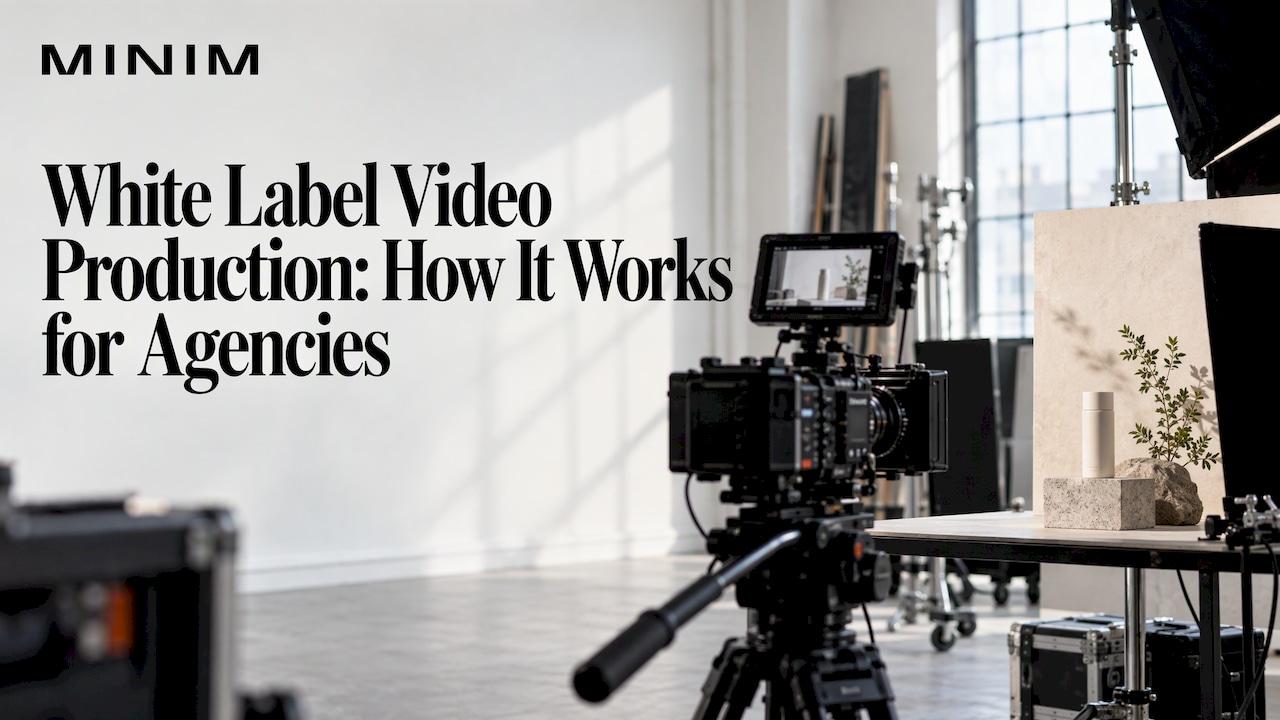
White label video production means a production company makes the film, photography or motion work, and your agency or brand delivers it under your own name. The partner stays behind the scenes. You keep the client relationship, the creative leadership and the credit. That is different from white label video editing software, which is a tool you rebrand and hand to users. This guide covers the production service: how a partnership runs from brief to delivery, what you can put inside it, how rights and confidentiality work, and how to choose a partner you can trust with your clients.
TL;DR
- White label video production is a service model: a studio produces the work and you present it as yours. It is not a software license.
- It lets you take on larger or more cinematic campaigns without hiring full-time directors, editors, VFX artists and producers.
- The partnership works when the brief, the approval rounds, the confidentiality terms and the rights transfer are written down before shoot day.
- Judge a partner on fit with your creative team, process, range of in-house capability and how they handle ownership, not on the lowest per-video rate.
- Pricing follows scope: concept depth, shoot days, talent, locations, VFX and the number of deliverables.
Table of Contents
- What white label video production actually is
- Why agencies and brand teams use it
- How a white label production partnership works, step by step
- What you can include in the arrangement
- Client communication, branding and confidentiality
- Revisions, approvals and rights
- How to choose a white label production partner
- What affects the price
- Our perspective
- Working with MINIM
- Making the first project work
- FAQ
- Sources
What white label video production actually is
The phrase covers two very different things, and search results mix them.
White label production services. A studio or production house does the work, and an agency resells it or presents it as its own. This is the meaning that matters if you run an agency, lead a creative department or own a brand that sells creative services. You buy capacity and craft, not a product.
White label video software. A vendor builds a video editor or creation tool that another company embeds in its own platform so users can make videos without leaving the site. Wochit's documentation, for example, describes adding its Frame Editor to a platform so customers can create videos in place. That is a technology purchase, and it answers a different question: how do I give my users an editing tool?
If your client asks for a launch film, a campaign spot, a product photography set or a 3D animated hero asset, you need the first model. The rest of this article is about it.
The idea is not unique to video. Agencies use the same pattern in other disciplines, and how white-label development works in engineering follows the same logic: a specialist team delivers under your brand while you own the relationship and the outcome.

Why agencies and brand teams use it
Production capacity is lumpy. A campaign needs a writer, art director, director of photography, gaffer, editor, colorist and VFX artists for a few weeks, then none of them for a month. Carrying that bench as salaried staff is expensive and risky. Four reasons explain why teams choose a partner instead.
- Range without headcount. A pitch that needs cinematic live action, product stills and 3D in one package is hard to staff internally. A partner with those skills under one roof closes the gap.
- Speed to yes. You can say yes to a client request on Monday and have a production plan by Friday, because the crew and studio already exist.
- Protected margin and focus. Your team keeps the strategy and the client conversation. Production risk, equipment and crew scheduling sit with the partner.
- Consistency. One partner who learns your brand standards, review habits and client preferences produces better work on the third project than a new freelancer on every job.
If you are weighing the broader decision, our guide to outsourcing video production for marketing teams walks through the in-house versus external question in more depth.
How a white label production partnership works, step by step
The good ones follow a process you can describe to your own client in one minute. Here is the sequence we see work best.
1. Alignment on the brief
Everything starts with a written brief: objective, audience, channels, tone, deliverables, budget range and approval path. A weak brief is the most common source of reshoots and blown timelines. If you do not have a standard format, our video creative brief template and field guide lays out the fields that matter.
2. Creative development
The partner develops or refines the concept with your creative director: treatments, scripts, boards, references, art direction. This is where integration with your team matters. The partner should work inside your creative thinking, not hand you a finished idea you have to defend.
3. Pre-production
Casting, locations, set design, schedules, shot lists, permits and insurance are locked. Your team signs off on the plan, and then your client signs off on it. Changes after this point cost real money, so this is the gate to treat seriously.
4. Production
Shoot days, studio time, photography and any capture for VFX. Many agencies attend on set; others prefer live review links. Remote video production workflows make it practical for creative leads in another city to approve takes in real time.
5. Post-production
Editorial, color, sound, motion graphics and visual effects. Review rounds happen here, usually in a defined number, with consolidated feedback from one person on your side.
6. Final delivery
Masters and cutdowns in the formats each channel needs, with project files, captions and any agreed source assets, delivered to your team ready to send to the client.
For a fuller phase-by-phase view, including a pilot approach, see our agency production workflow guide.
What you can include in the arrangement
A white label relationship is only as useful as the range behind it. Production partners with broad in-house capability let you sell a full campaign instead of one asset. Typical building blocks include:
- Creative strategy and campaign development: the idea, the platform, the rollout logic.
- Brand strategy and design: identity systems, motion branding and visual language. See our practical guide to motion branding systems.
- Screenwriting: scripts for spots, brand films and series content.
- Creative and art direction: the look, the sets, the wardrobe, the world of the piece.
- Photography and film: commercial shoots, hero stills, social cutdowns.
- Studio services: a photo studio that removes location logistics for product and talent work.
- 2D and 3D visual effects: animation, compositing and CG elements.
- Content marketing: the ongoing content layer that keeps a campaign alive after launch.
Motion work deserves its own line. If your clients buy paid social or video ads, our commissioning guide for motion graphics ads explains what to specify. For connected TV, the CTV creative best practices cover format and creative decisions that affect delivery specs.
Client communication, branding and confidentiality
The reason white label works is that everyone knows who speaks to whom.
One voice to the client. Your account lead or creative director owns the relationship. The partner takes feedback through you, and consolidated notes come back as one list. This prevents contradictory instructions and keeps your role clear.
Your name on the work. Deliverables carry your branding, your naming conventions and your file standards. Agree in advance whether the partner may mention the project in its own portfolio, and in what form and after what delay. Many agencies prohibit it, and some allow it once the campaign is public.
Confidentiality in writing. A mutual non-disclosure agreement should cover the client identity, the brief, unreleased footage and the commercial terms between you and the partner. Put sub-vendors, talent and crew under the same obligations, because they are the people with access to your client's material.
Clear contact rules. Decide whether partner staff may attend client meetings, and in what role. Some agencies introduce the partner's director as part of the production team. Others keep the partner out of the room entirely. Either can work. Ambiguity cannot.

Revisions, approvals and rights
This is where relationships break, so write it down.
Revisions
Specify how many review rounds each stage includes, who gives consolidated feedback, what counts as a new request versus a correction, and how long reviews may take before the schedule moves. Locking script and storyboard before shooting is the cheapest revision control there is.
Ownership of the finished video
Do not assume that paying for a video gives you the copyright. Under US law, a commissioned work counts as a "work made for hire" only if it falls into specific categories, which include a part of a motion picture or other audiovisual work, and only if both parties sign a written agreement saying so. The US Copyright Office's Circular 30 on works made for hire sets out those requirements. Where that route does not fit, a written assignment of rights does the job.
In practice, your production agreement should answer:
- Who owns the final films, stills and project files?
- Who owns raw footage, 3D models, rigs and other source assets?
- What are the licensing terms for music, stock, fonts, talent and locations, and for how long and in which media do they apply?
- Can the client re-edit or reuse the work in new campaigns?
Have your counsel review the contract. Talent usage terms in particular are tied to media, territory and duration, and they are worth getting right before the media plan is set.
How to choose a white label production partner
A low per-asset rate says little about whether a partner can carry a campaign. These criteria matter more.
| Criterion | What good looks like |
|---|---|
| Creative fit | A reel that matches the standard your clients expect, and willingness to work inside your creative direction |
| Range | Strategy, writing, art direction, photography, film and VFX available under one roof, so handoffs do not multiply |
| Process | A defined path from brief to delivery, with named approval gates and a single point of contact |
| Reliability | A track record of hitting dates and budgets, with references you can speak to |
| Capacity | Crew, studio and post resources that scale with a campaign, not a one-person operation |
| Contract clarity | NDA, rights transfer, revision limits and payment milestones written plainly |
| Communication | Quick, professional answers, and a producer who flags issues early |
Two practical habits help. First, begin with a bounded project before committing a whole account, so both teams learn each other's habits. Second, give the partner your brand standards and a past client review history so they can anticipate the notes you tend to receive.
What affects the price
There is no single rate for white label video production, because "video" spans a simple talking-head edit and a multi-day cinematic shoot with CG. Costs are driven by scope, not by the label. The main factors:
- Concept and writing depth: a developed idea and script take more time than a template.
- Shoot scale: number of days, crew size, locations versus studio, and equipment.
- Talent and usage: casting, wardrobe, hair and makeup, and the media and duration of usage rights.
- Visual effects and animation: 2D motion is a different effort from 3D character or product CG.
- Deliverables: the number of cutdowns, aspect ratios, languages and channel versions.
- Schedule: compressed timelines require more simultaneous resources.
- Revision allowance: more rounds and more stakeholders mean more post-production time.
Our breakdown of what US commercial video budgets actually buy gives ranges and trade-offs to plan around. When you quote your own client, build your agency's margin on top of a partner's scoped estimate, and scope contingency into the partner's budget instead of discovering it mid-shoot.
Our perspective
Agencies rarely lose a pitch because the idea was weak. They lose it because they could not show how the idea would be made, by whom, and at what quality. A good production partner closes that gap.
We built MINIM as a strategic production partner. We integrate with your creative team, from concept through final delivery, so you can offer premium commercial execution without growing internal headcount. We think of the relationship as an extension of your department: the strategy, writing, art direction, photography, film and VFX sit in one place, and your creative director stays in the driver's seat.
Our standard is simple. Every project is managed as a high-end production, whatever the budget. That discipline is what lets an agency put its name on the work with confidence, and it is why we focus on reliability and efficiency as much as on the cinematic look.
If you are considering a production partner, look for one that behaves like part of your team. The craft is expected. What separates a good partnership is how it handles the Tuesday before a shoot, when something changes and your client is waiting for an answer.
Steven Reina
Working with MINIM
If you are an agency, creative director or marketing director who needs premium commercial execution without hiring more staff, we can join your team on a project basis. Our services run from creative strategy and campaign development through screenwriting, art direction, photography and film, in-house studio work and 2D/3D visual effects. You can see the full range on our services page, explore our creative and art direction capability, or learn more about the company.
Tell us the campaign, the timeline and the deliverables, and we will tell you how we would build it with your team.
Making the first project work
A few moves make the first engagement smoother for everyone.
- Pick a project with a clear scope. A single campaign film plus cutdowns is a better trial than an open-ended retainer.
- Appoint one decision-maker. Consolidated feedback from one person on your side saves days in every review.
- Share the whole picture. Give the partner the client's brand guidelines, past work, competitors' creative and the media plan, so the output fits the channel.
- Agree the schedule backwards. Start from the air date or launch date, then fix the review windows, then the shoot, then the pre-production gate.
- Hold a short debrief. After delivery, list what worked and what to change. The second project is where the efficiency shows up.
For teams who want a more cinematic look on a defined budget, our poster-shot template for cinematic ads shows how to spend effort where the audience sees it.
FAQ
Is white label video production the same as video editing outsourcing?
No. Editing outsourcing covers post-production on footage you already have. White label production can cover the whole chain: strategy, scripting, art direction, shooting, effects and delivery. Choose editing alone when the footage exists. Choose production when you need the footage, the concept or the look created.
Will my client know a partner made the video?
That is your decision. The arrangement is built around your brand, your client relationship and your communication. Confidentiality terms in the contract define what the partner may say and show, and whether it can ever reference the work publicly.
Who owns the finished video?
Ownership depends on what the contract says. In the US, a commissioned video can qualify as a work made for hire only in specific categories and with a signed written agreement, as the Copyright Office explains. Otherwise rights move by written assignment. Settle this, along with source files and licensed elements, before production starts.
How much does white label video production cost?
It depends on scope: concept depth, shoot days, talent, effects and the number of deliverables. A simple short edit and a cinematic commercial campaign are priced very differently. Share your brief and range with a partner and ask for a scoped estimate by phase.
How long does a project take?
Timelines follow the same phases as any commercial production: brief, development, pre-production, shoot, post and delivery. A single spot with a modest shoot is faster than a multi-asset campaign with CG. Work backwards from your launch date and fix review windows early.
Sources
- Wochit Documentation
- US Copyright Office, Circular 30: Works Made for Hire
- How white-label development works